
Pulp Fiction, 1895 · page 2 of 16
Beadle's Half Dime Library No. 961 — page 2: what you’re looking at
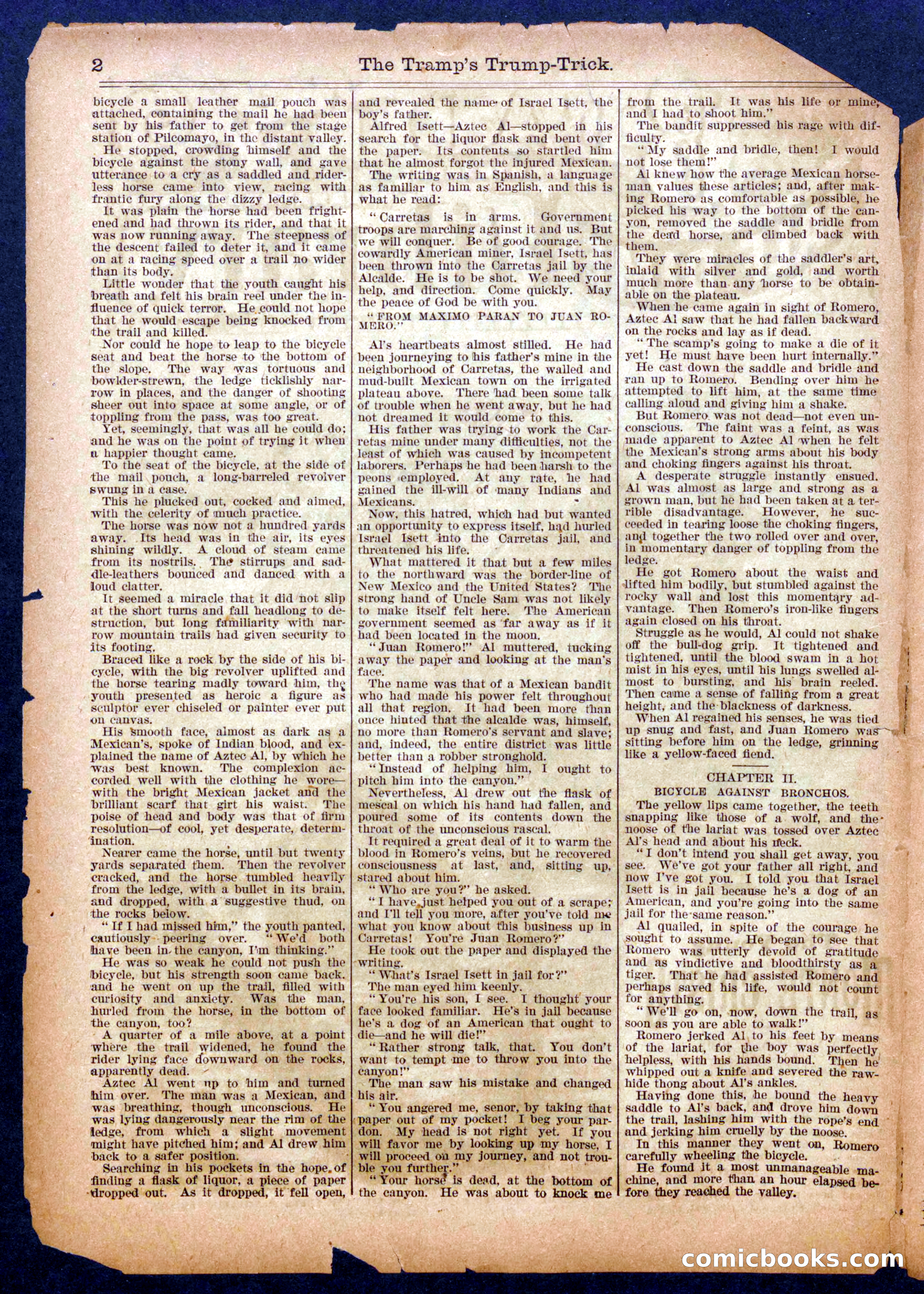
A restored page from Pulp Fiction, 1895. Page through the whole issue in the reader above.
📄 Transcribed text from this page (OCR, searchable)
Machine-transcribed from the original scan — historical spelling and the odd misread are preserved.
. a c* ‘dropped out. < - —t at ® » 2 —_—— —_————— bicycle a small leather mail pouch was attached, containing the mail he had been sent by his father to get from the stage station of Pilcomayo, in the distant valley. He stopped, crowding himself and the bicycle against the stony wall, and gave utterance to a cry as a saddled and rider- less horse came into view, racing with frantic fury along the dizzy ledge. It was plain the horse had been fright- ened and had thrown its rider, and that it was now running away. ‘The steepness of the descent failed to deter it, and it came on at a racing speed over a trail no wider than its body. Little wonder that the youth caught his breath and felt his brain reel under the in- fluence of quick terror. He could not hope that he would escape being knocked from the trail and killed. Nor could he hope to leap to the bicyele seat and beat the horse to the bottom of the slope. The way ‘was tortuous and bowlder-strewn, the ledge ticklishly nar- row in places, and the danger of shooting sheer out into space at some angle, or of toppling from the pass, was too great. Yet, seemingly, that was all he could do; and he was on the point of trying it when em happier thought came. To the seat of the bicycle, at the side of the mail. pouch, a long-barreled revolver swung in a case. This he plucked out, cocked and aimed, with the celerity of much practice. The horse was now not a hundred yards away. Its head was in the air, its eyes shining wildly. A cloud of steam came from its nostrils. The stirrups and sad- dle-leathers bounced and danced with a loud clatter, It seemed a miracle that it did not slip at the short turns and fall headlong to de- struction, but long familiarity with nar- row mountain trails had given security to its footing, Braced like a rock by the side of his bi- cycle, with the big revolver uplifted and the horse tearing madly toward him, the youth presented as heroic a figure sculptor ever chiseled or painter ever put ol Canvas. His Smooth face, almost as dark as a Mexican’s, spoke of Indian blood, and ex- plained the name of Aztec Al, by which he was best known. The complexion ac- corded well with the clothing he wore— with the bright Mexican jacket and the brilliant scarf that girt his waist. The poise of head and body was that of firm resolution—of cool, yet desperate, determ- us ‘ination. Nearer came the horse, until but twenty yards separated them. Then the revolver eracked, and the horse tumbled heavily from the ledge, with a bullet in its brain, and dropped, with a suggestive thud, on the rocks beiow. “If I had missed him,” the youth panted, cautiously-- peering over. “ We'd both have been inv the canyon, I'm thinking.” He was so weak he could not push the bicyele, but his strength soon came back. and he went on up the trail, filled with curiosity and anxiety. Was the man, hurled from the horse, in the bottom of the canyon, too? A quarter of a mile above, at a point where the trail widened, he found the rider lying face downward on the rocks, apparently dead. ~- Aztee Al went up to him and turned him over. The man was a Mexican, and was breathing, though unconscious. He was lying dangerously near the rim of the ledge, from which a slight movement might have pitched him; and Al drew him back to a safer position. Searching in his pockets in the hope, of finding a flask of liquor, a piece of paper As it dropped, it fell open, ‘paper out of my pocket! The Tramp’s Trump-Trick. and revealed the name of Israel Isett, the boy’s father. Alfred Isett—Aztee Al—stopped in his search for the liquor flask and bent over the paper. Its contents so startled him that he almost forgot the injured Mexican. The writing was in Spanish, a language as familiar to him as English, and this is what he read: *“Carretas is in arms. Government troops are Marching against it and us. But we will conquer. Be of good courage..The cowardly American miner, Israel Isett, has been thrown into the Carretas jail by the Alealde. He is to be shot. We need your help, and direction. Come quickly. May the peace of God be with you. a - oe MAXIMO PARAN TO JUAN RO- MERO.,”’ Al’s heartbeats almost stilled. He had been journeying to his father’s mine in the neighborhood of Carretas, the walled and mud-built Mexican town on the irrigated plateau above. There ‘had been some talk of trouble when he went away, but he had not dreamed it would come to this. His father was trying to work the Car- retas mine under many difficulties, not the least of which was caused by incompetent laborers. Perhaps he had been harsh to the peons employed. At any rate, he had gained the ill-will of many Indians and Mexicans. x Now, this hatred, which had but wanted an opportunity to express itself, had hurled Israel Isett into the COarretas jail, and threatened his life. What mattered it that but a few miles to the northward was the border-line of New Mexico and the United States? The strong hand of Uncle Sam was not likely to make itself felt here. The American government seemed as ‘far away as if it had been located in the moon, ‘Juan Romero!’ Al muttered, tucking away the paper and looking at the man's face. The name was that of a Mexican bandit who had made his power felt throughout all that region, It had been more than once hinted that the alealde was, himself, no more than Romero’s servant and slave; and, indeed, the entire district was little better than a robber stronghold. “Instead of helping him, I ought to pitch him into the canyon.” Nevertheless, Al drew out the flask of meseal on which his hand had fallen, and poured some of its contents down the throat of the unconscious rascal, It required a great deal of it to warm the blood in Romero’s veins, but he recovered consciousness at last, and, sitting up, stared about him. “Who are you?’ he asked. “TIT have,just hetped you out of a scrape; and I'll tell you more, after you've told me What you know about this business up in Carretas! You're Juan Romero?” He took out the paper and displayed the ‘writing. “What's Israel Isett in jail for?’ The man eyed him keenly. . “ You're his son, I see. I thought your face looked familiar. He’s in jail because he’s a dog of an American that ought to die—and he will die!” “Rather strong talk, that. You don’t want to tempt me to throw you into the canyon!” The man saw his mistake and changed his air. “You angered me, senor, by taking that I beg your par- don. My head is not right yet. If you will favor me by looking up my horse, I will proceed on my journey, and not trou- ble you further.” , “Your horse is dead, at the bottom of the canyon. He was about to knock me — from the trail. It was his life and I had to shoot him,” The bandit suppressed his rage with dif- ficulty. “My saddle and bridle, then! not lose them!” Ai knew how the average Mexican horse- man values these articles; and, after mak- ing Romero as comfortable as possible, he picked his way to the bottom of the Gan- yon, removed the saddle and bridle from the dead horse, and climbed back with them. They were miracles of the saddler’s art, inlaid with silver and gold, and worth much more than. any ‘horse to be obtain- able on the plateau. When he came again in sight of Romero, Aztec Ai saw that he had fallen backward on the rocks and lay as if dead. “The scamp’s going to make a die of it yet! He must have been hurt internally.” He cast down the saddle and bridle and ran up to Romero. Bending over him he attempted to lift him, at the same time calling aloud and giving him a shake. But Romero. was not dead—not even un- conscious. The faint was a feint, as was made apparent to Aztec Al when he felt the Mexican’s strong arms about his body and choking fingers against his throat. A desperate struggle instantly ensued. Al was almost as large and strong as a grown man, but he had been taken at a ter- rible disadvantage. However, he suc- ceeded in tearing loose the choking fingers, and together the two rolled over and over, in momentary danger of toppling from the ledge. He got Romero about the waist and lifted him bodily, but stumbled against the rocky wall and lost this momentary ad- vantage. Then Romero’s iron-like fingers again closed on his throat. Struggle as he would, Al could not shake off the bull-dog grip. It tightened and tightened, until the blood swam in a hot mist in his eyes, until his lungs swelled al- most to bursting, and his brain reeled. Then came a sense of falling from a great height, and the: blackness of darkness. When Al regained his senses, he was tied or mine} Il would up snug and fast, and Juan Romero was-~>» sitting before him on the ledge, grinning like a yellow-faced fiend. CHAPTER II. BICYCLE AGAINST BRONCHOS., The yellow lips came together, the teeth snapping like those of a. wolf, and the- noose of the lariat was tossed over Aztec Al’s head and about his rfeck. ak don’t intend you shall get away, you see. We've got your father all right, and now I've got you. I told you that Israel Isett is in jail because he’s a dog of an American, and you’re going into the same jail for the-same reason.”’ Al quailed, in spite of the courage he sought to assume. He began to see that Romero was utterly devoid of gratitude and as vindictive and bloodthirsty as 4 tiger. That he had assisted Romero and perhaps saved his life, would not eount for anything. “ We'll go on, now, down the trail, as soon as you are able to walk!’ Romero jerked Al,to his feet by means of the lariat, for the boy was perfectly, helpless, with his hands bound. Then he whipped out a knife and severed the raw- hide thong about Al’s ankles. Having done this, he bound the heayy saddle to Al’s back, and drove him down the trail, lashing him with the rope’s ena and jerking him cruelly by the noose, In this manner they went on, Romero carefully wheeling the bicycle. , He found it a most unmanageable »ma- chine, and more than an hour elapsed be- fore they reached the valley. te i> . % ty aot 4 | | . ae ‘ ‘os one 32, mis? = tee ee ee . * ams Sake TS a ; whe, | a! aS . - a * 4 (“TS at oe ad's | “™ *)