
Pulp Fiction, 1879 · page 6 of 16
Beadle's Half Dime Library, No. 81 — page 6: what you’re looking at
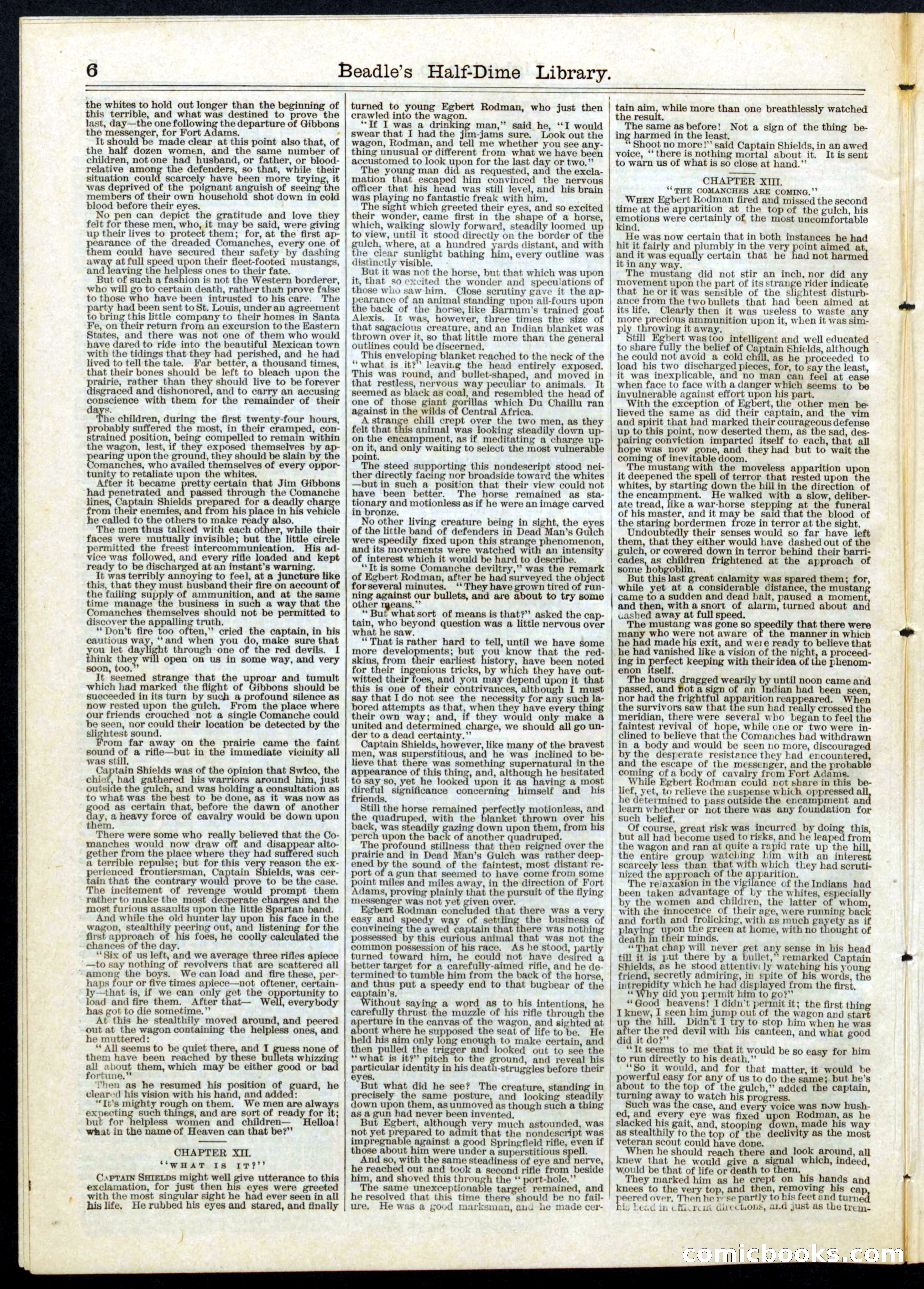
A restored page from Pulp Fiction, 1879. Page through the whole issue in the reader above.
📄 Transcribed text from this page (OCR, searchable)
Machine-transcribed from the original scan — historical spelling and the odd misread are preserved.
=——— a . = -_—— — ——— —-——_——- CC Or OC lc oO errr" = a — Se re eee ee + ee eer : j | - ly—that is, if we can only get the o 6 Beadle’s Half-Dime Library. the whites to hold out longer than the beginning of this terrible, and what was destined to prove the last, day—the one apna the departure of Gibbons the messenger, for Fort Adams. . It should be made clear at this point also that, of the half dozen women, and the same number of children, notone had husband, or father, or blood- relative among the defenders, so that, while their situation could scarcely have been more trying, it was deprived of the poignant anguish of seeing the members of their own household shot down in cold blood before their eyes. No pen can depict the gratitude and love they felt for these men, who, it may be said, were giving up their lives to protect them; for, at the first ap- pearance of the dreaded Comanches, every one of them could have secured their safety by dashing away at full speed upon their fleet-footed mustangs, and leaving the ap ess ones to their fate. But of such a fashion is not the Western borderer, who will go to certain death, rather than prove false to those who have been intrusted to his care. The party had been sent to St. Louis, under an agreement to bring this little company to their homes in Santa Fe, on their return from an excursion to the Eastern States, and there was not one of them who would have dared to ride into the beautiful Mexican town with the tidings that they had perished, and he had lived to tell the tale. Far better, a thousand times, that their bones should be left to bleach upon the este rather than they should live to be forever isgraced and dishonored, and to carry an accusing conscience with them for the remainder of their days. The children, during the first twenty-four hours, probably suffered the most, in their cramped, con- strained position, being compelled to remain within the wagon, lest, if they exposed themselves by ap- earing upon the ground, they should be slain by the omanches, who availed themselves of every oppor- tunity to retaliate upon the whites. After it became pretty certain that Jim Gibbons had penetrated and passed through the Comanche lines, Captain Shields prepared for a deadly comere from their enemies, and from his place in his vehicle he called to the others to make ready also. The men thus talked with each other, while their faces were mutually invisible; but the little circle permitted the freest intercommunication. His ad- vice was followed, and every rifle loaded and kept ready to be discharged at an instant’s warning. It was terribly annoying to feel, at a juncture like this, that they must husband their fire on account of the failing supply of ammunition, and at the same time manage the business in such a way that the Comanches themselves should not be permitted to discover the appalling truth. “Don’t fire too often,’ cried the captain, in his cautious way, ‘“‘and when you do, make sure that you let day ight through one of the red devils. I think they will open on us in some way, and very soon, too.” It seemed strange that the uproar and tumult which had marked the flight of Gibbons should be succeeded in its turn by such a profound silence as now rested upon the guich. From the place where our friends crouched not a single Comanche could be seen, nor could their location be detected by the slightest sound. From far away on the prairie came the faint sound of a rifle—but in the immediate vicinity all was still. Captain Shields was of the opinion that Swico, the chief, had gathered his warriors around him, just outside the gulch, and was holding a consultation as to what was the best to be done, as it was now as ood as certain that, before the dawn of another By, a heavy force of cavalry would be down upon them. There were some who really believed that the Co- manches would now draw off and disappear alto- gether from the place where they had suffered such a terrible repulse; but for this very reason the ex- erienced frontiersman, Captain Shields, was cer- in that the contrary would prove to be the case. The incitement of revenge would prompt them rather to make the most desperate charges and the most furious assaults upon the little Spartan band. And while the old hunter lay upon his face in the wagon, stealthily peering out, and listening for the first approach of his foes, he coolly calculated the chances of the day. ‘Six of us left, and we hg three rifles apiece —to say nothing of revolvers that are scattered all among the boys. We can load and fire these, per- haps four or five times apiece—not oftener, certain- rtunity to load and fire them. After that— Well, everybody has got to die sometime.” At this he stealthily moved around, and peered out at the wagon containing the helpless ones, and he muttered: ** All seems to be quiet there, and I guess none of them have been reached by these bullets whi = about them, which may be either good or ortune,” Then as he resumed his position of ein he cleared his vision with his hand, and added: “It’s mighty rough on them. We men are always ee such things, and are sort of ready for it; but for helpless women and children— Helloa! what in the name of Heaven can that be?’’ CHAPTER XII. ‘‘WHAT Is 1T?’’ Captain SHIELDS might well give utterance to this exclamation, for just then his eyes were greeted with the most singular sight he had ever seen in all his life. He rubbed his eyes and stared, and finally turned to young Egbert Rodman, who just then crawled into the wagon. “If I was a drinking man,” said he, “I would swear that I had the jim-jams sure. Look out the wagon, Rodman, and tell me whether you see any- thing unusual or different from what we have been accustomed to look upon for the last day or two.” The young man did as requested, and the excla- mation that escaped him convinced the nervous officer that his head was still level, and his brain was playing no fantastic freak with him. The sight which greeted their eyes, and so excited their wonder, came first in the shape of a horse, which, walking slowly forward, steadily loomed up to view, until it stood directly on the border of the gulch, where, at a hundred yards distant, and with the clear sunlight bathing him, every outline was distinctly visible. ———— ee But it was not the horse, but that which was upon | it, that so excited the wonder and speculations of those who saw him. Close scrutiny gave it the ap- pearance of an animal standing upon all-fours upon the back of the horse, like Barnum’s trained goat Alexis. It was, however, three times the size of that sagacious creature, and an Indian blanket was thrown over it, so that little more than the general outlines could be discerned. This enveloping blanket reached to the neck of the ‘what is it?” leaving the head entirely exposed. This was round, and bullet-shaped, and moved in that restless, nervous way peculiar to animals. It seemed as black as coal, and resembled the head of one of those giant gorillas which Du Chaillu ran against in the wilds of Central Africa. A strange chill crept over the two men, as they felt that this animal was looking steadily down up- on the encampment, as if meditating a charge up- wah and only waiting to select the most vulnex itl point. The steed supporting this nondescript stood nei- ther directly facing nor broadside toward the whites —butin such a position that their view could not have been better. The horse remained as sta- tionary and motionless as if he were an image carved in bronze. No other living creature being in sight, the eyes of the little band of defenders in Dead Man’s Gulch were speedily fixed upon this strange phenomenon, and its movements were watched with an intensity of interest which it would be hard to describe. “It is some Comanche deviltry,” was the remark of Egbert Rodman, after he had surveyed the object forseveral minutes. ‘‘ They have grown tired of run- ning against our bullets, and are about to try some other mgeans.”’ ‘But what sort of means is that?’’ asked the cap- tain, who beyond question was a little nervous over what he saw. “That is rather hard to tell, until we have some more developments; but you know that the red- skins, from their earliest history, have been noted for their ingenious tricks, by which they have out- witted their foes, and you may depend upon it that this is one of their contrivances, although I must say that Ido not see the necessity for any such la- bored attempts as that, when they have every thing their own way; and, if they would only make a united and determined charge, we should all go un- der to a dead certainty.”’ Captain Shields, however, like many of the bravest men, was superstitious, and he was inclined to lieve that there was something supernatural in the appearance of this thing, and, although he hesitated to say so, yet he looked upon it as having a_ most direful significance concerning himself and his friends. Still the horse remained perfectly motionless, and the quadruped, with the blanket thrown over his back, was steadily gazing down upon them, from his perch upon the back of another quadruped. The profound stillness that then reigned over the prairie and in Dead Man's Gulch was rather deep- ened by the sound of the faintest, most distant re- port of a gun that seemed to have come from some point miles and miles away, in the direction of Fort Adams, proving plainly that the pursuit of the flying messenger was not yet given over. Egbert Rodman concluded that there was a very easy and speedy way of settling the business of convincing the awed captain that there was nothing possessed by this curious animal that was not the common possession of his race. As he stood, partly turned toward him, he could not have desired a better target for a carefully-aimed rifle, and he de- termined to tumble him from the back of the horse, and thus put a speedy end to that bugbear of the captain’s. ithout saying a word as to his intentions, he carefully thrust the muzzle of his rifle through the pata in the canvas of the wagon, and sighted at about where he supposed the seat of life to be. He held his aim only long enough to make certain, and then aig the trigger and looked out to see the ‘““what is it?’ pitch to the ground, and reveal his particular identity in his death-struggles before their eyes. But what did he see? The creature, standing in recisely the same posture, and looking steadily own upon them, as unmoved as though such a thing as a gun had never been invented, But Egbert, ease very much astounded, was not yet prepared to admit that the nondescript was impregnable against a good Springfield rifle, even if those about him were under a superstitious spell. And so, with the same steadiness of eye and nerve, he reached out and took a second rifie from beside him, and shoved this through the * port-hole.”’ The same unexceptionable target remained, and he resolved that this time there should be no fail- ure, He was a good marksman, aud he made cer- nnn OEE EIEEIEEEEEEEIIEIIREEEEEEEEEEEIEEEEEE a ee Se tain aim, while more than one breathlessly watched the result. Not a sign of the thing be- The same as before! harmed in the least. ‘ Shoot no more!”’ said Captain Shields, in an awed voice, “there is nothing mortal about it. It is sent to warn us of what is so close at hand.” CHAPTER XTIT. ‘““THE COMANCHES ARE COMING.”’ WuaeEn Egbert Rodman fired and missed the second time at the apparition at the top of the gulch, his a were certainly of the most uncomfortable nd, He was now certain that in both instances he had hit it fairly and plumbly in the very point aimed at and it was equally certain that he had not harmed it in any way. The mustang did not stir an inch, nor did any movement upon the part of its strange rider indicate that he or it was sensible of the slightest disturb- ance from the two bullets that had been aimed at its life. Clearly then it was useless to waste any more precious ammunition upon it, when it was sim- ply throwing it away. still Egbert was too intelligent and well educated to share fully the belief of Captain Shields, although he could not avoid a cold chill, as he proceeded to _load his two discharged pieces, for, to say the least, it was inexplicable, and no man can feel at ease when face to face with a danger which seems to be invulnerable against effort upon his part. With the exception of Egbert, the other men be. lieved the same as did their captain, and the vim and spirit that had marked their courageous defense up to this point, now deserted them, as the sad, des- ss conviction imparted itself to each, that all ope was now gone, and they had but to wait the coming of inevitable doom. The mustang with the moveless apparition upon it deepened the spell of terror that rested upon the whites, by starting down the hillin the direction of the encampment. He walked with a slow, deliber- ate tread, like a war-horse stepping at the funeral of his master, and it may be said that the blood of the staring bordermen froze in terror at the sight. Undoubtedly their senses would so far have left them, that they either would have dashed out of the gulch, or cowered down in terror behind their barri- cades, as children frightened at the approach of some hobgoblin. But this last great calamity was spared them; for, while yet at a considerable distance, the mustan came to a sudden and dead halt, paused a momen and then, with a snort of alarm, turned about and uashed away at full speed. The mustang was gone so acne that there were many who were not aware of the manner in which he had made his exit, and were ready to believe that he had vanished like a vision of the night, a proceed- ing in perfect keeping with their idea of the phenom- enon itself. | The hours dragged wearily by until noon came and passed, and fot a - of an Indian had been seen, nor had the frightful apparition reappeared. When the survivors saw that the sun had really crossed the meridian, there were several who began to feel the faintest revival of ry es while one or two were in- clined to believe that the Comanches had withdrawn in a body and would be seen no more, discouraged by the desperate resistence they had encountered, and the escape of the messenger, and the probable coming of a body of cavalry from Fort Adame. _ While Egbert Rodman could not share in this_be- lief, yet, to relieve the suspense which oppressed he determined to pass outside the encampment an learn whether or not there was any foundation for such belief, Of course, great risk was incurred by doing this, but all had become used to risks, and he leaped from the wagon and ran at quite a rapid rate up the hill, the entire group watching him with an interest scarcely less than that with which they had scruti- nized the approach of the apparition. The re/axation in the vigilance of the Indians had been taken advantage of by the whites, especially by the women and children, the latter of whom, with the innocence of their age, were running back and forth and frolicking, with as much gayety as if playing upon the green at home, with no thought of death a their minds. “That chap will never get any sense in his head till it is put there by a bullet,” remarked Captain Shields, as he stood attentiv: ly watching his young friend, secretly admiring, in spite of his words, the intrepidity which he had displayed from the first, “Why did you permit him to go?” “Good heavens! I didn't permit it; the first thin I knew, I seen him jump out of the wagon and ri Op the hill. Didn't I try to stop him when he was after the red devil with his canteen, and witht good did * do?” Sai im ‘It seems to me that it would be so easy for him to run directly to his death,” 5 “So it would, and for that matter, it would be powerful easy for any of us to do the same; but he’s about to the top of the gulch,” added the captain, turning away to watch his progress. Such was the case, and every voice was now hush- ed, and every eye was fixed’ upon Rodman, as he slacked his gait, and, stooping down, made his way as stealthily to the top of the declivity as the most veteran scout could have done. When he should reach there and look around, all knew that he would give a al which, indeed, would be that of life or death to them, They marked him as he crept on his hands and knees to the very top, and then, removing his cap eered over, Then he rcse partly to his feet and turned tiy head in cMicrcut directons, aid just as the trem- COME JOOKS SO —-_ ’ “ j y