
Pulp Fiction, 1879 · page 5 of 16
Beadle's Half Dime Library, No. 81 — page 5: what you’re looking at
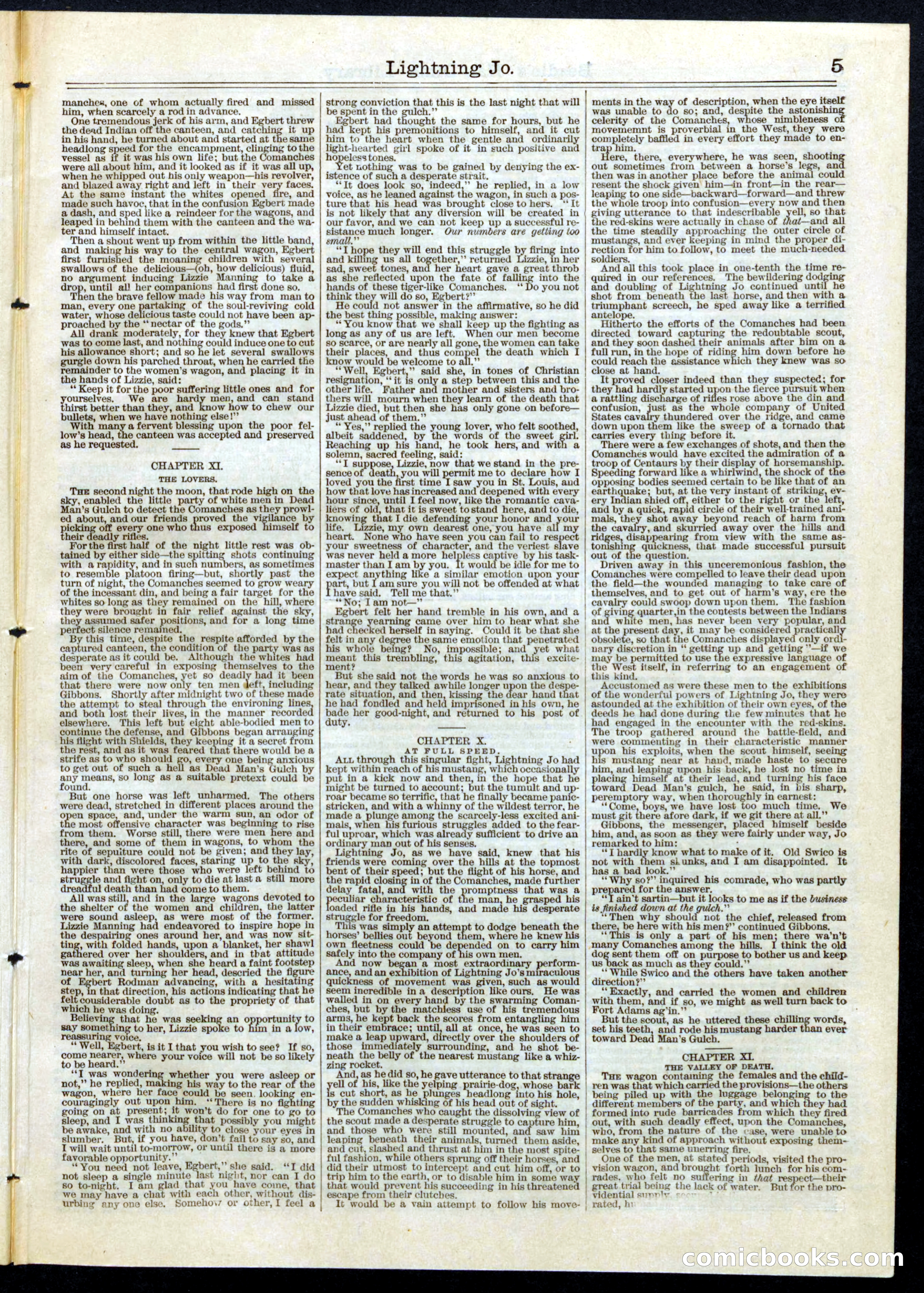
A restored page from Pulp Fiction, 1879. Page through the whole issue in the reader above.
📄 Transcribed text from this page (OCR, searchable)
Machine-transcribed from the original scan — historical spelling and the odd misread are preserved.
| manches, one of whom actually fired and missed him, when scarcely a rod in advance. One tremendous jerk of his arm, and Egbert threw the dead Indian off the canteen, and catching it up in his hand, he turned about and started at the same headlong speed for the encampment, clinging to the vessel as if it was his own life; but the Comanches were all about him, and it looked as if it was all up, when he whipped out his only weapon—his revolver, and blazed away right and left in their very faces. At the same instant the whites opened fire, and made such havoc, that inthe confusion Egbert made a dash, and sped like a reindeer for the wagons, and leaped in behind them with the canteen and the wa- ter and himself intact. Then a shout went up from within the little band, and making his way to the central wagon, Egbert first furnished the moaning children with several swallows of the delicious—(oh, how delicious) fluid, no argument inducing Lizzie Manning to take a a until al! her companions had first done so. Then the brave fellow made his way from man to man, every one ng of the soul-reviving cold water, whose delicious taste could not have been ap- proached by the “nectar of the gods.” All drank moderately, for they knew that Egbert was to come last, and nothing could induce one to cut his allowance short; and so he let several swallows le down his parched throat, when he carried the remainder to the women’s wagon, and placing it in the hands of Lizzie, said: “Keep it for the poor suffering little ones and for ners We are ree Ny Benaag and can stand hirst better than they, and know how to chew our bullets, when we have nothing else!”’ With eng fervent blessing upon the poor fel- low’s head, the canteen was accepted and preserved as he requested. CHAPTER XI. THE LOVERS. Tue second night the moon, that rode high on the sky, enabled the little party of white menin Dead Man’s Gulch to detect the Comanches as they prowl- ed about, and our friends proved the Ne Sone by icking off every one who thus exposed himself to their deadly rifles For the first half of the night little rest was ob- tained by either side—the < yom shots continuing with a rapidity, and in such numbers, as sometimes to resemble platoon firing—but, shortly past the turn of night, the Comanches seemed to grow weary of the incessant din, and being a fair target for the whites so long as they remained on the hill, where they were brought in fair relief against the sky, they assumed safer oa rOne, and for a long time perfect silence remained. By this time, despite the respite afforded by the captured canteen, the condition of the party was as desperate as it could be. Although the whites had been very careful in exposing themselves to the aim of the Comanches, yet so deadly had it been that there were now only ten men deff, including Gibbons. Shortly after midnight two of these made the attempt to steal through the environing lines and both lost their lives, in the manner recorde elsewhere. This left but eight able-bodied men to continue the defense, and Gibbons began arranging his flight with Shields, they keeping it a secret from the rest, and as it was feared that there would be a strife as to who should go, every one being anxious to get out of such a hell as Dead Man’s Gulch by any oF so long as a suitable pretext could be ound. But one horse was left unharmed. The others were dead, stretched in different places around the open space, and, under the warm sun, an odor of the most offensive character was beginning to rise from them. Worse still, there were men here and there, and some of them in wagons, to whom the rite of sepuiture could not be given; and they lay, with dark, discolored faces, staring up to the sky, happier than were those who were left behind to struggle and fight on, only to die at last a still more ul death than had come to them. All was still, and in the large wagons devoted to the shelter of the women and children, the latter were sound asleep, as were most of the former. Lizzie Manning had endeavored to inspire hope in the despairing ones around her, and was now sit- ting, with folded hands, upon a blanket, her shawl gathered over her shoulders, and in that attitude was awaiting sleep, when she heard a faint footstep near her, and turning her head, descried the fi of bert Rodman advancing, with a hesitating step, in that direction, his actions indicating that he felt cousiderable doubt as to the propriety of that which he was doing. > ne that he was an oO doeryd to say Something to her, Lizzie spoke to in a low, reassuring voice, “Well, Egbert, is it I that you wish to see? If so, come nearer, where your voice will not be so likel to be heard.” ! f “*T was wonde whether you were asleep or not,” he replied, g his way to the rear of the wagon, where her face could be seen. looking en- couragingly out upon him. ‘There is no fighting going on at present; it won’t do for one to go to sleep, and I was thin that possibly you might be awake, and with no ability to close your eyes in slumber. But, if you have, don’t fail to say so, and I will wait until to-morrow, or until there is a more favorable opportunity.’ “You need not leave, Egbert,” she said. “TI did not sleep a single minute last niglit, nor can I do so to-night. I am glad that you have come, that we may have a chat with each other, without dis- urbing any one else. Somehov7 or other, I feel a Lightning’ Jo. _ strong conviction that this is the last night that will be spent in the gulch.” Egbert had thought the same for hours, but he had kept his premonitions to himself, and it cut him to the heart when the gentle and ordinarily light-hearted girl spoke of it in such positive and me sh tones. et nothing was to be gained by denying the ex- istence of such a desperate strait. **It does look so, indeed,’ he replied, in a low voice, as he leaned against the wagon, in such a pos- ture that his head was brought close to hers. “It is not likely that any diversion will be created in our favor, and we can not keep up a successful re- om much longer. Our numbers are getting too small,” “T hope they will end this struggle by firing into and killing us all together,’’ returned Lizzie, in her sad, sweet tones, and her heart gave a great throb as she reflected upon the fate of falling into the hands of these tiger-like Comanches. ‘* Do you not think they will do so, Egbert?”’ He could not answer in the affirmative, so he did the best thing possible, making auswer: “You know that we shall keep up the fighting as long as any of us are left. When our men become so scarce, or are nearly all gone, the women can take their places, and thus compel the death which I know would be welcome to all.”’ “Well, Egbert,” said she, in tones of Christian resignation, “it is only a step between this and the other life. Father and mother and sisters and bro- thers will mourn when they learn of the death that Lizzie died, but then she has only gone on before— just ahead of them.” “ Yes,”’ replied the young lover, who felt soothed, albeit saddened, by the words of the sweet girl. Reaching up his hand, he took hers, and with a solemn, sacred feeling, said: a Se: Lizzie, now that we stand in the pre- senceof death you will permit me to declare how I loved you the first time I saw you in St. Louis, and how that love has increased and deepened with every hour since, until I feel now, like the romantic cava- liers of old, that it is sweet tostand here, and to die, knowing that I die sgiaeeo | your honor and your life. e, my own dearest one, you have all my heart. None who have seen you can fail to respect your sweetness of character, and the veriest slave was never held a more hel eon captive by his task- master than Iam by you. It would be idle for me to expect anything like a similar emotion _ your part, but Iam sure you will not be offended at what have said, Tell me that.” **No; I am not—” Egbert felt her hand tremble in his own, and a strange yearning came over him to hear what she had checked herself in saying. Could it be that she felt in any de the same emotion that penetrated his whole being? No, impossible; and yet what ms en this trembling, this agitation, this excite- ment} But she said not the words he was so anxious to hear, and they talked awhile longer ye the despe- rate situation, and then, kissing the dear hand that he had fondled and held imprisoned in his own, he bade her good-night, and returned to his post of duty. CHAPTER X. AT FULL SPEED. Aut through this singular fight, Lightning Jo had kept within reach of his mustang, which occasionally put in a kick now and then, in the hope that he might be turned to account; but the tumult and > roar became so terrific, that he finally became panic- stricken, and with a whinny of the wildest terror, he made a plunge among the scarcely-less excited ani- mals, when his furious cats Lea added to the fear- ful uproar, which was already sufficient to drive an ordinary man out of his senses. Lightning Jo, as we have said, knew that his friends were coming over the hills at the topmost bent of their speed; but the flight of his horse, and the rapid closing in of the Comanches, made further delay fatal, and with the promptness that was a uliar characteristic of the man, he grasped his oaded rifle in his hands, and made his desperate struggle for freedom. This was simply an rye to dodge beneath the horses’ bellies out beyond them, where he knew his own fleetness could = 4 pee on to carry him safely into the company of his own men. And now an a most extraordinary perform- ance, and an exhibition of Lightning Jo’s miraculous quickness of movement was given, such as would seem incredible in a description like ours, He was walled in on every hand by the swarming Coman- ches, but by the matchless use of his tremendous arms, he kept back the scores from entangling him in their embrace; until, all at once, he was seen to make a leap idk og ctly over the shoulders of those immediately surrounding, and he shot be- neath the belly of the nearest mustang like a whiz- zing rocket. And, as he did so, he gave utterance to that strange yell of his, like the yelping prairie-dog, whose bark cut short, as he plunges headlong into his hole, by the sudden whisking of his head out of sight. The Comanches who caught the dissolving view of the scout made a desperate struggle to ca oo him, and those who were still mounted, and saw him leaping beneath their animals, turned them aside, and cut, slashed and thrust at him in the most spite- ful fashion, while others sprung off their horses, and did their utmost to intercept and cut him off, or to trip him to the earth, or to disable him in some way that would prevent his succeeding in his threatened escape from their clutches. It would be a vain attempt to follow his move- 5 ments in the way of description, when the eye itself was unable to o so; and, despite the astonishi celerity of the Comanches, whose nimbleness 0 movememnt is proverbial in the West, they were completely baffled in every effort they made to en- a nim, ere, there, everywhere, he was seen, shootin | out sometimes from between a horse’s legs, an giving utterance to that indescribable soldiers. quired in our references. antelope. could reach the assistance w close at hand. States cav carries every thing before it. Speeding forward li mals, the the cav , and skurri tonishin out of the question. an at the poreens day, it may be considered obsolete, nary discretion in * gettin —————=— ee ee tC ee eee ee — up and this kind. a ‘*Come, s, we have lost and doubling of Lightning Jo continued until shot from beneath the last horse, and then with a triumphant screech, he sped away like a terrified then was in another place before the animal could resent the shock given him—in front—in the rear— leaping to one side—backward—forward—and threw the whole troop into confusion—every now and then ell, so that the red-skins were actually in chase of that—and all the time steadily approaching the outer circle of mustangs, and ever keeping in mind the proper di- rection for him to follow, to meet the much-needed And all this took place in one-tenth the time re- The bewildering dodging he Hitherto the efforts of the Comanches had been directed toward capturing the redoubtable scout, and they soon dashed their animals after bim on a full run, in the hope of Jape! him down before he ich they knew was so It proved closer indeed than they suspected; for they had hardly started upon the fierce pursuit when a rattling discharge of rifles rose above the din and confusion, just as the whole company of United thundered over the ridge, and came down upon them like the sweep of a tornado that There were a few exchanges of shots, and then the Comanches would have excited the admiration of a troop of Centaurs ~ their display of ap Ee ce a whirlwind, the shock of the opposing bodies seemed certain to be like that of an earthquake; but, at the very instant of striking ery Indian shied off, either to the right or the and by a quick, rapid circle of their well-trained ani- ev- left, shot away beyond reach of harm from away over the hills and ridges, disappearing from view with the same as- quickness, that made successful pursuit Driven away in this unceremonious fashion, the Comanches were compelled to leave their dead upon the field—the wounded managing to take care of themselves, and to get out of harm’s way, ere the cavalry could swoop down upon them. The fashion of giving quarter,in the contests between the Indians white men, has never been very popular, and cx eapoe | so that the Comanches displayed only ordi- etting ’—if we may be permitted to use the expressive language of the West itself, in referring to an engagement of Accustomed as were these men to the exhibitions of the wonderful powers of Lightning Jo, they were astounded at the exhibition of their own eyes, of the deeds he had done during the few minutes that he had engaged in the encounter with the red-skins. The troop gathered around the battle-field, and were commenting in their characteristic manner upon his exploits, when the scout himself, seeing his mustang near at hand, made haste to secure him, and leaping upon his back, he lost no time in lacing himself at their lead, and turning his face ward Dead Man's gulch, he said, in bis sharp, pepemunery way, when nag in earnest: oy oo much time. We must git there afore dark, if we git there at all.”’ Gibbons, the messenger, placed himself beside remarked to him: : “*T hard has a bad look.”’ prepared for the answer. is finished down at the h.”” “Then why shoul direction?” Fort Adams ag’in.”’ But the scout, as he uttered these c toward Dead Man’s Gulch. CHAPTER XL THE VALLEY OF DEATH. being piled u with the luggage belongin different mem Es him, and, as soon as they were fairly under way, Jo know what to make of it. Old Swico is not with them shunks, and I am disappointed. It ‘*Why so?’ inquired his comrade, who was partly “T ain't sartin—but it looks to me as if the businese not the chief, released from there, be here with his men?’ continued Gibbons. “This is only a part of his men; there wa’n’t many Comanches among the hills. I think the old dog sent them off on pu to bother us and keep us back as much as they could.” ‘While Swico and the others have taken another ‘Exactly, and carried the women and children with them, and if so, we might as well turn back to words, set his teeth, and rode his mustang harder than ever THE wagon contaiming the females and the child- ren was that which carried the provisions—the = to the rs of the party, and which they had _ formed into rude barricades from which they fired out, with such deadly effect, upon the Comanches, | who, from the nature of the case, were unable to make any kind of approach without exposing them- selves to that same unerring fire. One of the men, at stated periods, visited the pro- vision wagon, and brought forth lunch for his com- ct—their great trial being the lack of water. But for the pro- vidential sunn'y : | | rades. who felt no suffering in that res | rated, hi 0)(0)(0) SAE