
Pulp Fiction, 1879 · page 6 of 16
Beadle's Half Dime Library, No. 80 — page 6: what you’re looking at
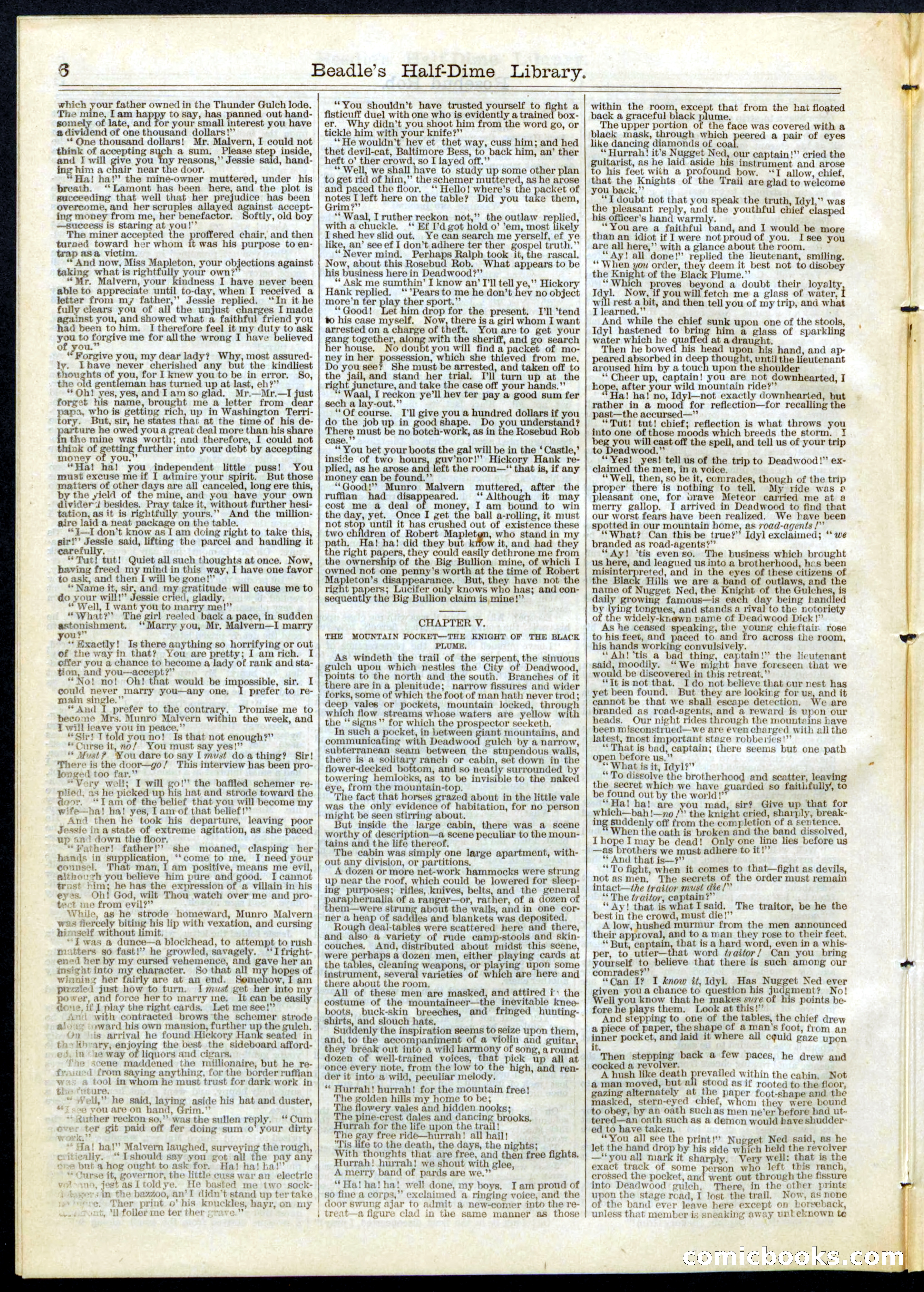
A restored page from Pulp Fiction, 1879. Page through the whole issue in the reader above.
📄 Transcribed text from this page (OCR, searchable)
Machine-transcribed from the original scan — historical spelling and the odd misread are preserved.
$ Beadle’s Half-Dime Library. which your father owned in the Thunder Gulch lode. The mine, lam happy to say, has panned out hand- somely of late, and for your small interest you have a dividend of one thousand dollars!”’ “One thousand dollars! Mr. Malvern, I could not think of accepting such a sum. Please step inside, and I will em you Iy reasons,’’ Jessie said, hand- ing him a chair near the door. ‘Ha! ha!” the mine-owner muttered, under his breath. “Lamont has been here, and the plot is succeeding that well that her prejudice has been overcome, and her scruples allay ainst accept- ing money from me, her benefactor. ftly, old boy —suceess is staring at you!”’ The miner accepted the proffered chair, and then turaed toward her whom it was his purpose to en- trap asa victim. ** And now, Miss Mapleton, your objections against taking what is rightfully your own?’ “Mr. Malvern, your kindness I have never been able to appreciate until to-day, when I received a letter from my father,’ Jessie replied. ‘“‘In it he fully clears you of all the unjust charges I made against you, and showed what a faithful friend you had been to him. I therefore feel it my oy to ask + to forgive me for allthe wrong I have believed of you.” “ Forgive you, my dear lady? Why, most assured- ly. Lhave never cherished any but the kindliest thoughts of you, for I knew you to be in error. So, the old gentleman has turned up at last, eh?” * Oh! yes, yes,andIlamso glad. Mr.—Mr.—I just forget his name, brought me a letter from dear papa, who is getting rich, up in Washington Terri- ory. But, sir, he states that at the time of his de- arture he owed youa great deal more than his share nthe mine was worth; and therefore, I could not think of getting further into your debt by accepting money of you.” “Ha! ha! you independent little puss! You must excuse me if I admire your spirit. But those matters of other days are all canceled, long ere this, by the yield of the mine, and you have your own divider besides. Pray take it, without further hesi- tation, as it is rightfully yours.’’ And the million- aire laid a neat package on the table. “{—I don’t know as | am doing right to take this, oll ~ said, lifting the parcel and handling it carefully. “Tut! tut! Quiet all such thoughts at once. Now, having freed my mind in this way, I have one favor to ask, and then I will be gone!”’ * Name it, sir, and my gratitude will cause me to do your will!” Jessie cried, gladly, “ Well, I want you to marry me!” “What?” The girl reeled back a pace, in sudden astonishment. ‘Marry you, Mr. Malvern—I marry ou?” ‘Exactly! Is there anything so horrifying or out of the way in that? You are pretty; I am rich. offer you a chance to become a lady of rank and sta- tion, and you—accept?”’ “No! no! Oh! that would be 8 yeenrt sir. I could never marry you—any one, prefer to re- main single.” * And I prefer to the contrary. Promise me to become Mrs. Munro Malvern within the week, and I will leave you in peace,”’ “Sir! T told you no! Is that not enough?” “Curse it, no/ You must say yes!” ‘* Must? Wou dare to say I mvst doathing? Sir! There is the door—go/ This interview has been pro- longed too far.” “Very well; I will go!’ the baffled schemer re- ‘ied, as he picked up his hat and strode toward the Soor. “Tam of the belief that you will become my wife—ha! ha! yes, I am of that belief!” And then he took his departure, leaving poor Jessie ina state of extreme agitation, as she paced up sn? down the floor. “Wather! father!’ she moaned, clasping her hands in supplication, ‘‘come to me. I need your connsel. That man, I am positive, means me evil, althou ch you believe him pure and good. I cannot trust him; he has the expression of a villain in his eyes. Oh! God, wilt Thou watch over me and pro- tect me from evil?” While, as he strode homeward, Munro Malvern was flercely biting his lip with vexation, and cursing himself without limit, “{ was a dunce—a blockhead, to attempt to rush matters so fast!” he growled, sarge I fright- ened her by my cursed vehemence, and gave her an insight into my character. So that all my hopes of winning her fairly are at an end. Somehow, I am puzzled just how to turn. I must get her into my »wer, and force her to marry me, It can be easily one, if I play the right cards, Let me see!” . And with contracted brows the schemer strode alous \oward his own mansion, further up the gulch. Qn is arrival he found Hickory Hank seated in the libvary, enjoying the best the sideboard afford- ed, in ne way of liquors and cigars. fhe scene maddened the millionaire, but he re- froiued from saying anything, for the border ruffian was a tool in whom he must trust for dark work in tie frture. “ Well,” he said, laying aside his hat and duster, “J «ee you are on hand, Grim.” * Ruther reckon so,”’ was the sullen reply.“ Cum nee ter git paid off fer doing sum o’ your dirty “ Ha! hal’ Malvern laughed, surveying the rough, critieally. “ Ishould say you got all the pay any cone but a hog ought to ask for. Ha! ha! ha!” “ Curse it, governor, the little cuss war an electric ye oan, jest as ltoldye. He basted me two sock- | tasers in the bazzoo, an’I didn’t stand up ter take Ther print o’ his knuckles, hayr, on my b wd Tum, * foller me ter ther srave “You shouldn’t have trusted yourself to fight a fisticuff duel with one who is evidently a trained box- er. Why didn’t you shoot him from the word go, or tickle him with your knife?” **He wouldn't hev et thet way, cuss him; and hed thet devil-cat, Baltimore Bess, to back him, an’ ther heft o’ ther crowd, so I layed off.”’ “Well, we shall have to study up some other plan to get rid of him,”’ the schemer muttered, as he arose and paced the floor. ‘* Hello! where’s the packet of ae I left here on the table? Did you take them, rim?” ‘** Waal, I ruther reckon not,’’ the outlaw replied, with a chuckle. ‘ Ef I'd got hold o’ ’em, most likely I shed hev slid out. Ye can search me yerself, ef ye like, an’ see ef I don’t adhere ter ther gospel truth.” “Never mind. pein ig Ralph took it, the rascal. Now, about this Rosebud Rob. What appears to be his business here in Deadwood?”’ ** Ask me sumthin’ I know an’ I'll tell ye,” Hickory Hank replied. ‘’Pears to me he don’t hev no object more’n ter eg ther sport.” “* Good! him drop for the present. I'll tend to his case myself. Now, there is a girl whom I want arrested on a charge of theft. You are to get your gang together, along with the sheriff, and go search er house. No doubt you will find a packet of mo- ney in her pate. which she thieved from me. Do you see? She must be arrested, and taken off to the jail, and stand her trial. Ill turn up at the right juncture, and take the case off your hands.” ‘Waal, I reckon ye’ll hev ter pay a good sum fer sech a lay-out.” “Of course. I'll give you a hundred dollars if you do the job up in good shape. Do you understand? There must be no botch-work, as in the Rosebud Rob case 9 **'You bet your boots the gal will be in the ‘ Castle,’ inside of two hours, guv’nor!’’ Hickory Hank re- plied, as he arose and left the room—* that is, if any money can be found.”’ “Good!” Munro Malvern muttered, after the ruffian had pe gene ‘Although it may cost me a deal of money, I am bound to win the day, yet. Once I get the ball a-rolling, it must not stop until it has crushed out of existence these two children of Robert Mapletgn, who stand in my ath, Ha! ha! did they but kfow it, and had they he right oe ode they could easily dethrone me from the ownership of the Big Bullion mine, of which I owned not one penny’s worth at the time of Robert Mapleton’s disappearance. But, they have not the right Hey Jats Lucifer ouly knows who has; and con- sequently the Big Bullion claim is mine!” CHAPTER V. THE MOUNTAIN POCKET—THE KNIGHT OF THE BLACK PLUME, As windeth the trail of the serpent, the sinuous gulch upon which nestles the City of Deadwood, Pag to the north and the south. Branches of it here are ina plenitude; narrow fissures and wider forks, some of which the foot of man hath never trod; deep vales or pockets, mountain locked, through which flow streams whose waters are yellow with the “signs” for which the prospector seeketh, In such a pocket, in between giant mountains, and communicating with Deadwood gulch by a narrow, subterranean seam between the stupendous walls, there is a solitary ranch or cabin, set down in the flower-decked bottom, and so neatly surrounded by towering hemlotks, as to be invisible to the naked eye, from the mountain-top. The fact that horses grazed about in the little vale was the only evidence of habitation, for no person might be seen stirring about. But inside the large cabin, there was a scene worthy of description—a scene peculiar to the moun- tains and the life thereof. The cabin was simply one large apartment, with- out any division, or partitions, A dozen or more net-work hammocks were strung up near the roof, which could be lowered for sleep- ing purposes; rifles, knives, belts, and the general ade emg of a ranger—or, rather, of a dozen of hem—were strung about the walls, and in one cor- ner a heap of saddles and blankets was deposited, Rough deal-tables were scattered here and there, and also a variety of rude camp-stools and skin- couches, And, distributed about midst this scene, were perhaps a dozen men, either playing cards at the tables, cleaning weapons, or playing upon some instrument, several varieties of which are here and there about the room, All of these men are masked, and attired i> the costume of the mountaineer—the inevitable knee- boots, buck-skin breeches, and fringed hunting- shirts, and slouch hats. Suddenly the inspiration seems to seize upon them, and, to the accompaniment of a violin and guitar they break out into a wild harmony of song, a roun dozen of well-trained voices, that pick up all at once every note, from the low to the high, and ren- der it into a wild, peculiar melody, “ Hurrah! hurrah! for the mountain free! The golden hills my home to be; The flowery vales and hidden nooks; The pine-crest dales and dancing brooks. Hurrah for the life upon the trail! The gay free ride—hurrah! all hail! ‘Tis life to the death, the days, the nights; With thoughts that are free, and then free fights. Hurrah! hurrah! we shout with glee, A merry band of pards are we.” ‘Ha! ha! ha! well done, my boys. Iam proud of so fine a corps,” exclaimed a ringing voice, and the door swung ajar to admit a new-comer into the re- treat—a figure clad in the same manner as those within the room, except that from the hat floated back a graceful black plume, The upper portion of the face was covered with a black mask, through which peered a pair of eyes like dancing diamonds of Seal. “Hurrah! it’s Nugget Ned, our captain!” cried the uitarist, as he laid aside his instrument and arose oO his feet with a profound bow. “T allow, chief, that the Knights of the Trail are glad to welcome you back,”’ “I doubt not that you speak the truth, Idyl,” was the pleasant reply, and the youthful chief clasped his officer’s hanc Mott w “You are a faithful band, and I would be more than an idiot if I were not proud of you. Isee you are all here,’’ with a glance about the room. “Ay! all done!’ replied the lieutenant, smiling. ‘When you order, they deem it best not to disobey the Knight of the Black Plume.” ‘Which proves beyond a doubt their loyalty Idyl. Now, if you will fetch me a glass of water, I will rest a bit, and then tell you of my trip, and what I learned.” And while the chief sunk upon one of the stools, Idyl hastened to bring him a glass of sparkling water which he quaffed at a draught, Then he bowed his head upon his hand, and ap- peared absorbed in deep thought, until the lieutenant aroused him by a touch upon the shoulder ‘* Cheer up, captain! you are not downhearted, I hope, after your wild mountain ride?” “Ha! ha! no, Idyl—not exactly downhearied, but rather in a mood for reflection—for recalling the t—the accursed—” “Tut! tut! chief; reflection is what throws you a one me = which Seem et ene bf ou will cast o e spell, and tell us of your to Deadwood.” ah “Yes! yes! tell us of the trip to Deadwood!” ex- claimed the men, in a voice. Well, then, so be it, comrades, though of the trip proper there is nothing to tell. My ride was @ pleasant one, for vwrave Meteor carried me at a merry gallop. I arrived in Deadwood to find that our worst fears have been realized. We have been spotted in our mountain home, as road-agents |” ‘What? Can this be true?’’ Idyl exclaimed; ‘* we branded as road-agents?”’ “Ay! ‘tis even so. The business which brought us here, and leagued us into a brotherhood, hes been peg Lethe and in the eyes of these citizens of the B Hills we are a band of outlaws, and the name of Nugget Ned, the Knight of the Gulches, is daily growing famous—is each day being handled by lying tongues, and stands a rival to the notoriety of the widely-kn@wn name of Deadwood Dick!” As he ceased speaking, the young chieftain rose to his teet, and paced to and fro across the room, his hands working convulsively. “Ah! ‘tis a bad thing, captain!” the lieutenant said, moodily. “‘We might have foreseen that we would be discovered in this retreat,” “Tt is not that. Ido not believe that our nest has yet been found. But they are looking for us, and it cannot be that we shall escape detection. We are branded as road-agents, and a reward is upon our heads. Our night rides through the mountains have been misconstrued—we are even charged with all the latest, most important stage robberies!” “That is bad, captain; there seems but one path open before us.” * What is it, Idyl?” “To dissolve the brotherhood and scatter, leaving the secret which we have guarded so faithfully, to be found out by the world!’ ‘Ha! ha! are you mad, sir? Give up that for which—bah !—no /* the knight cried, sharply, break- ing suddenly off from the completion of a sentence, When the oath is broken and the band dissolved, I hope I may be dead! Only one line lies before us —as brothers we must adhere to it!”’ ** And that is—?” “To fight, when it comes to that—fight as devils, not asmen. The secrets of the order must remain intact—the traitor must die /” ‘* The traitor, captain?” “Ay! that is whatI said. The traitor, be he the best in the crowd, must die!” A low, hushed murmur from the men announced their approval, and to a man they rose to their feet. “But, captain, that is a hard word, even in a whis- per, to utter—that word ¢7aitor/ Can you bring yourself to believe that there is such among our comrades?” ? “Can I? I know it, Idyl. Has Nugget Ned ever iven you a chance to question his judgment? No! Well you know that he makes sure of his points be- fore he plays them. Look at this!” And stepping to one of the tables, the chief drew a piece of paper, the shape of a man’s foot, from an inner pocket, and Jaid it where all cquld gaze upon i t. Then stepping back a few paces, he drew and cocked a revolver. A hush like death prevailed within the cabin. Not a man moved, but all stood as if rooted to the floor, gazing alternately at the paper foot-shape and the masked, stern-eyed chief, whom they were bound to obey, by an oath such as men ne'er before had ut- tered—an oath such as a demon would have shudder- ed to have taken. “You all see the print!” Nugget Ned said, as he Jet the hand drop by his side which held the revolver —‘‘you all mark it sharply. Very well: that is the exact track of some person who left this ranch, crossed the pocket, ond went out through the fissure into Deadwood gulch, There, in the other prints open the stage road, I lost. the trail. Now, as none of the band ever leave here except on borveback, unless that member is sneaking away unteknown te GONE JOOKS