
Pulp Fiction, 1878 · page 8 of 16
Beadle's Half Dime Library, No. 70 — page 8: what you’re looking at
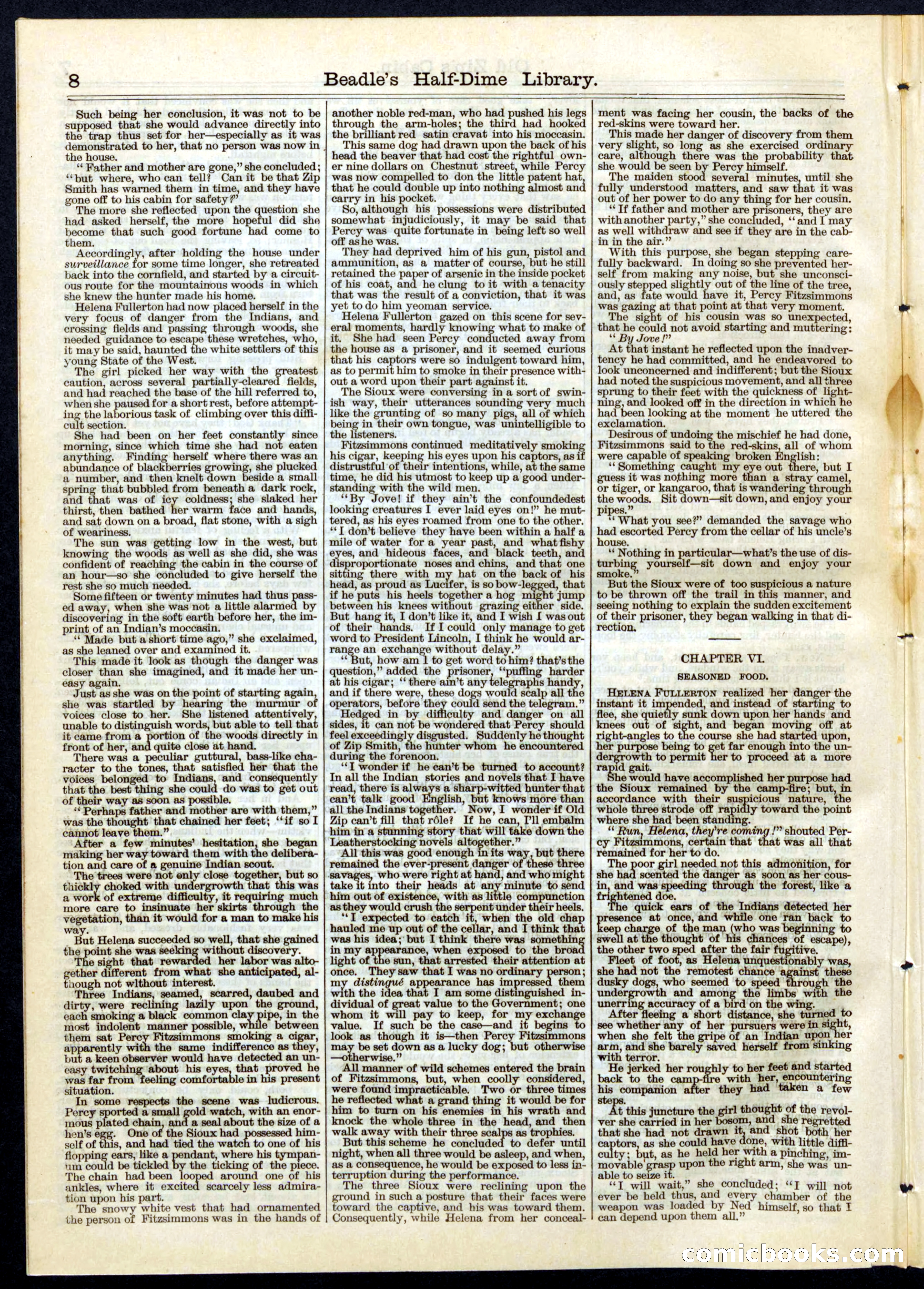
A restored page from Pulp Fiction, 1878. Page through the whole issue in the reader above.
📄 Transcribed text from this page (OCR, searchable)
Machine-transcribed from the original scan — historical spelling and the odd misread are preserved.
SG Eo 3) 5S ee —-<« . 8 Such being her conclusion, it was not to be supposed that she would advance directly into the trap thus set for her—especiallv as it was demonstrated to her, that no person was now in the house. ‘‘ Father and mother are gone,” she concluded ; ‘“but where, who can tell? Canit be that Zip Smith has warned them in time, and they have gone off to his cabin for safety?’ The more she reflected upon the question she had asked herself, the more hopeful did she become that such good fortune had come to them. Accordingly, after holding the house under surveillance for some time longer, she retreated back into the cornfield, and started by a circuit- ous route for the mountainous woods in which she knew the hunter made his home. Helena Fullerton had now placed herself in the very focus of danger from the Indians, and crossing fields and passing through woods, she needed guidance to escape these wretches, who, it may be said, haunted the white settlers of this young State of the West. The girl picked her way with the test caution, across several partially-cleared fields, and had reached the base of the hill referred to, when she paused for a short rest, before attempt- ing the laborious task of climbing over this diffi- cult section. She had been on her feet constantly since morning, since which time she had not eaten anything. Finding herself where there was an abundance of blackberries growing, she plucked a number, and then knelt down beside a small spring that bubbled from beneath a dark rock, and that was of icy coldness; she slaked her thirst, then bathed her warm face and hands, and sat down on a broad, flat stone, with a sigh of weariness. The sun was getting low in the west, but knowing the woods as well as she did, she was confident of reaching the cabin in the course of an hour—so she concluded to give herself the rest she so much needed. Some fifteen or twenty minutes had thus pass- ed away, when she was not a little alarmed by discovering in the soft earth before her, the im- print of an Indian’s moccasin. ‘‘ Made but ashort time ago,” she exclaimed, as she leaned over and examined it. This made it look as though the danger was closer than she imagined, and it made her un- easy again. ust as she was on the point of starting again she was startled by hearing the murmur o voices close to her. She listened attentively unable to distinguish words, but able to tell that it came from nl gpm of the woods directly in front of her, quite close at hand. There was a peculiar guttural, bass-like cha- racter to the tones, that satisfied her that the voices belonged to Indians, and consequently that the best thing she could do was to get out of their way as soon as possible. ‘‘ Perhaps father and mother are with them,” was the thought that chained her feet; ‘‘if so I cannot leave them.” After a few minutes’ hesitation, she began making her way toward them with the delibera- — and care of a genuine Indian scout. ) thi choked with undergrowth that was a work of extreme difficulty, it requiring much more care to insinuate her skirts through the vegetation, than it would for a man to make his way. But Helena succeeded so well, that she gained the point she was — without discovery. The sight that re her labor was alto- gether different from what she anticipated, al- though not without interest. Three Indians , scarred, daubed and dirty, were reclining lazily upon the ground, each smoking a black common clay pipe, in the most indolent manner possible, while between them sat pet Fitzsimmons smoking a cigar, apparently with the same indifference as they, but a keen observer would have de an un- easy twitching about his eyes, that proved he was far from feeling comfortable in his present situation. In some respects the scene was ludicrous. Perey a small gold watch, with an enor- mous plated chain, and a seal about the size of a hen’s e One of the Sioux had him- self of this, and had tied the watch to one of his flopping ears, like a pendant, where his tympan- nm could be tickled by the ticking of the piece. The chain had been loo around one of his ankles, where it exci scarcely less admira- tion upon his part. The snowy white vest that had ornamented the person of Fitzsimmons was in the hands of trees were not enly close together, but so |. another noble red-man, who had pushed his legs through the arm-holes; the third had hooked the brilliant red satin cravat into his moccasin. This same dog had drawn upon the back of his head the beaver that had cost the rightful own- er nine dollars on Chestnut street, while Percy was now compelled to don the little patent hat that he could double up into nothing almost and carry in his ory So, although his possessions were distributed somewhat injudiciously, it may be said that Percy was quite fortunate in being left so well off as he was. They had deprived him of his gun, pistol and ammunition, as a matter of course, but he still retained the paper of arsenic in the inside pocket of his coat, and he clung to it with a tenacity that was the result of a conviction, that it was yet todo him yeoman service. Helena Fullerton on this scene for sev- eral moments, hardly knowing what to make of it. She had seen Percy conducted away from the house as a prisoner, and it seemed curious that his captors were so indulgent toward him, as to permit him to smoke in their presence with- out a word upon their part against it. The Sioux were conversing in a sort of swin- ish way, their utterances sounding very much like the grunting of so many pigs, all of which being in their own tongue, was unintelligible to the listeners. Fitzsimmons continued meditatively smokin his cigar, keeping his eyes upon his captors, asi distrustful of their intentions, while, at the same time, he did his utmost to keep up a good under- standing with the wild men. ‘*By Jove! if they ain’t the confoundedest looking creatures I ever laid eyes on!” he mut- tered, as his eyes roamed from one to the other. ‘*T don’t believe they have been within a half a mile of water fora year past, and what fishy eyes, and hideous faces, and black teeth, and disproportionate noses and chins, and that one sitting there with my hat on the back of his head, as proud as Lucifer, is so bow-le that if he puts his heels to ther a hog mig t jump between his knees without grazing either side. But hang it, I don’t like it, and I wish [ was out of their hands. If I could only manage to get word to President Lincoln, I think he would ar- range an a without delay.” ‘* But, how am | to get word to him? that’s the question,” added the prisoner, “‘puffing harder at his cigar; ‘‘ there ain’t any telegraphs handy, and if there were, these dogs would scalp all the operators, before they could send the telegram.” Hed in by culty and danger on all sides, it can not be wondered that Percy should feel exceedingly disgusted. Suddenly he thought of Zip Smith, the hunter whom he encountered during the forenoon. ‘‘T wonder if he ean’t be turned to account? In all the Indian stories and novels that I have read, there is Sa a sharp-witted hunter that can’t talk good English, but knows more than all the Indians her. Now, I wonder if Old Zip can’t fill that réle? If he can, [ll embalm him in a stunning story that will take down the Leatherstocking novels al ther.” All this was good enough in its way, but there remained the ever-present danger of these three sa who were right at hand, and who might take it into their heads at any minute to send him out of existence, with as little compunction as they would crush the ——— under their heels. ‘*T expected to catch it, when the old chap hauled me up out of the cellar, and I think that was his idea; but I think there was somethin in my @ ce, when exposed to the bro light ane sun, ky i Teaiuaky vere at once. ey saw was no 0 n; m a ap ce has im mc them th the idea that I am some di ished in- eee - t on _ the bare one whom it pay eep, for m Nees oa value. If such be the case—and i look as though it is—then Percy Fitzsimmons = set down as a lucky dog; but otherwise —otherwise.” All manner of wild schemes entered the brain of Fitzsimmons, but, when coolly considered, were found impracticable. Two or three times he reflected what a grand thing it would be for him to turn on his enemies in his wrath and knock the whole three in the head, and then walk away with their three scalps as trophies. But this scheme he concluded to defer until night, when all three would be asleep, and when, as a consequence, he would be exposed to less in- terruption during the performance. The three Sioux were reclining upon the ground in such a posture that their faces were toward the captive, and his was toward them. Consequently, while Helena from her conceal- Beadle’s Half-Dime Library. ment was facing her cousin, the backs of the red-skins were toward her. This made her danger of discovery from them very slight, so long as she exercised ordi care, although there was the probability that she would be seen by Percy himself. The maiden stood several minutes, until she fully understood matters, and saw that it was out of her power to do any thing for her cousin. ‘If father and mother are prisoners, they are with another party,” she concluded, ‘‘ and I may as well withdraw and see if they are in the cab- With this J she be ith this purpose, she began stepping care- fully backward. In doing so she prevented her- self from pt any noise, but she unconsci- ously stepped slightly out of the line of the tree, and, as fate would have it, Percy Fitzsimmons was gazing at that point at that very moment. The sight of his cousin was so unexpected, that he could not avoid starting and muttering: ** By Jove!” At that instant he reflected upon the inadver- tency he had committed, and he endeavored to look unconcerned and indifferent; but the Sioux had noted the suspicious movement, and all three sprung to their feet with the quickness of light- ning, and looked off in the direction in which he had been looking at the moment he uttered the exclamation. Desirous of undoing the mischief he had done, Fitzsimmons said to the red-skins, all of whom were capable of speaking broken English: ‘‘Something caught my eve out there, but I guess it was nothing more than a stray camel, or tiger, or kangaroo, that is wandering through the woods. Sit down—sit down, and enjoy your ipes.” | ‘* What you see?” demanded the savage who cae escorted Percy from the cellar of his uncle’s ouse. ‘* Nothing in particular—what’s the use of dis- turbing yourself—sit down and enjoy your smoke,” But the Sioux were of too suspicious a nature to be thrown off the il in this manner, and seeing nothing to explain the sudden excitement of 94 prisoner, they began walking in that di- rection, —_—_ ——- — CHAPTER VI. SEASONED FOOD, HELENA FULLERTON realized her danger the instant it impended, and instead of starting to flee, she quietly sunk down upon her hands and knees out of sight, and began moving off at right-angles to the course she had started upon, her purpose being to get far enough into the un- ies Hach to permit her to proceed at a more rapid She inn have accomplished her had the Sioux remained by the Gaskip Five: but, in accordance with their ppepicious nature, the whole three strode off rapidly toward the point where she had been standing. “ Run, Helena, they’re comi cy Fitzsimmons, certain that t remained for her to do. ot ae girl needed not this admonition, for she scented the danger as soon as her cous- in, and was speeding through the forest, like a tened doe. e quick ears of the Indians detected her ge at oy and ern one ran back to ee charge of the man (who was beginning to swell at the thought of his chances of ebbape); the pe wre a otter the fair fugitive. Fleet of foot, as Helena unquestionably w she had not the remotest chance a; phe dusky dogs, who seemed to speed thro ha hb ros Sate and among the limbs unerring accuracy of a on the wing. After fleeing a short distance, she turned to see whether any of her pursuers were in sight, when she felt the gripe of an Indian upon her arm, and she barely saved herself from sinking with terror. He jerked her roughly to her feet and started back to the cam an with her, encountering his companion r they had take steps. At this juncture the girl thought of the revol- ver she carried in her bosom, and she regretted that she had not drawn it, and shot both her captors, as she could have done, with little diffi- pa ° but, as he held her with a pinching, im- movable grasp upon the right arm, she was un- able to seize it. ‘‘T will wait,” she concluded; “T will not ever be held thus, and every chamber of the weapon was loaded by Ned himself, so that I can depend upon them all,” /” shouted Per- t was all that na few EOPMIE DOC KS (eo) ] ' ' | :