
Pulp Fiction, 1878 · page 7 of 16
Beadle's Half Dime Library, No. 70 — page 7: what you’re looking at
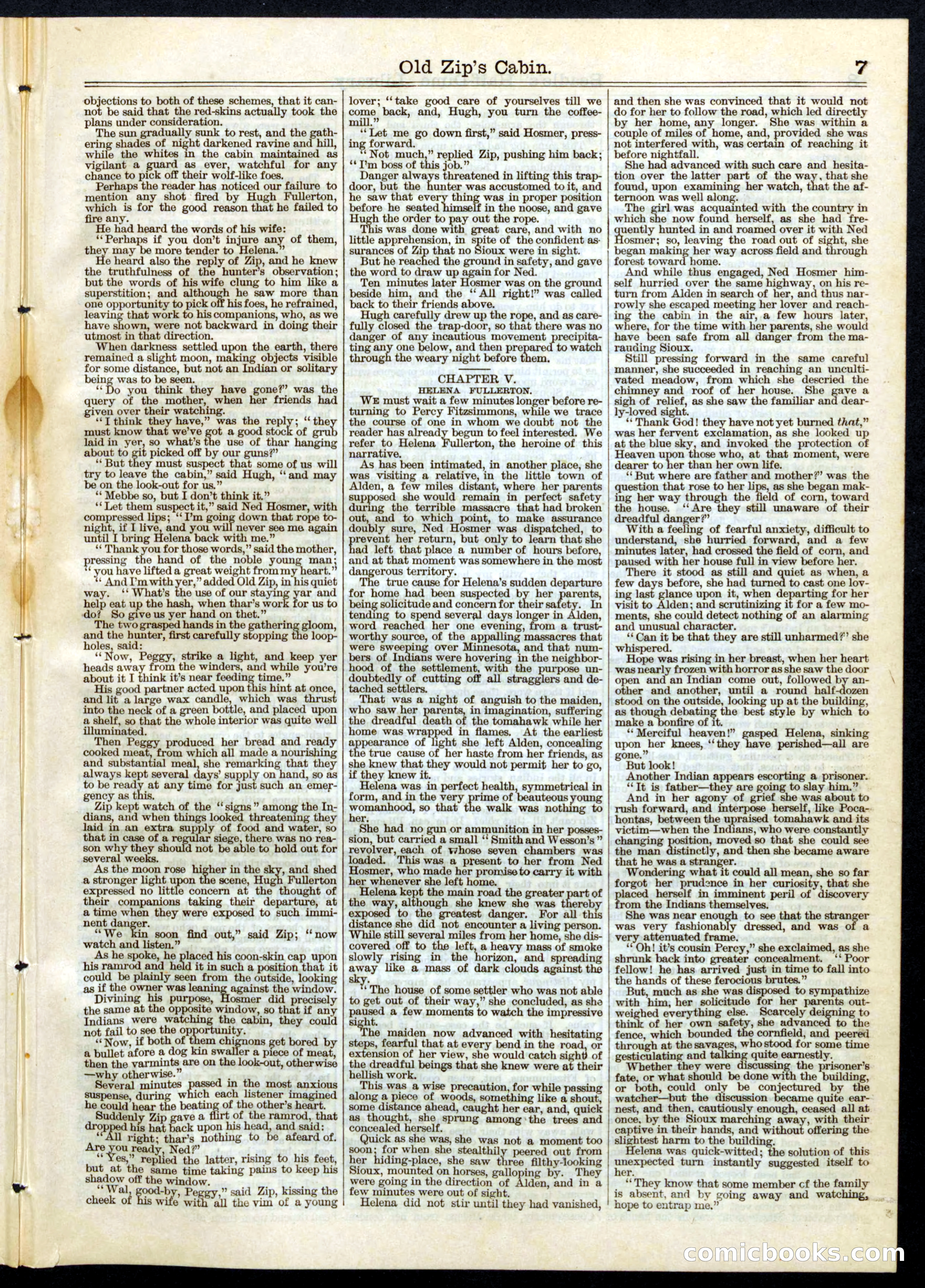
A restored page from Pulp Fiction, 1878. Page through the whole issue in the reader above.
📄 Transcribed text from this page (OCR, searchable)
Machine-transcribed from the original scan — historical spelling and the odd misread are preserved.
| do? So give us yer Old Zip’s Cabin. v4 objections to both of these schemes, that it can- not be said that the red-skins actually took the plans under consideration. The sun gradually sunk to rest, and the gath- ering shades of night darkened ravine and hill, while the whites in the cabin maintained as vigilant a guard as ever, watchful for any chance to pick off their wolf-like foes. Perhaps the reader has noticed our failure to mention any shot fired by Hugh Fullerton, which is for the good reason that he failed to fire any. He had heard the words of his wife: **Perhaps if you don’t injure any of them, mney may be more tender to Helena.” e heard also the reply of Zip, and he knew the truthfulness of the hunter’s observation; but the words of his wife clung to him like a superstition; and although he saw more than one opportunity to pick off his foes, he refrained, leaving that work to his companions, who, as we have shown, were not backward in doing their utmost in that direction. When darkness settled upon the earth, there remained a slight moon, making objects visible for some distance, but not an Indian or solitary being was to be seen. ‘‘Do you think they have gone?’ was the query of the mother, when her friends had given over their watching. ‘‘T think they have,” was the reply ; “the must know that we’ve got a good stock of gru laid in yer, so what’s the use of thar hanging about to git picked off by our guns?” ‘** But they must suspect that some of us will try to leave the cabin,” said Hugh, “ and may be on the look-out for us.” ** Mebbe so, but I don’t think it.” ‘* Let them suspect it,” said Ned Hosmer, with compressed lips; ‘‘ I’m going down that rope to- night, if I live, and you will never see me again until I bring Helena back with me.” ‘‘ Thank you for those words,” said the mother, pressing the hand of the noble young man; ‘you have lifted a great weight from my heart.” ‘* And ’m with yer,” added Old Zip, in his quiet way. ‘* What’s the use of our staying _ and help eat up the when thar’s work for us to The tw reiesli hands. othe sath i ] e two e ering gloom, and the hunter, first carefully stopping the loop- holes, said: ,, Now, Peggy, strike a light, and keep yer heads away from the winders, and while you’re about it I think it’s near feeding time.” His good partner acted upon this hint at once and lit a large wax candle, which was thrust into the neck of a green bottle, and placed upon a shelf, so that the whole interior was quite well illuminated. Then Peggy produced her bread and ready cooked meat, from which all made a nourishing and substantial meal, she remarking that they always kept several days’ supply on hand, so as to be ready at any time for just such an emer- gency as this, Zip kept watch of the “signs” among the In- dians, and when things looked threatening they laid in an extra supply of food and water, so that in case of a regular siege, there was no rea- son why they should not be able to hold out for several weeks. As the moon rose higher in the sky, and shed a stronger light upon the scene, Hugh Fullerton expressed no little concern at the thought of their companions taking their departure, at a time when they were exposed to such immi- nent d e. “We kin soon find out,” said Zip; ‘now watch and listen.” _As he spoke, he placed his coon-skin cap upon his ramrod and held it in such a position that it could be plainly seen from the outside, looking as if the owner was leaning against the window. Divining his purpose, Hosmer did precisely the same at the opposite window, so that if any Indians were watching the cabin, they could not fail to see the onporvinity, “Now, if both of them mee an get bored by a bullet afore a dog kin swaller a piece of meat, then the varmints are on the look-out, otherwise —why otherwise.” , Several minutes p: in the most anxious suspense, during which each listener imagined he could hear the healing of the other’s heart. Suddenly Zip gave a flirt of the ramrod, that cree hat back upon his head, and said: * right; thar’s nothing to be afeard of. Are you ready, Ned?” ) es,” replied the latter, rising to his feet, but at the same time taking pains to keep his Wal, good Ng - Zip, k h ‘Wal, good-by, Peggy,” said Zip, kissing the cheek of his wite wi win the vim of a young lover; ‘‘take good care of yourselves till we come , and, Hugh, you turn the coffee- ‘*Let me go down first,” said Hosmer, press- ing forward. ‘* Not much,” replied Zip, pushing him back; ‘* I’m boss of this job.” Danger always threatened in ne this trap- door, but the hunter was accustomed to it, and he saw that every thing was in proper position before he seated hi in the noose, and gave Hugh the order to pay out the rope. is was done with great care, and with no little apprehension, in spite of the confident as- surances of Zip that no Sioux were in sight. But he reached the ground in safety, and gave the word to draw up again for Ned. Ten minutes later Hosmer was on the ground beside him, and the ‘All right!” was called back to their friends above. Hugh carefully drew up the rope, and as care- fully closed the trap-door, so that there was no danger of any incautious movement precipita- ting any one below, and then prepared to watch through the weary night before them. CHAPTER V. HELENA FULLERTON. WE must wait a few minutes longer before re- turning to Percy Fitzsimmons, while we trace the course of one in whom we doubt not the reader has already begun to feel interested. We refer to Helena Fullerton, the heroine of this narrative. As has been intimated, in another place, she was Visiting a relative, in the little town of Alden, a few miles distant, where her parents supposed she would remain in perfect safety during the terrible massacre that had broken out, and to which point, to make assurance doubly sure, Ned Hosmer was dispatched, to prerane her return, but only to learn that she ad left that place a number of hours before, and at that moment was somewhere in the most dangerous territory. e true cause for Helena’s sudden departure for home had been suspected by her parents, being solicitude and concern for their safety. In tending to spend several days longer in Aiden, word reached her one evening, from a trust- worthy source, of the appalling massacres that were arr ooning over Minnesota, and that num- bers of Indians were hovering in the neighbor- hood of the settlement, with the purpose un- doubtedly of cutting off all stragglers and de- tached settlers. That was a night of anguish to the maiden, who saw her parents, in imagination, suffering the dreadful death of the tomahawk while her home was wrapped in flames. At the earliest appearance of light she left Alden, concealing the true cause of her haste from her friends, as she knew that they would not permit her to go, if they knew it. Helena was in perfect health, symmetrical in form, and in the very prime of beauteous young basset so that the walk was nothing to er. She had no gun or ammunition in her posses- sion, but carried a small ‘‘ Smith and Wesson’s ” revolver, each of whose seven chambers was loaded. This was a present to her from Ned Hosmer, who made her promise to carry it with her whenever she left home. Helena kept the main road the sree park of the way, although she knew she was t ereby to the greatest danger. For all this distance she did not encounter a living person. While still several miles from her home, she dis- covered off to the left, a heavy mass of smoke slowly rising in the horizon, and spreading away like a mass of dark clouds against the ‘The house of some settler who was not able to get out of their way,” she concluded, as she paused a few moments to watch the impressive sight. "The maiden now advanced with hesitating steps, fearful that at every bend in the road, or = oe = a peop she weal catch sight of e drea at she w were ir hellish work. chee ge This was a wise precaution, for while passing along a piece of woods, something like a shout, sore) omnes SRORA, caught her -% and, wae as thought, she sprung among: concealed herself. glen pe dgiagsertings Quick as she was, she was not a moment too soon; for when she stealthily peered out from her hiding-place, she saw three filthy-looking Sioux, mounted on horses, galloping by. They were going in the direction of xiioer and in a few minutes were out of sight. Helena did not stir until they had vanished, | | ‘ and then she was convinced that it would not do for her to follow the road, which led directly by her home, any longer. She was within a couple of miles of home, and, provided she was not interfered with, was certain of reaching it before nightfall. She had advanced with such care and hesita- tion over the latter part of the way, that she found, upon examining her watch, that the af- ternoon was well along. The girl was acquainted with the country in which she now found herself, as she had fre- foamy hunted in and roamed over it with Ned osmer; so, leaving the road out of sight, she began making her way across field and through forest toward home. And while thus engaged, Ned Hosmer him- self hurried over the same highway, on his re- turn from Alden in search of her, and thus nar- rowly she escaped meeting her lover and reach- ing the cabin in the air, a few hours later, where, for the time with her parents, she would have been safe from all danger from the ma- rauding Sioux. Still pressing forward in the same careful manner, she succeeded in reaching an unculti- vated meadow, from which she descried the chimney and roof of her house. She gave a sigh of relief, as she saw the familiar and dear- ly-loved sight. ** Thank God! they have not yet burned that,” was her fervent exclamation, as she looked up at the blue sky, and invoked the protection of Heaven upon those who, at that moment, were dearer to her than her own life. ‘‘ But where are father and mother?’ was the question that rose to her Ups, as she began mak- ing her way through the field of corn, toward the house. ‘Are they still unaware of their dreadful danger?’ With a feeling of fearful anxiety, difficult to understand, she hurried forward, and a few minutes later, had crossed the field of corn, and paused with her house full in view before her. There it stood as still and quiet as when, a few days before, she had turned to cast one loy- ing last glance upon it, when departing for her visit to Alden; and scrutinizing it for a few mo- ments, she could detect nothing of an alarming and unusual character. ‘*Can it be that they are still unharmed?’ she whispered. Hope was rising in her breast, when her heart was nearly frozen with horror as she saw the door open and an Indian come out, followed by an- other and another, until a round half-dozen stood on the outside, looking up at the building, as though debating the best style by which to make a bonfire of it. ‘*‘ Merciful heaven!” Helena, sinking upon her knees, ‘‘they have perished—all are gone. But look! Another Indian appears escorting a prisoner. ‘Tt is father—they are going to slay him.” And in her agony of grief she was about to rush forward, and interpose herself, like Poca-. hontas, between the upraised_ tomahawk and its victim—when the Indians, who were constantly changing position, moved so that she could see the man distinctly, and then she became aware that he was a stranger. Wondering what it could all mean, she so far forgot her prudence in her curiosity, that she sey herself in imminent peril of discovery rom the Indians themselves. She was near enough to see that the stranger was very fashionably dressed, and was of a very attenuated frame. ‘“‘ Oh! it’s cousin Perey,” she exclaimed, as she shrunk back into greater concealment. ‘‘ Poor fellow! he has arrived just in time to fall into the hands of these ferocious brutes.” But, much as she was di to sympathize with him, her solicitude for her parents out- weighed everything else. Scarcely deigning to think of her own yb she advan to the fence, which bounded cornfield, and peered through at the sav: who stood for some time gesticulating and quite earnestly. Whether they were ae the prisoner’s fate, or what should be done with the building, or both, could only be conjectured by the watcher—but the discussion e quite ear- nest, and then, cautiously enough, ceased all at once, by the Sioux marching away, with their captive in their hands, and without offering the slightest harm to the building. Helena was quick-witted; the solution of this re turn instantly suggested itself to er. _ “They know that some member cf the family is absent, and by going away and watching, hope to entrap me,” GOmilecboo Sa(GO)