
Pulp Fiction, 1877 · page 4 of 16
Beadle's Half Dime Library, No. 6 — page 4: what you’re looking at
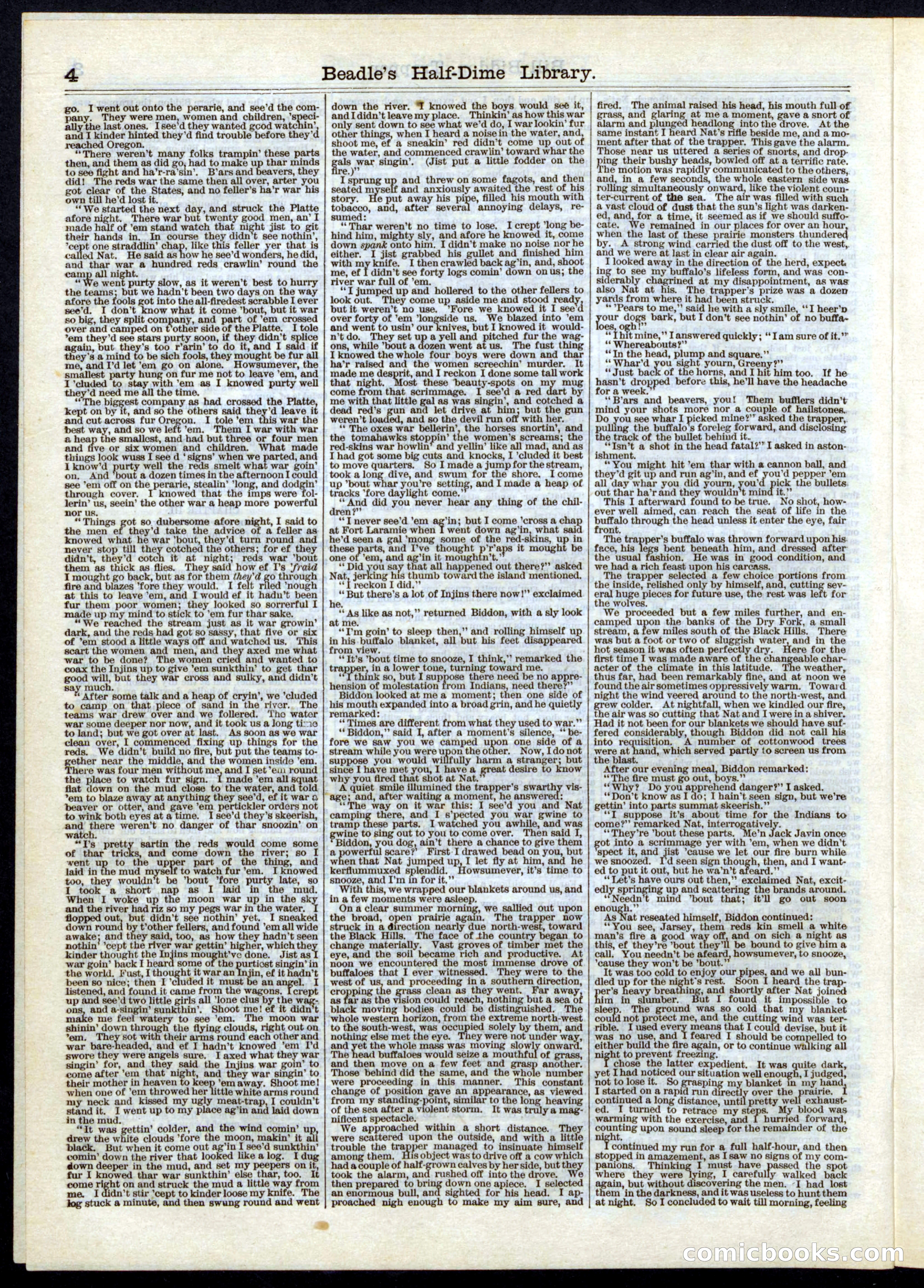
A restored page from Pulp Fiction, 1877. Page through the whole issue in the reader above.
📄 Transcribed text from this page (OCR, searchable)
Machine-transcribed from the original scan — historical spelling and the odd misread are preserved.
e - —--——-— —- go. I went out onto the perarie, and see’d the com- pany. They were men, women and children, : i- ally the last ones. Isee’d they wanted gcod watchin and I kinder hinted they'd find trouble before they'd reached Oregon. “There weren't many folks trampin’ these parts then, and them as did go, had to make up thar minds to see fight and ha’r-ra’sin’. B’ars and vers, they did! The reds war the same then all over, arter you got clear of the States, and no feller’s ha’r war his own till he’d lost it. “We started the next day, and struck the Platte afore night. There war but twenty good men, an’ I made half of ’em stand watch that night jist to git their hands in. Im course they didn’t see nothin’, *cept one straddlin’ 4° like this feller yer that is call ed Nat. He said as how he see’d wonders, he did, and thar war a hundred reds crawlin’ round the camp all night. “We went purty slow, as it weren’t best to hurry the teams; but we hadn't been two days on the way afore the fools got into the all-firedest scrabble I ever see’d. I don’t know what it come ‘bout, but it war so big, they split company, and part of ‘em crossed over and camped on t’other side of the Platte. I tole *em they’d see stars purty soon, if they didn’t splice again, but they’s too r’arin’ to do it, and I said if they’s a mind to be sich fools, they mought be fur all me, and I’d let ’em go on alone. Howsumever, the smallest party hung on fur me not to leave ‘em, and I ‘cluded to stay with 'em as I knowed purty well a need me all the time. “The biggest company as had crossed the Platte, — on by it, and so the others said they’d leave it and cut across fur Oregon. I tole ’em this war the best way, and so we left 'em. Them I war with war a <r ° the smallest, and had but three or four men and five or six women and children. What made things look wuss I see d ‘sign rted, and I know’d purty well the reds smelt what war goin’ on. And ‘bout a dozen times in the afternoon I could see *em off on the perarie, stealin’ ‘long, and cam acd through cover. I knowed that the imps were fol- lerin’ us, seein’ the other war a heap more powerful nor us. “Things got so dubersome afore night, I said to the men ef they’d take the advice of a feller as knowed what he war ‘bout, they’d turn round and never stop till arial cotched the others; for ef they didn’t, they’d cotch it at night; S war ‘bout them as thick as flies. They said how ef I’s '/raid I mought go back, but as for them they Ase through fire and blazes ‘fore they would. I felt riled ’nough at this to leave em, and I would ef it hadu’t been fur them poor women; they looked so sorrerful I made up my mind to stick to em fur thar sake. “We reached the stream just as it war growin’ dark, and the reds had got so sassy, that five or six of *em stood a little ways off and watched us, This scart the women and men, and they axed me what war to be done? The women cried and wanted to coax the Injins up to give ’em sunkthin’ to get thar good ee but they war cross and sulky, and didn’t say much. ‘After some talk and a heap of cryin’, we ’cluded to camp on that piece of sand in the river.. The teams war drew over and we follered. Tho water war some deeper nor now, and it took us a Jong time to land; but we got over at last. As soon as we war clean over, I commenced fixing up things for the reds. We didn’t build no fire, but put the teams to- ether near the middle, and the women inside ’em. There was four men without me, and I set ein round the place to watch fur sign. 1 made em all squat flat down on the mud close to the water, and told *em to blaze away at anything they see’d, ef it war a | beaver or otter, and gave ’em pertickler orders not to wink both eyes ata time. I see’d they’s skeerish, and there weren't no danger of thar snoozin’ on w sartin the reds would come some : s and come what - river; so ; wen to the upper part o e thing, an laid in the mud m to watch fur’em. I knowed too, they wouldn’t be "bout ‘fore purty late, so I took a short nap as laid in the mud. When I woke up the moon war up in the sk and the river had riz so my pegs war in the water. flopped out, but didn’t see nothin’ yet. I sneaked down roun re t’other fellers, and found ’em all wide awake; and they said, too, as how they hadn't seen nothin’ cept the river war gettin’ higher, which the kinder thought the Injins mought’ve done. Jist as war goin’ back I h some of the purtiost singin’ in the world. Fust, I thought it war an , ef it hadn’t been so nice; then I ’cluded it must be an eS listened, and found it came from the wagons. [crept up and see’d two little girls all ‘lone clus by the wag- ons, and a-singin’ sunkthin’, Shoot me! ef it didn’t me feel watery to see ‘em. The moon war shinin’ down through the flying clouds, right out on ’em. They sot with their arms round each other and war bare-headed, and ef I hadn’t knowed ‘em I'd swore they were angels sure, I axed what a war singin’ for, and they said the Injins war goin’ to come after ’em that t, and they war singin’ to their mother in heaven to keep 'em away. Shoot me! when one of ’em throwed her little white arms round my neck and kissed my ugly meat-trap, I couldn't stand it. I went up to my place ag’in and laid down in the mud. “Tt was gettin’ colder, and the wind comin’ UP, drew the white clouds ‘fore the moon, makin’ it black. But when it come out ag’in I see’d sunkthin’ comin’ down the river that looked like a log. I dug down deeper in the mud, and set my peepers on it, fur I knowed thar war sunkthin’ else thar, too, It come right on and struck the mud a little way from me. I didn’t stir ‘cept to kinder loose my e. The log stuck a minute, and then swung round and went “Ts prett of thar tri Beadle’s Half-Dime Library. down the river. & knowed the boys would see it, and I didn’t leave my place. n’ as how this war only sent down to see what we'd do, I war lookin’ fur other things, when I heard a noise in the water, and shoot me, ef a sneakin’ red didn’t come up out o the water, and commenced crawiin’ toward whar the gals war singin’, (Jist put a little fodder on the as I up and threw on some fagots, and then seated myself and anxiously awaited the rest of 1 story. He put away his pipe, filled his mouth with perce and, after several annoying delays, re- sumed: “Thar weren’t no time to lose. I crept ‘long be- hind him, mighty sly, and afore he knowed it, come down spank onto him. I didn’t make no noise nor he either. I jist grabbed his gullet and finished him with my knife. I then crawled back ag’in, and, shoot me, ef I didn’t see forty logs comin’ down on us; the river war full of ’em. ‘*T jumped up and hollered to the other fellers to look out. They come up aside me and stood ready but it weren’t no use. ‘Fore we knowed it I seed over forty of ’em ‘lo de us. We blazed into ’em and went to usin’ our knives, but I knowed it would- n'tdo. They set up a yell and piteoes fur the wag- ons, while "bout a dozen went atus. The fust thing I knowed the whole four boys were down and thar ha’r raised and the women screechin’ murder. It made me desprit, and I reckon I done some tall work ost these ‘beauty-spots on my mug come from that scrimmage. I see’d a red by me with that little gal as was singin’, and cotched a dead red’s gun and let drive at him; but the gun weren’t beaded: and so the devil run off with her. ‘* The oxes war bellerin’, the horses snortin’, and the tomahawks stoppin’ the women’s screams; the red-skins war howlin’ and yellin’ like all mad, and as I had got some big cuts and knocks, I ‘cluded it best to move quarters. So I made a jump for the stream, took a long dive, and swum for the shore. I come up *bout whar you’re setting, and I made a heap of tracks ‘fore daylight come.’ ded ae did you never hear any thing of the chil- n 9 ‘“*T never see’d 'em agin; but I come ‘cross a — at Fort Laramie when I went down ag’in, what sai he'd seen a gal ‘mong some of the red-skins, § in these i got and I’ve thought sh Hy it mought be one of ‘em, and ag’in it moughtn’t.’ ‘* Did you say that all happened out there?’’ asked Nat, jerking his thumb toward the island mentioned, ‘**T reckon I did.”’ “But there’s a lot of Injins there now!’’ exclaimed he. *‘ As like as not,” returned Biddon, with a sly look at me. ‘I’m goin’ to sleep then,” and rolling himself u in his.buffalo blanket, all but his feet disap from view. ‘“* It’s "bout time to snooze, I think,’ remarked the trapper, in a lower tone, turning toward me. Hy think so, but I sup there need be no appre- hension of molestation from Indians, need there?”’ Biddon looked at me a moment; then one side of his mouth expanded into a broad grin, and he quietly remarked: “Times are different from what they used to war.” ‘* Biddon,”’ said I, after a moment's silence, “* be- fore we saw you we camped upon one side of a stream while you were upon the other. Now, Ido not suppose you would willfully harm a rorya ah but since I have met you, I have a great desire to know why you fired that shot at Nat.’ A quiet smile illumined the trapper’s swarthy vis- age; and, after waiting a moment, he answered: “The way on it war this: I see’d you and Nat oars. there, and I s’pected you war gwine to tramp these parts. I watched you awhile, and was gwine to sing out to you to come over. Then said I, Biddon, you dog, ain’t there a chance to give them a powerful scare?’ First I drawed bead on you, but when that Nat jumped up, I let fly at him, and he kerflummuxed splendid. Howsumever, it’s time to snooze, and I’m in for it,”’ With this, we wrapped our blankets around us, and in a few moments were asleep. On a clear summer = nigh, 2 we sallied out upon the broad, open prairie again. The trapper now struck in a direction nearly due north-w toward the Black Hills. The face of the country began to change materially, Vast groves of timber met the eye, and the soil became rich and productive. At noon we encountered the most immense drove of buffaloes that I ever witnessed. They were to the west of and proceeding in a southern direction, cropping the clean as they went. Far away as far as the vision could reach, nothing but a sea of black moving bodies could be disti hed. The whole western horizon, from the extreme north-west to the south-west, was occupied solely by them, and nothing else met the eye. ey were not under way, and yet the whole mass was moving slow cnwart The head buffaloes would seize a mout of grass, and then move on a few feet and another. Those behind did the same, and the whole number were eho yen in this manner. This constant change of position gave an appearance, as viewed from my standing-point, similar to the long heaving of the sea after a violent storm. It was truly a mag- nificent spectacle. We appeenet within a short distance. The were scattered upon the outside, and with a little trouble the 49 managed to insinuate himself among them. His object was to drive off a cow which had a couple of half-grown calves by her side, but the took the alarm, and rushed off into the drove. e then prepared to b down one apiece. I selected an enormous bull, and sighted for his head. I ap- proached nigh enough to make my aim sure, and A fired. The animal raised his head, his mouth full of grass, and glaring at me a moment, gave a snort of alarm and plunged headlong intothe drove. At the same instant I heard Nat’s beside me, and a mo- ment after that of the trapper. This gave the alarm. Those near us uttered a series of snorts, and drop- ping their bushy heads, bowled off at a terrific rate. ‘he motion was rapidly communicated to the others, and, in a few seconds, the whole eastern side was rolling simultaneously onward, like the violent coun- ter-current of the sea. The air was filled with such a vast cloud of dust that the sun’s light was darken- ed, and, for a time, it seemed as if we should suffo- cate. We remained in our places for over an hour when the last of these prairie monsters thunde by. A strong wind carried the dust off to the west,. and we were at last in clear air again. _ L looked away in the direction of the herd, expect, ing to see my buffalo’s lifeless form, and was con- siderably chagrined at my disappointment, as was also Nat at his. The trapper’s prize was a dozen yards from where it had been struck. * Pears to me,’’ said he with a sly smile, ‘‘I heer’p our oe bark, but I don’t see nothin’ of no buffa~ oes on “Thit mine,” I answered quickly; “Iam sure of it.’” ** Whereabouts?” “In the head, plump and square.”’ ‘“Whar’d you sight yourn, Greeny?” ** Just back of the horns, and I hit him too. If he hasn't dropped before this, he’ll have the headache for a week. ‘‘B’ars and beavers, you! Them bufflers didn’t mind your shots more nor a couple of hailstones. Do you see whar I picked mine?’’ asked the trapper,. Pp the buffalo’s foreleg forward, and disclosing the track of the bullet behind it- “*Isn’t a shot in the head fatal?” I asked in aston- ishment. “You might hit ’em thar with a cannon ball, and they’d git up and run ag’in, and ef you’d pepper ’em all day whar you did yourn, you'd pick the bullets. out thar ha’r and they wouldn’t mind it.”’ This I afterward found to be true. No shot, how- ever well aimed, can reach the seat of life in the ey through the head unless it enter the eye, fair ront. The ag nal buffalo was thrown forward upon his. face, his ¥ bent beneath him, and d after the usual fashion. He was in good condition, and we had a rich feast upon his carcass. The trapper selected a few choice portions from the inside, relished only by himself, and, cutting sev- eral huge pieces for future use, the rest was left for the wolves. We proceeded but a few miles further, and en- camped upon the banks of the Dry Fork, a small stream, a few miles south of the Black Hills. There was but a foot or two of sluggish water, and in the hot season it was often perfectly dry. Here for the first time I was made aware of the changeable char- acter of the climate in this latitude. e weather, thus far, had been remarkably fine, and at noon we found the air sometimes oppressively warm. Toward night the wind veered around to the north-west, and w colder. At nightfall, when we kindled our fire, he air was so cutting that Nat and I were in a shiver. Had it not been for our blankets we should have suf- fered considerably, though Biddon did not call his into uisition. A number of cottonwood trees Nee! head Me d, which served partly to screen us from - | After our evening meal, Biddon remarked: “The fire must go out, boys.” “Why? Do you ‘ear danger?”’ I asked. **Don’t know as I do; I hain’t seen sign, but we’re gettin’ into parts summat skeerish.”’ “*T suppose it’s about time for the Indians to come?’ remarked Nat, int atively. **They’re "bout these parts. Me’n Jack Javin once got into a scrimmage yer with ’em, when we didn't spect it, and jist ‘cause we let our fire burn while we snoozed. I'd seen sign though, then, and I want- ed to put it out, but he wa’n’t afeard.”’ itt Let’s have ours ty er yg ne aks pes springing up and sea ng the brands around. Of Needn't mind "bout that; it'll go out soon enough.” As Nat reseated himself, Biddon continued: ‘You see, Jarsey, them reds kin smell a white man’s fire a good way off, and on sich a “— as this, ef they’re "bout t ey'll be bound to give him a call, You needn’t be afeard, howsumever, to snooze, ‘cause they won't be "bout.’ It was too cold to enjoy our pipes, and we all bun- dled up for the night’s rest. Soon I heard the trap- r’s heavy brea ing, and shortly after Nat joined m in slumber. ut I found it impossible to sleep. The und was so cold that my blanket could not protect me, and the cooing. wind was ter- rible. I used nae | means that I could devise, but it was no use, and I feared I should be compelled to either build the fire again, or to continue walking all nignt to prevent freezing. chose the latter expedient. It was quite dark, yet [had noticed our situation well ee , judged, not to lose it. So grasping my blanket in my hand I on a rapid run direct over the prairie. 1 continued a long distance, until pretty well exhaust- ed. I turned to retrace my ste My blood was warming with the exercise, and I bh ed forward, rg upon sound sleep for the remainder of the continued my run for a full half-hour, and then stopped in amazement, as Isaw no signs of my com- panions, en I must have the spot where they were g, I carefully walked back again, but without overing the men. -I had lost them in the darkness, and it was useless to hunt them at night. So I concluded to wait till morning, feeling Gomicbooks (S