
Pulp Fiction, 1877 · page 3 of 16
Beadle's Half Dime Library, No. 6 — page 3: what you’re looking at
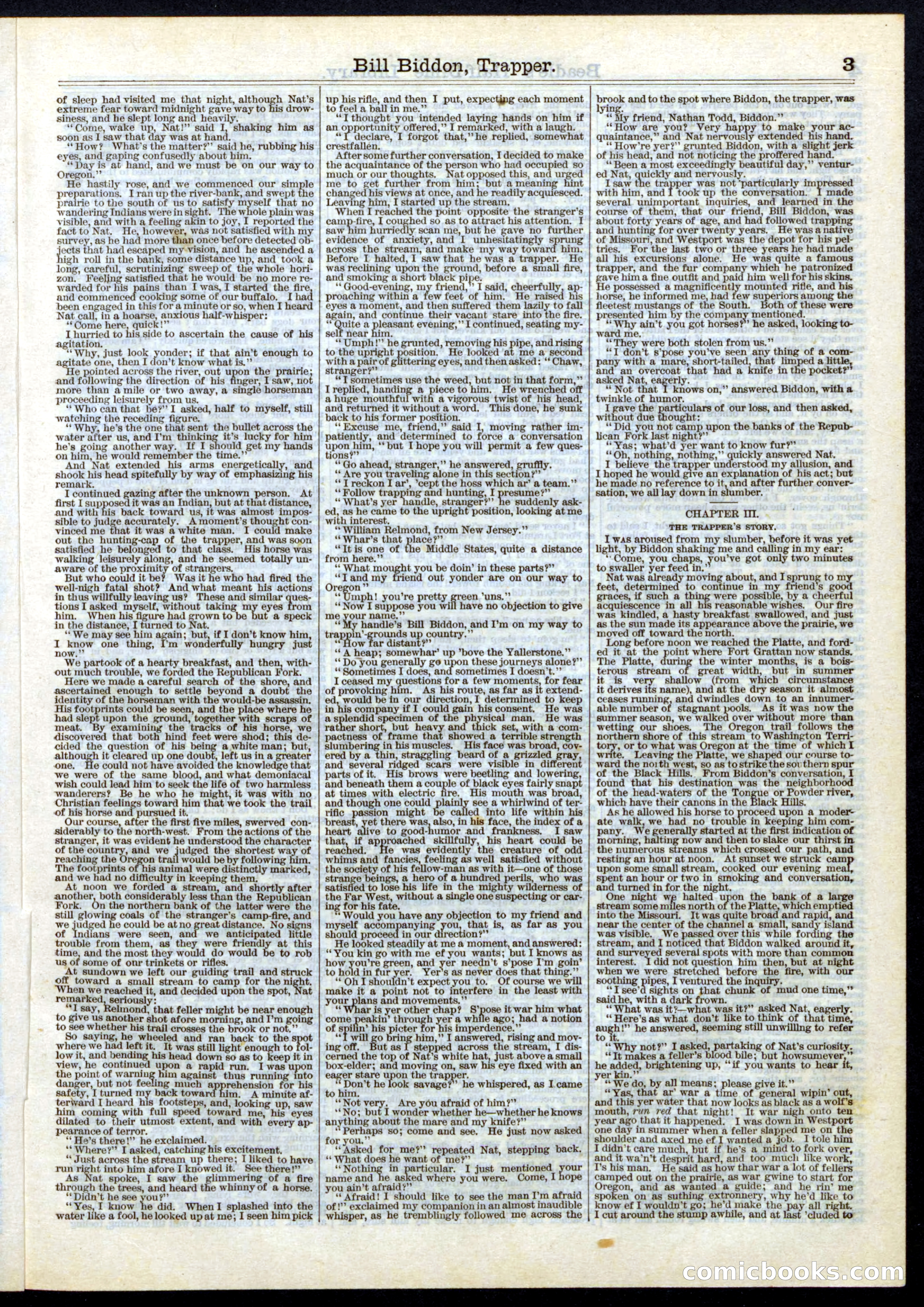
A restored page from Pulp Fiction, 1877. Page through the whole issue in the reader above.
📄 Transcribed text from this page (OCR, searchable)
Machine-transcribed from the original scan — historical spelling and the odd misread are preserved.
EO ——— a —— of sleep had visited me that night, although Nat’s extreme fear toward midnight gave way to his drow- siness, and he slept long and heavily. ‘*Come, wake up, Nat!’’ said I, shaking him as soon as I saw that day was at hand. ‘*How? What's the matter?” said he, rubbing his eyes, and gaping confusedly about him. “Day is at hand, and we must be on our way to Oregon.,”’ He hastily rose, and we commenced our simple preparations. Iran up the river-bank, and swept the prairie to the south of us to satisfy hee that no wandering Indians were in sight. The whole plain was visible, and with a feeling akin to joy, I reported the fact to Nat. He, however, was not satisfied with my survey, as he had more than once before detected ob- co that had escaped my vision, and he ascended a 1igh roll in the bank, some distance up, and took a long, careful, scrutinizing sweep of the whole hori- zon, Feeling satisfied that he would be no more re- warded for his pains than I was,I started the fire and commenced cooking some of our buffalo. I had been engaged in this for a minute or so, when I heard Nat call, in a hoarse, anxious half-whisper: ‘*Come here, quick!” I hurried to his side to ascertain the cause of his agitation. ‘“Why, just look ponders if that ain’t enough to agitate one, then I don’t know what is.”’ Ie pointed across the river, out upon the prairie; and following the direction of his finger, I saw, not more than a mile or two away, a single horseman proceeding leisurely from us. “Who can that be?’ I asked, half to myself, still watching the receding figure. ‘Why, he’s the one that sent the bullet across the water after us, and I’m thinking it’s lucky for him he’s going another way. If I should get my hands on him, he would remember the time.”” And Nat extended his arms energetically, and shook oe head spitefully by way of emphasizing his remark. I continued ng after the unknown person. At first I sonpos it was an Indian, but at that distance, and with his back toward us, it was almost impos- sible to judge accurately. A moment’s thought con- vinced me that it was a white man. I could make out the hunting-cap of the trapper, and was soon satisfied he belonged to that class. His horse was walking leisurely along, and he seemed totally un- aware of the proximity of strangers. But who could it be? Was it he who had fired the well-nigh fatal shot? And what meant his actions in thus willfully leaving us? These and similar ques- tions I asked myself, without taking my eyes from him. When his figure had grown to be but a speck in the distance, I turned to Nat. ‘* We may see him again; but, if I don’t know him, I know one thing, I'm wonderfully hungry just now.” We partook of a hearty breakfast, and age with- out much trouble, we forded the Republican Fork. Here we made a careful search of the shore, and ascertained enough to settle beyond a doubt the identity of the horseman with the would-be assassin. His footprints could be seen, and the place where he had slept upon the ground, together with scraps of meat. By examining the tracks of his horse, we discovered that both hind feet were shod; this de- cided the question of his a a white man; but, yom ite it cleared up one doubt, left us in a greater one. He could not have avoided the knowledge that we were of the same blood, and what demoniacal wish could lead him to seek the life of two harmless wanderers? Be he who he might, it was with no Christian feelings toward him that we took the trail of his horse and pursued it. Our course, after the first five miles, swerved con- siderably to the north-west. From the actions of the stranger, it was evident he understood the character of the country, and we judged the shortest way of reaching the Oregon trail would be by following The footprints o and we had no difficulty in keeping them. At noon we forded a stream, and shortly after another, both considerably less than the Republican Fork. On the northern bank of the latter were the still glowing coals of the stranger's camp-fire, and we judged he could be at no prone distance. No ens of Indians were seen, and we anticipated little trouble from them, as they were friendly at this time, and the most they would do would to rob us of some of onr trinkets or rifles. At sundown we left our guiding trail and struck off toward a small stream to camp for the night, ‘When we reached it, and decided upon the spot, remarked seriously: ‘I say, Relmond, that feller might be near enough to give us another shot afore morning, and I’m going to see whether his trail crosses the brook or not.” So saying, he wheeled and ran k to the spot where we had left it. It was still light enough to fol- low it, and bending his head down so as to keep it in view, he continued upon a rapid run. I was upon the point of Mg ae, * oe against thus running Fito danger, but not feeling much apprehension for his safety, I turned my back towa m. A minute af- terward I heard his footsteps, and, looking up, saw him coming with full toward me, his eyes dilated to their utmost extent, and with every ap- pearance of terror. ; ‘* He’s there!’’ he exclaimed. ‘* Where?” I asked, catching his excitement. ‘“* Just across the stream up there; I liked to have run right into him afore I knowed it. See there!” As Nat spoke, I saw the glimmering of a fire through the trees, and heard the whinny of a horse. ‘*Didn’t he see you?” ‘**Yes, I know he did. WhenI splashed into the water like a fool, he looked up at me; I seen him pick at animal were distinctly marked, - Trapper. Bill Biddon, up his rifle, and then I put, expecting each moment to feel a ball in me.” “T thought you intended laying hands on him if an 2 Ae offered,” I remarked, with a laugh. “TI declare, I forgot that,’ he replied, somewhat crestfallen. After some further conversation, I decided to make the acquaintance of the person who had occupied so much or our thoughts. Nat opposed this, and urged me to get further from him; but a meaning hint ein his views at once, and he readily acquiesced. Leaving him, I started up the stream, When I reached the point opposite the stranger's camp-fire, I coughed so as to attract his attention. I saw him hurriedly scan me, but he gave no further evidence of anxiety, and I unhesitatingly sprung across the stream, and make my way toward him. Before I halted, 1 saw that he was a trapper. He was reclining upon the ground, before a small fire, and smoking a short black pipe. ‘* Good-evening, my friend,’’ I said, cheerfully, ap- proaching within a few feet of him. He rai his eyes a moment, and then suffered them lazily to fall again, and continue their vacant stare into the fire. eure a pies evening,”’ I continued, seating my- self near him. ‘*Umph!”’ he grunted, removing his pipe, and ri to the upright position. He looked at me a secon with a pair of glittering eyes, and then asked: “* Ww, stranger?” “T sometimes use the weed, but not in that form,” I replied, weeny a ee to him, He wrenched off a huge mouthful with a vigorous twist of his head, and returned it without a word, This done, he sunk back to his former position. ‘*Excuse me, friend,”’ said I, moving rather im- patiently, and determined to force a conversation ar **but [hope you will permit a few ques- ons?’ “Go ahead, stranger,’’ he answered, gruffly. ** Are you traveling alone in this section?”’ ‘**T reckon I ar’, ’cept the hoss which ar’ a team.”’ “Follow trapping and hun , | presume?” “What's yer handle, stranger?’ he suddenly ask- ed, as he came to the upright position, looking at me with interest. “William Relmond, from New Jersey.” ‘*Whar’s that place?” “It is one of the Middle States, quite a distance from here.”’ * What mougnt you be doin’ in these parts?”’ “Tand my friend out yonder are on our way to Oregon” ‘*Umph! you're pretty green ‘uns.”’ ‘*Now I suppose you will have no objection to give me your name,”’ < handle’s Bill Biddon, and I’m on my way to trappin’-grounds up country,”’ ‘*“How far distant?” ‘* A heap; somewhar’ up "bove the Yallerstone.”’ ‘Do you generally go eee these journeys alone?”’ ** Sometimes I does, and sometimes I doesn’t.’’ I ceased my questions for a few moments, for fear of provoking h As his route, as far as it extend- would be in our direction, 1 determined to keep in his company if I could gain his consent. He was a veep specimen of the de cal man. He was rather short, but heavy an ck set, with a com- pactness of frame that showed a terrible st ered by @ thin, straggling ‘beard of e grissiol Kray, e a thin, n of a y and several ridged rae were visible in different parts of it. His brows were beetling and lowering, and beneath them a couple of black eyes fairly snapt at times with electric fire. His mouth was broad, and though one could a see a whirlwind of ter- rific on might ed into life within his breast, yet there was, also, in his face, the index of a heart alive to good-humor and frankness. I saw that, if approached skillfully, his heart could be reached. e was evidently the creature of odd whims and fancies, feeling as well satisfied without the society of his fellow-man as with it—one of those strange beings, a hero of a hundred perils, who was satisfied to lose his life in the mighty wilderness of the Far West, without a single one suspecting or car- ing for his fate. F *Would you ound any ge py hg may ope and myself accompanying you, that is, as far as you should proceed in our direction?” . He looked steadily at me a moment, and answered: “You kin go with me ef you wants; but I knows as how you're green, and yer needn't s° I'm goin’ to hold in fur yer. Yer’s as never does that thing.” ““ Oh I shouldn’t expect you to. Of course we will make it a point not to interfere in the least with your plans and movements.” 7 is yer other chap? ot ge it war him what come Fay cra through yer a while ago; had a notion of * his picter for his imperdence.”’ “*T will go bring him,"’ I answered, rising and mov- ing off. But as I stepped across the stream, I dis- cerned the top of Nat’s white hat, just above a small box-elder; and moving on, saw his eye fixed with an er stare upon the trapper. Don’t he look savage?’’ he whispered, as I came him. ‘* Not ve Are you afraid of him?” ‘*No; but I wonder whether he—whether he knows anything about the mare and my knife?” . “Perhaps so; come and see, He just now asked or you,” ‘“Asked for me?” repeated Nat, stepping back. ‘* What does he want of me?” ** Not in particular. I just mentioned your name and he asked where you were. Come, I hope you ain’t afraid?” “ Afraid! I should like to see the man I’m afraid of !’’ exclaimed my companion in an almost inaudible whisper, as he tremblingly followed me across the 3 ~ prook and to the spot where Biddon, the trapper, was ying. ns iy friend, Nathan Todd, Biddon.”’ ‘How are you? Very happy to make your ac- quaintance,” and Nat nervously extended his hand. ‘“* How’re yer?” grunted Biddon, with a slight jerk of his head, and not noticing the proffered hand. “Been a most exceedingly beautiful day,’’ ventur- ed Nat, quickly and nervously. I saw the trapper was not ‘particularly iB iors with him, and I took up the conversation. made several unimportant inquiries, and learned in the course of them, that our friend, Bill Biddon, was about forty years of age, and had followed trapping and hunting for over twenty years. He was a native of Missouri, and Westport was the depot for his pel- tries. For the last two or three years he had made all his excursions alone. He was quite a famous trapper, and the fur company which he patronized gave hima fine outfit and paid him well for his skins, He possessed a magnificently mounted rifle, and his horse, he informed me, had few superiors among the fleetest mustangs of the South. th of these were presented him by the company mentioned. ‘Why ain’t you got horses?” he asked, looking to- ward me, ““They were both stolen from us.”’ “TI don’t s*pose you've seen any thing of a com- pany with a mare, short-tailed, that lim a little, and an overcoat that had a knife in the pocket? asked Nat, erly. “Not that I knows on,”’ answered Biddon, with a twinkle of humor. I gave the culars of our loss, and then asked, without due thought: “Did you not camp upon the banks of the Repub- lican Fork last night?” “Yas; what'd yer want to know fur?” “Oh, nothing, nothing,”’ Semi answered Nat. I believe the trapper understood my allusion, and I hoped he would give an explanation of his act; but he made no reference to it, and after further conver- sation, we all lay down in slumber. CHAPTER II. . THE TRAPPER’S STORY. I was aroused from my slumber, before it was yet light, by Biddon shaking me and calling in my ear: ‘Come, you chaps, you've got only two minutes to swaller yer feed in.’ Nat was already moving about, and I sprung to my feet, determined to continue in my friend's g if such a thing were possible, by a cheerful acquiescence in all his reasonable wishes. Our fire was kindled, a hasty breakfast swallowed, and just as the sun made its appearance above the prairie, we moved off toward the north. Long before noon we reached the Platte, and ford- ed it at the point where Fort Grattan now stands. The Platte, during the winter months, is a bois- terous stream of great width, but in summer it is ve shallow (from which circumstance it derives its name), and at the dry season it almost ceases running, and dwindles down to an innumer- able number of stagnant ls. As it was now the summer season, we walked over without more than wetting our shoes. The Oregon trail follows the northern shore of this stream to Washington Terri- tory, or to what was Oregon at the time of whichI write. Leaving the Platte, we shaped our course to- ward the noith west, so as tostrike the southern spur of the Black Hills. From Biddon’s conversation, I found that his destination was the neighborhood of the head-waters of the Tongue or Powder river, which have their canons in the Black Hills. As he allowed his horse to proceed upon a moder ate walk, we had no trouble in keeping him com- pany. We generally started at the first indication of morning, halting now and then to slake our thirst in the numerous streams which crossed our path, and resting an hour at noon. At sunset we struck cam upon some small stream, cooked our evening m spent an hour or two in smo and conversation, and turned in for the night. One night WF halted upon the bank of a large stream some miles north of the Platte, which emptied into the Missouri. It was quite broad and rapid, and near the center of the channel a small, sandy island was visible. We over this while fording the stream, and I noticed that Biddon walked around it, and verry several spots with more than common interest. I did not question him then, but at night when we zee seid 9 jam the fire, with soothing pipes, I venture e uiry. rf bee’ sights on that chunk of mud one time,” said he, with a dark frown. “What was it?—what was it?”’ asked Nat, eagerly. “Here's as what don't like to think of that time, my ag he answered, seeming still unwilllng to refer © it. “Why not?” I asked, cin ow pag of Nat's curiosity. “Tt makes a feller’s blood bile; but howsumever,” he 5° Ki brightening up, “if you wants to hear er kin.”’ we We do, by all means; please give it.” “Yas, that ar’ war a time of general wipin’ out, our and this yer water that now looks as black as a wolf's mouth, run red that night! It war nigh onto ten_ year ago that it happened. I was down in Westport one day in summer when a feller slapped me on the shoulder and axed me ef I wanted a job. I tole him I didn’t care much, but if he’s a mind to fork over, and it wa'n't desprit hard, and too much like work, I's hisman. He said as how thar war a lot of fellers camped out on the prairie, as war gwine to start for Oregon, and as wanted a guide; and he rin’ me spoken on as suthing extronnery, why he'd like to know ef I wouldn't go; he’d make the pay all right. I cut around the stump awhile, and at last ‘cluded to JOO cS €om (E 7 (E()