
Pulp Fiction, 1877 · page 15 of 16
Beadle's Half Dime Library, No. 6 — page 15: what you’re looking at
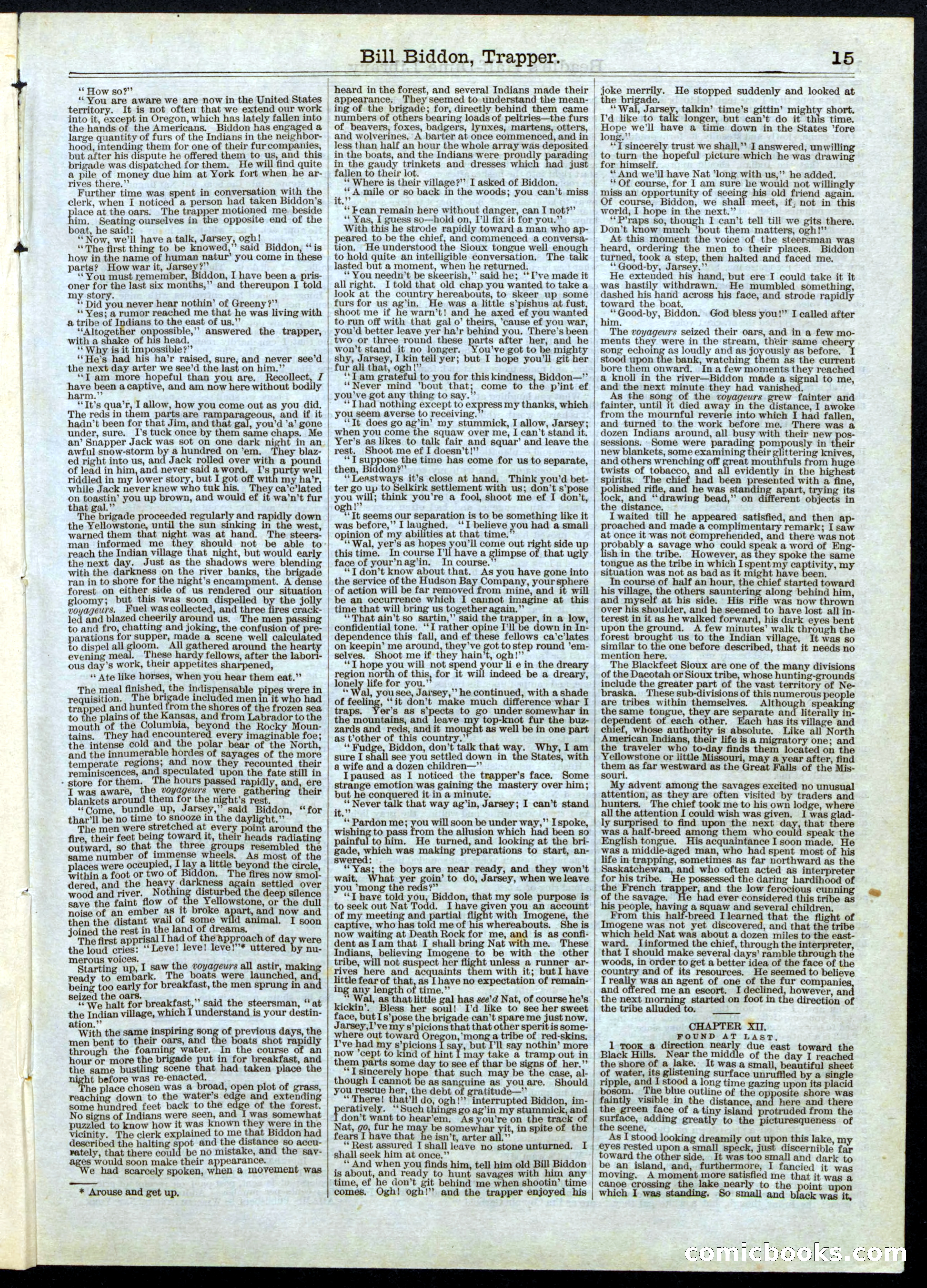
A restored page from Pulp Fiction, 1877. Page through the whole issue in the reader above.
📄 Transcribed text from this page (OCR, searchable)
Machine-transcribed from the original scan — historical spelling and the odd misread are preserved.
- store for them. ** How so?” “You are aware we are now in the United States territory. It is not often that we extend our work | into it, except in Oregon, which has lately fallen into | the hands of the Americans. Biddon has eng large quantity of furs of the Indians in the neighbor- hood, intending them for one of their fur companies, but after his dispute he offered them to us, and this brigade was dispatched for them. He will find quite a pile of money due him at York fort when he ar- rives there.”’ ‘ Further time was spent in conversation with the clerk, when I noticed a person had taken Biddon’s lace at the oars. The trapper motioned me. beside him. Seating ourselves in the opposite end of the boat, he said: “ Now, we'll have a talk, Jarsey, ogh! “The first thing to be knowed,” said Biddon, “is how in the name of human natur’ you come in these parts? How war it, Jarsey?”’ ‘‘ You must remember, Biddon, I have been a pris- oner for the last six months,’’ and thereupon I told my story. rer ‘Did you never hear nothin’ of Greeny?” ‘* Yes; a rumor reached me that he was living with a tribe of Indians to the east of us.”’ “Alto other onpossible,’’ answered the trapper, with a shake of his head, ‘* Why is it impossible?” ‘* He’s had his ha’r raised, sure, and never see’d the next day arter we see’d the last on him.”’ ‘‘I am more hopeful than you are, Recollect, 7 pie been a captive, and am now here without bodily arm.”’ ‘Tt’s qua’r, I allow, how you come out as you did. The reds in them parts are ramparageous, and if it hadn't been for that Jim, and that gal, you’d ‘a’ gone under, sure. I's tuck once by them same chaps. Me an’ Snapper Jack was sot on one dark night in an awful snow-storm by a hundred on’em. They blaz- ed right into us, and Jack rolled over with a pound of lead in him, and never said aword. I's P y well riddled in my lower story, but I got off with my ha’r while Jack never knew who tuk his. They ca’c’lat on toastin’ you up brown, and would ef it wa'n’t fur that gal.”’ The brigade proceeded regularly and rapidly down the Yellowstone, until the sun sinking in the west, warned them that ht was at hand. The steers- man informed me they should not be able to reach the Indian village that night, but would early the next day. Just as the shadows were blending with the darkness on the river banks, the brigade ran in to shore for the night’s encampment. A dense forest on either side of us rende our situation gloomy; but this was soon dispelled by the jolly voyageurs. Fuel was collected, and three fires crack- led and blazed cheerily around us. The men passing to and fro, chatting and joking, the confusion of pre- yarations for supper, made a scene well calculated o dispel all goon. All gathered around the heart evening meal, These hardy fellows, after the labori- ous day’s work, their appetites sharpened, ‘* Ate like horses, when you hear them eat.” The meal finished, the indispensable pipes were in requisition. The brigade included men in it who had trapped and hunted from the shores of the frozen sea to the plains of the Kansas, and from Labrador to the mouth of the Columbia, beyond the Rocky Moun- tains. They had encountered every imaginable foe; the intense cold and the polar bear of the North, and the innumerable hordes of sayages of the more temperate regions; and now they recounted their reminiscences, and speculated upon the fate still in The hours passed rapidly, and, ere I was aware, the voyageurs were gathering their blankets around them for the night's rest. “Come, bundle up, Jarsey,” said Biddon, “for thar’ll be no time to snooze in the daylight.” The men were stretched at every point around the fire, their feet being toward it, their heads radiating outward, so that the three groups resembled the same number of immense wheels. As most of the places were occupied, I lay a little beyond the circle, within a foot or two of Biddon. The fires now smol- dered, and the heavy darkness n settled over wood and river. Not distur the deep silence save the faint flow of the Yellowstone, or the dull noise of an ember 4s it broke a and now and then the distant wail of some d I soon joined the rest in the land of dreams. The first apprisal I had of the approach of day were the loud cries: ‘‘ Leve! leve! leve!’’* uttered by nu- ices. Starla : , 1 saw the voyageurs all astir, ready to embark. The boats were launched, an being too early for breakfast, the men sprung in an rs. Ore halt for breakfast,’’ said the steersman, “ at the Indian village, which I understand is your destin- ation.”’ ith the same inspiring so sper bal to their oars, and the boats shot rapidly through the foaming water. In the course of an hour or more the brigade put in for breakfast, and the same bustling scene that had taken place the at before was re-enacted. he place chosen was @ broad, open plot of grass, reaching down to the water's — and extending some hundred feet back to the ge of the forest. No signs of Indians were seen, and I was somewhat puzzled to know how it was known they were in the vicinity. The clerk explained to me that Biddon had described the halting spot and the nce so accu- rately, that there could be no mistake, and the sav- es would soon make their appearance. e had scarcely spoken, when @ movement was * Arouse and get up. of previous days, the eda Bill Biddon, Trapper. heard in the forest, and several Indians made their | appearance. ing of the pega for, directly behind them came numbers of others bearing loads of peltries—the furs of beavers, foxes, badgers, lynxes, martens, otters, and wolverines. A barter at once commenc in the gaudy trinkets and dresses which fallen to their lot. ‘* Where is their village?’’ I asked of Biddon. " ‘** A mile or so back in the woods; you can’t miss i th ‘*Fcan remain here without danger, can I not?’’ ‘** Yas, I guess so—hold on, I'll fix it for you.” With this he strode rapidly toward a man who ap- peared to be the chief, and commenced a conversa- tion. He understood the Sioux tongue well mange to hold quite an intelligible conversation, The lasted but a moment, when he returned. all right. I told that old chap you wanted to take a furs for us ag’in, e was a little s’pishus at fust shoot me if he warn’t! and he axed ef you want to run off with that gal o’ theirs, ‘cause ef you war, you'd better leave yer ha’r behind you. There's been two or three round these parts after her, and he won't stand it no longer. ou’ve got to be mighty shy, Jarsey, I kin tell yer; but I hope you'll git her fur all that, ogh!”’ ‘*T am grateful to you for this kindness, Biddon—”’ ‘Never mind *bout that; come to the pint ef you've got any thing to say.” ‘*Thad nothing except to express my thanks, which you seem averse to receiving.”’ ‘It does go ag’in’ my stummick, I allow, Jarsey; when you come the squaw over me, I can’t stand it. Yer’s as likes to talk fair and squar’ and leave the rest. Shoot me ef I doesn’t!” ig aappcee the time has come for us to separate, then, Biddon?”’ ‘*Leastways it’s close at hand. Think you'd bet- ter go up to Selkirk settlement with us; don’t s’ you will; think you're a fool, shoot me ef I don’t, ogh!”’ a It seems our separation is to be something like it was before,” I laughed. ‘‘I believe you had a small opinion of my abilities at that time.” ‘‘Wal, yer’s as hopes you'll come out yo as side up this time. In course I'll have a glimpse of that ugly face of your’nag’in. In course.” “T don’t know about that. As you have gone into the service of the Hudson Bay Company, your sphere of action will be far removed from mine, and it will be an occurrence which I cannot imagine at this time that will bring us together again.”’ ‘*That ain’t so sartin,’’ said the trapper, in a low, confidential tone. “I rather opine I'll be down in In- dependence this fall, and ef these fellows ca’c’lates on keepin’ me around, they've got to step round ’em- selves. Shoot me if ‘they ain’t, ogh!”’ region north of this, for it will indeed be a dreary, lonely life for you.’ ‘Wal, you see, Jarsey,”’ he continued, with a shade of comes “it don’t make much difference whar I traps. Yer’s as s’pects to go under somewhar in the mountains, and leave my top-knot fur the buz- zards and reds, and it moug t as well be in one part as t’other of this country.’ ‘*Fudge, Biddon, don’t talk that way. Why, I am surels see you settled down in the States, with a wife and a dozen children—”’ Ipaused as I noticed the trapper’s face. Some strange emotion was gaining the mastery over him; but he conquered it in a minute. of Never talk that way ag’in, Jarsey; I can’t stand ‘** Pardon me; you will soon be under way,’’ Ispoke, wishing to rom the allusion which had been so painful to him. He turned, and looking at the bri- real apes was making preparations to start, an- swered: “Yas; the boys are near ready, and they won't wait. What yer goin’ to do, Jarsey, when we leave you ’mong the reds?” ‘*T have told you, Biddon, that my sole purpose is pe seek out Nat ka sartial fi safe ae oa ae of my meeting an Ww ogene, the ies told me of ne whereabouts. She is nd is as confi- dent as Iam that I shall bring Nat with me. These Indians, believing Imogene to be with the other tribe, will not suspect her flight unless a runner ar- rives here and acquaints them with it; but I have little fear of that, as I have no expectation of remain- ing any length of time.” Wal, as that little gal has see’d Nat, of course he’s kickin’. Bless her soul! I'd like to see her sweet face, but Is’pose the brigade can’t spare me just now. arsey,l’ve my s’picions that that other sperit is some- where out toward Oregon,’mong a tribe of red-skins. I’ve had my s’ iiona f ry 5 but I'll say nothin’ more t to kind of hint | may take a tramp out in them arts some day to see ef thar be signs of her.”’ I sincerely hope that such may be the case, al- though I cannot be as sanguine as you are. Should you rescue her, the debt of gratitude—" ‘There! that'll do, ogh!’’ interrupted Biddon, im- ratively. “Such things go ag’in my stummick, and don't want to hear’em. As you're on the track of Nat, go, fur he may be somew r vit in spite of the fears I have that he isn’t, arter all.”’ ‘* Rest assured I shall leave no stone unturned. I shall seek him at once.” ‘And when you finds him, tell him old Bill Biddon is about, and ready to hunt savages with him any time, ef he don’t git behind me when shootin’ time gh! ogh!’’ and the trapper enjoyed his captive, who now waiting at Death Rock for me, now ‘ce comes, ‘“‘T hope you will not spend your li e in the dreary | They seemed to understand the mean- | , and in | _ Jess than half an hour the whole array was deposited in the boats, and the Indians were proudly pang | just —— NE a a ‘** You needn’t be skeerish,’’ said he; ‘* ’ve made it | was hastily withdrawn. look at the country hereabouts, to skeer up some | 15 joke merrily. He stopped suddenly and looked at the brigade. Wal, Jarsey, talkin’ time’s gittin’ mighty short. I'd like to talk longer, but can’t do it this time. roe we'll have a time down in the States ‘fore ong.”’ “I sincerely trust we shall,” I answered, unwilling to turn the hopeful picture which he was drawing for himself. “ And we'll have Nat ‘long with us,”’ he added. ‘Of course, for I am sure he would not willingly miss an opportunity of —— his old friend again. Of course, Biddon, we sh meet, if, not in this world, I hope in the next.” *P’raps so, though I can’t tell till we gits there. Don’t know much ‘bout them matters, ogh!"’ At this moment the voice of the steersman was heard, ordering the men to their places. Biddon turned, took a step, then halted and faced me. ‘**Good-by, Jarsey.”’ He extended his hand, but ere I could take it it ' He mumbled something, dashed his hand across his face, and strode ranidly toward the boat. Si Good-by, Biddon. God bless you!” I called after im. The voyageurs seized their oars, and in a few mo- ments they were in the stream, their same chee song echoing as loudly and as joyously as before. y stood upon the bank, watching them as the current bore them onward. Ina few moments they reached a knoll in the river—Biddon made a py to me, and the next minute they had vanished. As the song of the voyageurs grew fainter and fainter, until it died away in the distance, 1 awoke from the mournful reverie into which I had fallen, and turned to the work before me. There was a dozen Indians around, all busy with their new pos- sessions. Some were parading pompously in their new blankets, some examining their glittering knives, and others wrenching off great mouthfuls from huge twists of tobacco, and evidently in the highest spirits. The chief had been presented with a fine, lished rifle, and he was standing apart, trying its ock, and “drawing bead,” on different objects in the distance. I waited till he appeared satisfied, and then ap- proached and made a complimentary remark; I saw at once it was not comprehended, and there was not eg aap a savage who could speak a word of Eng- shin the tribe. However, as they spoke the same tongue as the tribe in which I spent my captivity, my situation was not as bad as it might have aon In course of half an hour, the chief started toward his village, the others sauntering along behind him, and myself at his side. His rifle was now thrown over his shoulder, and he seemed to have lost all in- terest in it as he walked forward, his dark eyes bent upon the ground. A few minutes’ walk through the forest brought us to the Indian village, It was so similar to the one before described, that it needs no mention here. The Blackfeet Sioux are one of the many divisions of the Dacotah or Sioux tribe, whose hunting-grounds include the greater part of the vast territory of Ne- braska, These sub-divisions of this numerous people are tribes within themselves. Although the same tongue, they are se te ant literally in- Copetent of each other. h has its village and chief, whose authority is absolute. Like all North American In their life is a migratory one; and the traveler who to-day finds them located on the Yellowstone or little Missouri, may a year after, find them as far westward as the Great Falls of the Mis- souri. My advent among the savages excited no unusual attention, as they are often visited by traders and hunters. The chief took me to his own lodge, where all the attention I could wish was given. I was giad- ly mes to find upon the next ny that there was a half-breed among them who could speak the English tongue. His acquaintance I soon made, He was a middle-aged man, who had spent most of his life in trapping, sometimes as far northward as the Saskatchewan, and who often acted as interpreter for his tribe. He possessed the daring hardihood of the French tra and the low ferocious cunning of the savage. He had ever considered this tribe as his people, having a squaw and several children. From this half-breed I learned that the flight of me 8 HY was not yet discovered, and that the tribe which held Nat was about a dozen miles to the east- ward. Linformed the chief, through the interpreter, that I should make several days’ ramble through the woods, in order to get a better idea of the face of the country and of its resources. He seemed to believe I really was an agent of one of the fur compani and offered me an escort. I declined, however, an the next morning started on foot in the direction of the tribe alludedto. CHAPTER XU. : Pe UND AT - AST, TOOK @ on near ue east toward the Black Hills. Near the middle of the day I reached the shore of a lake. It was a small, beautiful sheet of water, its glistening surface unruffled by a single ripple, and I stood a long time gazing upon its placid bosom. The blue outline of the op Pe. shore was faintly visible in the distance, and here and there the green face of a tiny island protruded from the marmace,: adeting greatly to the picturesqueness of As I stood looking dreamily out upon this lak eyes rested u <= oy i? te nasmall speck, j discernible far toward the other side. It was too small and dark to be an island, and, furthermore, I fancied it was moving. A moment more satisfied me that it was a canoe crossing the lake nearly to the point upon which I was standing. So small and black was tt, 900 com cS (E(@)