
Pulp Fiction, 1877 · page 14 of 16
Beadle's Half Dime Library, No. 6 — page 14: what you’re looking at
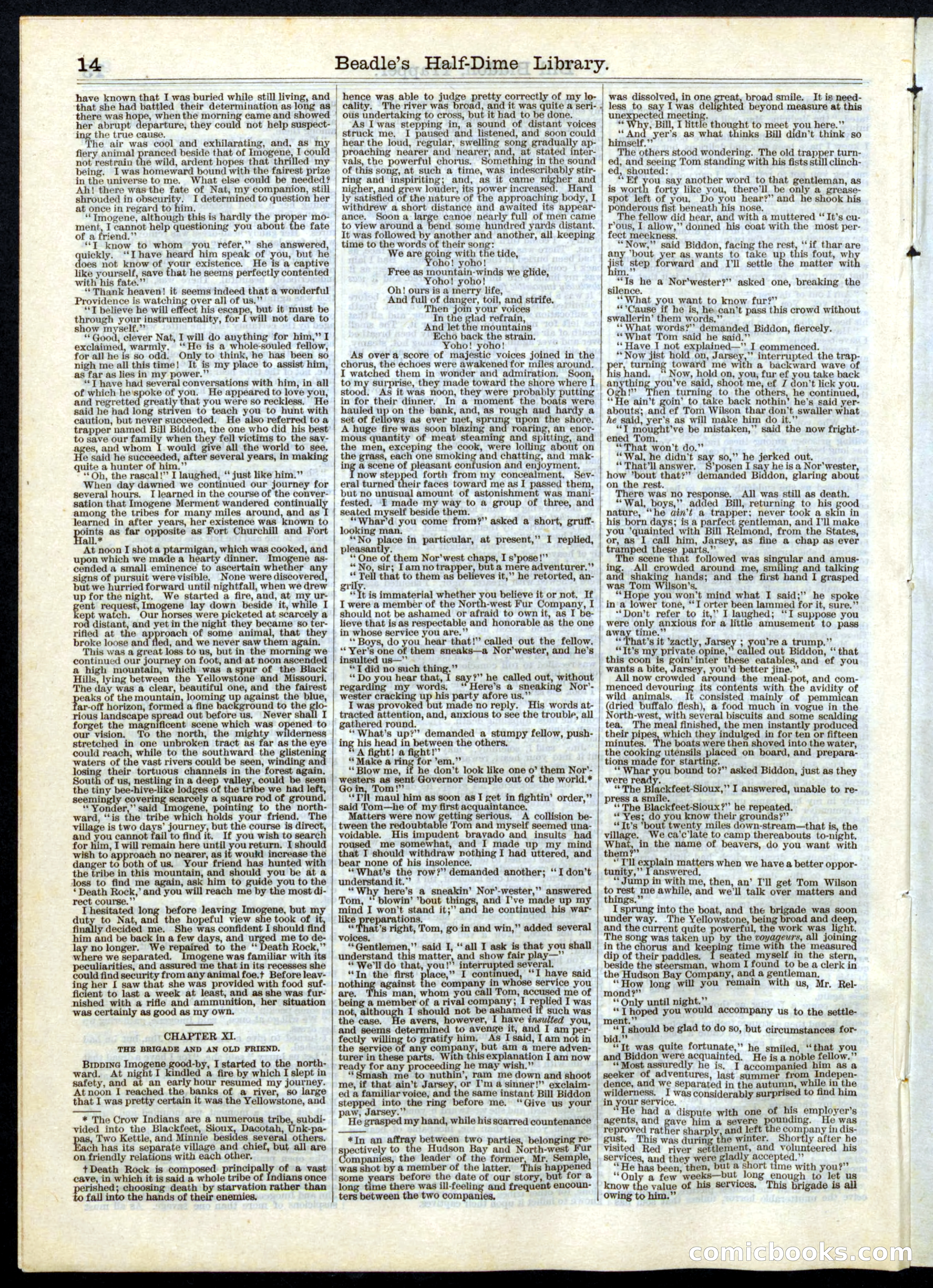
A restored page from Pulp Fiction, 1877. Page through the whole issue in the reader above.
📄 Transcribed text from this page (OCR, searchable)
Machine-transcribed from the original scan — historical spelling and the odd misread are preserved.
a Re have known that I was buried while still living, and | hence was able to judge pretty correctly of my lo- ‘that she had battled their determination as long as there was ho her abrupt departure, they could not help suspect- the true cause. ‘he air was cool and exhilarating, and, as my fiery animal pranced beside that of Imogene, I could | ; not restrain the wild, ardent hopes that thrilled my | being. Iwas homeward bound with the fairest prize | in the universe to me. What else could be needed? Ah! there was the fate of Nat, my companion, still | shrouded in verse 4 I determined to question her | im. at once in regard to ‘Imogene, although this is hardly the proper mo- ment, I cannot help questioning you about of a friend.” ‘*T know to whom you refer,” she answered, uickly. “‘I have heard him speak of you, but he does not know of your existence. He is a captive like yourself, save that he seems perfectly contented with his fate.”’ ‘Thank heaven! it seems indeed that a wonderful Providence is watching over all of us.” ‘*T believe he will effect his escape, but it must be through your instrumentality, for [ will not dare to show myself.” ‘** Good, clever Nat, I will do anything for him,” I exclaimed, warmly. ‘He is a whole-souled fellow, for all he is so odd. Only to think, he has been so nigh me all this time! It is my place to assist him, as far as lies in my power.” ‘“*T have had several conversations with him, in all of which he'spoke of you. He appeared to love you, and regretted greatly that you were so reckless. He said he had long striven to teach you to hunt with caution, but never succeeded. He also referred to a trapper named Bill Biddon, the one who did his best to save our — when they fell victims to the say- es, and whom I would give all the world to see, e said he succeeded, after several years, in making quite a hunter of him.” ‘*Oh, the rascal!’’ I laughed, ‘ just like him.” When day dawned we continued our journey for several hours. I learned in the course of the conver- sation that Imogene Merment wandered continuall - among the tribes for many miles around, and as learned in after years, her existence was known to rk as far opposite as Fort Churchill and Fort all. At noon I shota ptarmigan, which was cooked, and upon which we made a hearty dinner. Imogene as- cended a small eminence to ascertain whether an signs of pursuit were visible, None were discovered, but we hurried forward until nightfall, when we drew up for the night. We started a fire, and, at my ur- ent request, Imogene lay down beside it, while I > t watch. Our horses were —— at scarcely a rod distant, and yet in the nigh rified at the eee of some animal, that they broke loose and fled, and we never saw them : This was a great loss to us, but in the mo g we continued our journey on foot, and at noon ascended a high mountain, which was aspur of the Black Hills, lying between the Yellowstone and Missouri, The day was a clear, beautiful one, and the fairest aks of the mountain, looming up against the blue, ar-off horizon, formed a fine bac und to the glo- rious landscape spread out before us. Never shall I forget the m ficent scene which was opened to our vision. To the north, the mighty derness stretched in one unbroken tract as far as the eye could reach, while to the southward the gliste waters of the vast rivers could be seen, winding an losing their tortuous channels in the forest again. South of us, nestling in a deep valley, could be seen the tiny bee-hive-like lodges of the tribe we had left, seeming] gttetty nd a square rod of ground. ** Yonder,”’ said ne, pointing to the north- ward, “‘is the tribe which holds your friend. The village is two days’ journey, but the course is direct, and you cannot fail to find it. If you wish to search for him, I will remain here until you return. I should wish to approach no nearer, as it would increase the danger to both of us. Your friend has hunted with the tribe in this mountain, and should you be at a loss to find me again, ask him to guide you to the ‘Death Rock,’ and you will reach me by the most di- rect course.”’ I hesitated long before leaving may hy = but wd duty to Nat, and the hopeful view she took of i finally decided me. She was confident I should find him and be back in a few days, and om me to de- lay no longer. We re to the “* Death Rock,” where we separated. ogene was familiar with its peculiarities, and assured me that in its recesses she could find security from any animal foe,+ Before leav- ing her [ saw that she was provided with food suf- ficient to last a week at least, and as she was fur- nished with a rifle and ammunition, her situation was certainly as good as my Own. CHAPTER XI. THE BRIGADE AND AN OLD FRIEND. BIDDING Imogene -by, I started to the north- ward. At night Il dled a fire by which I slept in safety, and at an early hour resumed my journey. At noon I reached the banks of a river, so that I was pretty certain it was the Yellowstone, and * The Crow Indians are a numerous tribe, subdi- vided into the Blackfeet, Sioux, Dacotah, Unk-pa- Two Kettle, and Minnie besides several others. has its se te village and chief, but all are on friendly relations with each other, +Death Rock is composed principally of a vast cave, in which it is said a whole tribe of todinne once ; choosing death by starvation rather than fall into the hands of their enemies. ’ e fate | ring and inspiriting; and, as it came cality. The river was broad, and it was quite a seri- , when the morning came and showed | ous undertaking to cross, but it had to be done. As I was stepping in, a sound of distant voices struck me. I paused and listened, and soon could hear the loud, regular, swelling song gradually ap- proaching nearer and nearer, and, at stated inter- vals, the powerful chorus. Something in the sound of this song, at such a time, was indescribably stir- her and nigher, and grew louder, its power increased. Hard ly satisfied of the nature of the approaching body, I withdrew a short distance and awaited its appear- ance. Soon a ge canoe nearly full of men came to view around a bend some hundred yards distant. | It was followed by another and another, all keeping _ time to the words of their son ES —— . they became so ter- | We are going with the tide, oho! yoho! Free as mountain-winds we glide, Yoho! yoho! Oh! ours is a merry life, And full of danger, toil, and strife. Then jom your voices In the glad refrain, And let the mountains Echo back the strain. Yoho! yoho! As over a score of majestic voices joined in the chorus, the echoes were awakened for miles around. I watched them in wonder and admiration. Soon to — surprise, they made toward the shore where I Ss . As it was noon, they were probably putting in for their dinner. In a moment the boats were hauled up on the bank, and, as rough and hardy a set of fellows as ever met, sprung upon the shore. A huge fire was soon blazing and roaring, an enor- mous quantity of meat steaming and spitting, and the men, exceping the cook, were lolling about on the grass, each one smoking and chatting, and mak- ing a scene of pleasant confusion and enjoyment. now step forth from my concealment. Sev- eral turned their faces toward me as I passed them, but no unusual amount of astonishment was mani- fested. I made my way to a group of three, and seated myself beside them. **Whar’d you come from?’ asked a short, gruff- looking man. *““No place in particular, at present,”’ I replied, pleasantly. ** One of them Nor’west chaps, I s’*pose!”’ “No, sir; Iam notrapper, but a mere adventurer.” “ Tell that to them as believes it,” he retorted, an- rily. : “Yt is immaterial whether you believe it or not. If I were a member of the North-west Fur Company, I should not be ashamed or afraid to own it, as I be- lieve that is as respectable and honorable as the one in whose service you are.” ‘* Boys, do you hear that!” called out the fellow. ‘* Yer’s one of them sneaks—a Nor’wester, and he’s ted us—”’ “T did no such ee “*Do you hear that, say?” he called out, without reg my words. “ Here’s a sneaking Nor’- wester cracking up his party afore us.” I was provoked but made no reply. His words at- | | ete ~-l= tracted attention, and, anxious to see the trouble, all | gathered round. ‘What's up?’ demanded a stumpy fellow, push- ing his head in between the others. ‘A fight! a fight!’ “Make a for ’em.,”’ ‘* Blow me, if he don’t look like one o’ them Nor’- westers as sent Governor Semple out of the world.* Go Tom!’ ‘*Tll maul him as soon as I get in fightin’ order,” said Tom—he of my first acquaintance. Matters were now getting serious. A collision be- tween the redoubtable Tom and myself seemed una- voidable. His impudent bravado and insults had roused me somewhat, and I made up my mind that I should withdraw nothing I had uttered, and bear none of his insolence. “What's the row?” demanded another; ‘I don’t understand it.”’ “ here’s a sneakin’ Nor’-wester,’’ answered Tom, “ blowin’ "bout things, and I’ve made up my mind I won’t stand it; and he continued his war- like pre tions. a oe right, Tom, go in and win,” added several voices. ““Gentlemen,”’ said I, ‘‘all I ask is that you shall understand this matter, and show fair play— “We'll do that, you!” interru several. “In the first nen,” I continued, “I have said no against the company in whose service you are. man, whom you call Tom, accused me of being a member of a rival company; I replied I was not, although I should not be ashamed if such was the case. He avers, however, I have insulted you, and seems determined to avenge it, and I am per- fectly willing to gratify him. said, I am not in the service of any company, but am a mere adven- turer in these parts. With this explanation I am now a a any proceeding he may wish.” “Smash me to nuthin’, ram me down and shoot me, if that ain’t Jarsey, or I'm a sinner!” exclaim- ed a familiar voice, and the same instant Bill Biddon the ring before me. “Give us your paw, Jarsey.”’ He grasped my hand, while his scarred countenance *In an affray between two parties, belonging re- spectively to the Hudson Bay and North-west Fur Companies, the leader of the former, Mr. Semple, was shot by a member of the latter. This happen some years before the date of our story, but for a long e there was ill-feeling and frequent encoun- ters between the two companies, Beadle’s . Half-Dime~ Library. was dissolved, in one tary broad smile. It is need- less to say I was de ghted beyond measure at this unexpected Bis Bill, I little oR to meet you here.” “And, ‘yer's as what thinks Bill didn’t think so The others stood wondering. The old trapper turn- ed, and seeing Tom standing with his fists still clinch- ed, shouted: “*Ef you say another word to that gentleman, as is worth forty like you, there'll be only a grease- spot left of you. Do you hear?” and he shook his ponderous fist beneath his nose. The fellow did hear, and with a muttered “ It’s cu- r’ous, I allow,’ donned his coat with the most per- fect meekness. “Now,” said Biddon, facing the rest, ‘“‘if thar are ony ‘bout ast as wants to take up this fout, wh is step orward and I'll settle the matter wit m 9 “Ts he a Nor’wester?”’ asked one, breaking the silence. ‘What you want to know fur?” ***Cause if he is, he can’t pass this crowd without swallerin’ them words,” ‘**What words?’ demanded Biddon, fiercely. ‘What Tom said he said.” ‘**Have I not explained—" I commenced. **Now jist hold on, Jarsey,” interrupted the trap- r, turning toward me with a backward wave of 1is hand. ‘“‘ Now, hold on, you, fur ef you take back anything you've said, shoot me, ef Z don’t lick you. Ogh!”’ 1en turning to the others, he continued, “He ain’t peng to take back nothin’ he’s said yer- abouts; and ef Tom Wilson thar don’t swaller what he said, yer’s as will make him do it.” “IT mought’ve be mistaken,” said the now fright- ened Tom, “That won't do.” ‘““Wal, he didn’t say so,” he jerked out. “That'll answer. S’posen I say he is a Nor’wester, how ‘bout that?’ demanded Biddon, glaring about on the rest. There was no response. All was still as death. “Wal, boys,’’ added Bill, returning to his good nature, “he ain't a trapper; never took a skin in his born days; is a parfect gentleman, and I'll make you ‘quainted with Bill Relmond, from the States, or, as I call him, Jarsey, as fine a chap as ever tramped these parts.” The scene that followed was singular and amus- ing. All crowded around me, ng and talkin and shaking hands; and the first hand I gras was Tom Wilson's. “Hope you won't mind what I said;’’ he spoke in a lower tone, *‘I orter been lammed for it, sure.” “Don’t refer to it,’’ I laughed; “I suppose you were only anxious for a little amusement to pass away time.” “That's it "zactly, Jarsey BN yo fi a trump.” “It’s my private opine,’ ed out Biddon, “ that this coon is goin’inter these eatables, and ef you wants a bite, Jarsey, you'd better jine.”’ All now crowded around the meal- menced devouring its contents with the avidity of wild animals. It consisted mainly of pemmican Cree buffalo flesh), a food much in vogue in the orth-west, with several biscuits and some scaldi tea. The meal finished, the men instantly produc their pipes which they indulged in for ten or fifteen minutes. The boats were then shoved into the water, the cooking utensils placed on board, and prepara- tions made for starting. ‘Whar you bound to?” asked Biddon, just as they were Deh “The Blackfeet-Sioux,’’ I answered, unable to re- press a smile. “The Blackfeet-Sioux?”’ he repeated. “Yes; do you know their grounds?” “It’s "bout twenty miles down-stream—that is, the village. We ca’c'late to camp thereabouts to-night. bed * in the name of beavers, do you want with em?” “Tl explain matters when we have a better oppor- tunity,’’ I answered, shi “Jump in with me, then, an’ I'll get Tom Wilson 2 rest me awhile, and we'll talk over matters and ngs.” I sprung into the boat, and the brigade was soon under way. The Yellowstone, being broad and deep, and the current quite powerful, the work was light. The song was taken up by the voyageurs, all joining in the chorus and keeping time with the measu dip of their paddles. I seated myself in the stern, ide the steersman, whom I found to be a clerk in the Hudson Bay Company, and a gentleman. ‘How long will you remain with us, Mr. Rel- mond?” ae | hoped you would accompany us to the settle- ment. ‘‘T should be glad to do so, but circumstances for- ” “It was quite fortunate,” he smiled, ‘‘that you and Biddon were acquainted. He is a noble fellow.” ‘Most assuredly he is. I accompanied him as a seeker of adventures, last summer from Indepen- dence, and we separated in the autumn, while in the wilderness. I was considerably surprised to find him in your service. “He had a dispute with one of his employer's agents, and gave Mim a severe unding. He was reproved rather sharply, and left the company in dis- ust. This was during the winter. Shortly after he visited Red river settlement, and volunteered his services, and they were gladly accepted.” ‘He has been, then, but a short time with you?” “Only a few weeks—but long enough to let us know the value of his services. This brigade is all owing to him.’ t, and com- EonmiGawooks (E(0) R