
Pulp Fiction, 1878 · page 11 of 16
Beadle's Half Dime Library No. 52 — page 11: what you’re looking at
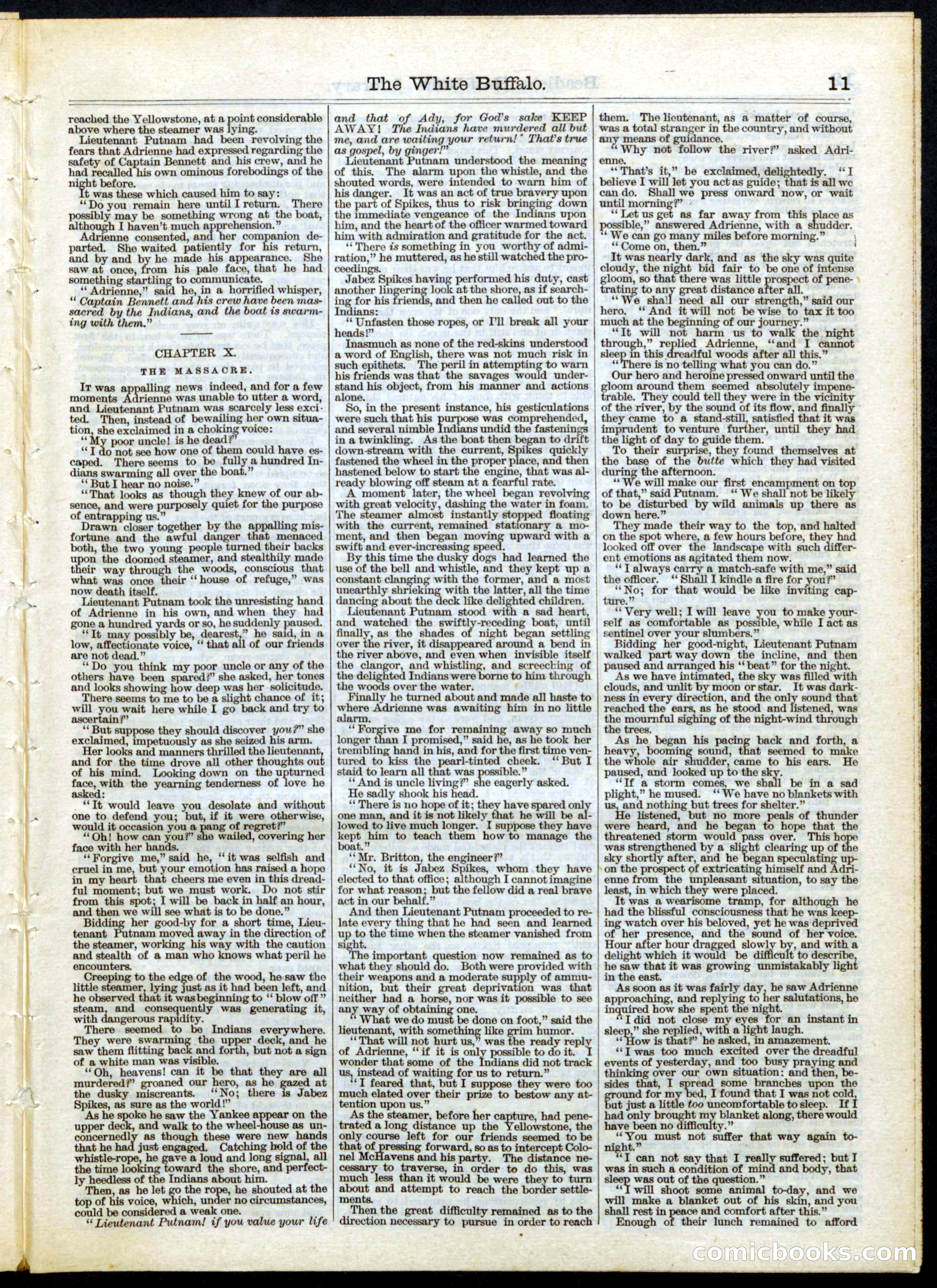
A restored page from Pulp Fiction, 1878. Page through the whole issue in the reader above.
📄 Transcribed text from this page (OCR, searchable)
Machine-transcribed from the original scan — historical spelling and the odd misread are preserved.
em we ee ee — a - a = reached the Yellowstone, at a point considerable above where the steamer was lying. Lieutenant Putnam had been revolving the fears that Adrienne had expressed regarding the safety of Captain Bennett and his crew, and he had recalled his own ominous forebodings of the night before. F t was these which caused him to say: “‘Do you remain here until I return. There possibly may be something wrong at the boat, although I haven’t much a rehension.” - Adrienne consented, and her com on de- parted. She waited patiently for his return, and by and by he made his appearance. She saw at once, from his pale face, that he had something startling to communicate. ’ ‘‘ Adrienne,” said he, in a horrified whisper, “ Captain Bennett and his crew have been mas- sacred by the Indians, and the boat is swarm- ing with them.” CHAPTER X. THE MASSACRE. IT was a ing news indeed, and for a few moments Adrienne was unable to utter a word, and Lieutenant Putnam was scarcely less exci- ted. Then, instead of bewailing her own situa- tion, she exclaimed in a choking voice: ‘“‘My poor uncle! is he dead? ‘““T do not see how one of them could have es- caped. There seems to be fully a hundred In- dians swarming all over the boat.” ‘* But I hear no noise.” “That looks as i they knew of our ab- sence, and were purposely quiet for the purpose of entrapping us.” Drawn closer together by the appalling mis- fortune and the awful danger that menaced both, the two young people turned their backs upon the doomed steamer, and stealthily made their way through the woods, conscious that what was once their ‘‘ house of refuge,” was now death itself. = Lieutenant Putnam took the unresisting hand of Adrienne in his own, and when they had gone a hundred yards or so, he suddenly paused. ‘It may possibly be, dearest,” he said, in a low, affectionate voice, “ that all of our friends are not dead.” ‘Do you think my poor uncle or any of the others have been spared?” she asked, her tones and looks showing how deep was her solicitude. There seems to me to be a slight chance of it; will you _ here while I go back and try to asce ‘‘ But suppose they should discover you?” she exclaimed, impetuously as she seized his arm. Her looks and manners thrilled the lieutenant and for the time drove all other thoughts out of his mind. Looking down on the upturned ae with the yearning tenderness of love he ‘“*It would leave you desolate and without one to defend you; but, if it were otherwise, would it occasion you a of regret?” “Oh! how can you?” wailed, covering her face with her hands. ‘‘Forgive me,” said he, “it was selfish and cruel in me, but your emotion has raised a hope in my heart that cheers me even in this dread- ful moment; but we must work. Do not stir from this spot; I will be back in half an hour, and then we will see what is to be done.” Bid her good-by for a short time, Lieu- tenant Putnam moved away in the direction of the steamer, working his way with the caution and stealth of a man who knows what peril he encounters. Creeping to the edge of the wood, he saw the little er, lying just as it had been left, and he observed that it was beginning to “‘ blow off” steam, and co ently was generating it with dangerous vaptitey. , There seemed to be Indians ev here. They were swarming the i deck, and he saw them flitting back and forth, but not a sign of a white man was visible. ‘‘Oh, heavens! can it be that they are all murdered?’ groaned our hero, as he at the dusky miscreants. ‘‘No; there is Jabez Spikes, as sure as the world!” As he spoke he saw the Yankee 1 on on the upper deck, and walk to the wheel-house as un- eens | as though these were new hands that he just Catching hold of the he gave a loud and long signal, all the time loo ward the shore, and perfect- ly heedless of the Indians about him. Then, as he let go the rope, he shouted at the top of his voice, which, under no circumstances, could be considered a weak one. ‘“‘ Lieutenant Putnam! if you value your life The White Buffalo. and that of Ady, for God’s sake KEEP AWAY! The Indians have murdered all but me, and are waiting your return!” That’s true as gospel, by ginger!” Lieutenant Polen understood the meaning of this. The alarm upon the whistle, and the shouted words, were intended to warn him of | his danger. It was an act of true bravery upon the part of Spikes, thus to risk bringing down the immediate vengeance of the Indians upon him, and the heart of the officer warmed toward him with admiration and gratitude for the act. ‘‘ There is sometbing in you worthy of admi- ration,” he muttered, as he still watched the pro- ceedings. Jabez Spikes having performed his duty, cast another lingering look at the shore, as if search- ing for his friends, and then he called out to the Indians: ‘* Unfasten those ropes, or I'll break all your heads!” Inasmuch as none of the red-skins understood a word of English, there was not much risk in such epithets. The peril in attempting to warn his friends was that the savages would under- stand his object, from his manner and actions alone. So, in the present instance, his gesticulations were such that his was comprehended, and several nimble Indians undid the fastenings in a twinkling. As the boat then began to drift down-stream with the current, = quickly fastened the wheel in the proper place, and then hastened below to start the engine, that was al- ready blowing off steam at a fearful rate. A moment later, the wheel began revolving with great velocity, dashing the water in foam. The steamer almost instantly stopped floating with the current, remained stationary a mo- ment, and then began movin swift and ever-increasing speed. By this time the dusky dogs had learned the upward with a he | nn —E eee use of the bell and whistle, and they kept up a | constant clanging with the former, and a most unearthly shrieking with the latter, all the time dancing about the deck like delighted children. Lieutenant Putnam stood with a sad heart, and watched the swiftly-receding boat, until finally, as the shades of night began settling over the river, it disappeared around a bend in the river above, and even when invisible itself the se re and whistling, and screeching of the delighted Indians were borne to him through the woods over the water. Finally he turned about and made all haste to where Adrienne was awaiting him in no little aap A me for remaining away so much longer than I promised,” said he, as he took her trembling hand in his, and for the first time ven- tured to kiss the pearl-tinted cheek. ‘But I staid to learn all that was ible.” ‘* And is uncle living?’ she eagerly asked. rp sadly — his ree ee ‘* There is no hope of it; they have spared onl one man, and it is not likely that he will be =f lowed to live much longer. I suppose they have a him to teach them how to manage the t. ‘*Mr. Britton, the engineer?” “No, it is Jabez Spikes, whom they have elected to that office; although I cannot imagine for what reason; but the fellow did a real brave act in our behalf.” And then Lieutenant Putnam proceeded to re- late every thing that he had seen and learned up to the time when the steamer vanished from sight. e important question now remained as to what they should do. Both were provided with their weapons and a moderate supply of ammu- nition, but their great deprivation was that neither had a horse, nor was it possible to see any way of obtaining one. nee t we do must be done on foot,” said the lieutenant, with something like _— humor. ‘That will not hurt us,” was the ready reply of Adrienne, “if it is only possible to do it. wonder that some of the Indians did not track us, instead of waiting for us to return.” ‘I feared that, but I suppose they were too much elated over their prize to bestow any at- tention upon us.” As the steamer, before her ca , had pene- trated a long distance up the Yellowstone, the caly a ps ah? for - friends seemed oe be of pressing forw so as to intercept Colo- nel ilovens and his party. The distance ne- cessary to traverse, in order to do this, was much less than it would be were they to turn about and attempt to reach the border settle- ments. Then the great difficulty remained as to the direction necessary to pursue in order to reach LT them. The lieutenant, as a matter of course, was a total stranger in the country, and without any means of guidance. ‘Why not follow the river?’ asked Adri- enne. ‘That's it,” be exclaimed, delightedly. ‘I believe I will let you act as guide; that is all we can do. Shall we press onward now, or wait until morning?” “Let us get as far away from this place as possible,” answered Adrienne, with a shudder. ‘We can go many miles before morning.” **Come on, then.” It was nearly dark, and as the sky was quite cloudy, the night bid fair to be one of intense gloom, so that there was little be ig of pene- r trating to a, great distance a . ‘We sha!l need all our strength,” said our : Fe Bee ae be wise to tax it too much at the beginning of our journey. “It will not harm us to walle the night through,” replied Adrienne, ‘‘and I cannot sleep in this. woods after all this.” “There is no telling what you can do.” Our hero and heroine pressed onward until the gloom around them seemed absolutely impene- trable. They could tell they were in the vicinity of the river, by the sound of its flow, and finally they came to a stand-still, satisfied that it was imprudent to venture further, until they had the light of day to guide them. To their surprise, they found themselves at the base of the butte which they had visited during the afternoon. “We will make our first encampment on top of that,” said Putnam. ‘“ We shall not be likely to be disturbed by wild animals up there as down here.” They made their way to the top, and halted on the spot where, a few hours before, they had looked off over the landscape with such differ- ent emotions as agitated them now. ‘‘T always carry a match-safe with me,” said the officer. ‘‘ Shall I kindle a fire for you?” se No; for that would be like inviting cap- ture ‘Very well; I will leave you to make your- self as comfortable as possible, while I act as sentinel over your slumbers.” Bidding her good-night, Lieutenant Putnam walked part way down the incline, and then paused and arranged his ‘‘ beat” for the night. As we have intimated, the sky was filled with clouds, and unlit by moon orstar. It was dark- ness in every direction, and the only sound that reached the ears, as he stood and ned, was the mournful sighing of the night-wind through ke he baba ‘Bie cing back and forth & pa ck and fo a heavy, booming sound, that seemed to make the whole air shudder, came to his ears. He paused, and looked up to the A “If a storm comes, we sh be in a sad plight,” he mused. ‘‘ We have no blankets with us, and nothing but trees for shelter.” He listened, but no more peals of thunder were heard, and he began to hope that the threatened storm would pass over. This hope was strengthened by a slight clearing up of the sky shortly after, and he began speculating up- ‘on the prospect of extricating himself and Adri- enne from the unpleasant situation, to say the least, in which they were placed. It was a wearisome tramp, for although he had the blissful consciousness that he was keep- ing watch over his beloved, yet he was deprived of her presence, and the sound of her voice. Hour after hour dragged slowly by, and with a delight which it would be difficult to describe he saw that it was growing unmistakably light in the east. As soon as it a oT of) he tae a A seg approaching, and replying er salutations, he tm Sire bee she spent night. I did not close my es for an instant in “oh. she replied, wit a light ‘* Ho e laugh. w is that?’ he asked, in amazement. ‘‘T was too much excited over the dreadful events of yesterday, and too busy praying _ ’ t ing over our own situation: and sides that, I spread some branches upon the und for my I found that I was not cold Ea tenet Dag at wo only m et along, there w have been no difficulty.” “You must not suffer that way again to- ht.” me can not say that I pos dened but I was in such a condition of mind and body, that was out of the question.” *“*T will shoot some animal to-day, and we will make a blanket out of his skin, and you shall rest in and comfort after this.” Enough of their lunch remained to afford GOMGDVOCKS (E() — ~~ ee Oo ee . ee ee ee ee et ee —-— ee — a ————————————————— eee ee eee ee ee ee 4 —- ee : ~ oe Oe Oe —— te - ~ —.* —— — i —_ ~ » an a ee ee - ee Oe ee —_— m— @ 3 -_— pore