
Pulp Fiction, 1878 · page 10 of 16
Beadle's Half Dime Library No. 52 — page 10: what you’re looking at
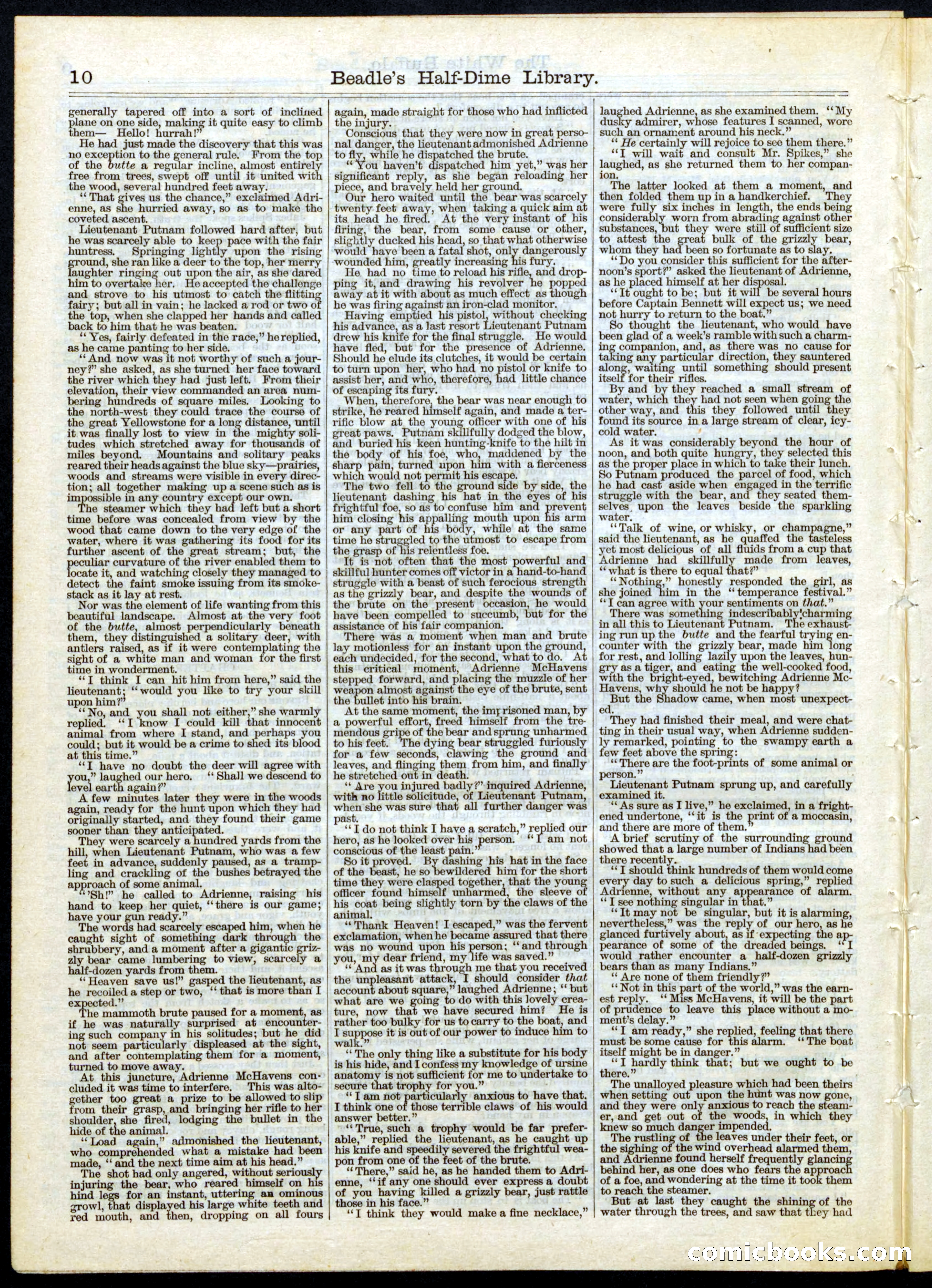
A restored page from Pulp Fiction, 1878. Page through the whole issue in the reader above.
📄 Transcribed text from this page (OCR, searchable)
Machine-transcribed from the original scan — historical spelling and the odd misread are preserved.
-_——_—- - ——_—_—_—— SS ee ee $< = —— —= — generally tapered off into a sort of inclined plane on one side, making it quite easy to climb them— Hello! hurrah!’ He had just made the discovery that this was no exception to the general rule. From the top of the butte a regular incline, almost entirel free from trees, swept off until it united wit the wood, several hundred feet away. “That res us the chance,” exclaimed Adri- enne, as she hurried away, so as to make the coveted ascent. Lieutenant Putnam followed hard after, but he was scarcely able to keep pace with the fair huntress. Springing lightly upon the rising und, she ran like a deer to the top, her merry ughter ringing out upon the air, as she dared him to overtake her. He accepted the challenge and strove to his utmost to catch the flitting fairy; but all in vain; he lacked a rod or two of the top, when she clapped her hands and called back to him that he was beaten. ‘* Yes, fairly defeated in the race,” he replied, as he came panting to her side. ‘* And now was it not worthy of such a jour- ney?’ she asked, as she turned her face toward the river which they had just left. From their elevation, their view commanded an area num- bering hundreds of square miles. Looking to the north-west they could trace the course of the great Yellowstone for a long distance, until it was finally lost to view in the mighty soli- tudes which stretched away for thousands of miles beyond. Mountains and solitary peaks reared their heads against the blue sky—prairies, woods and streams were visible in every direc- tion; all together making up a scene such as is sea Sep in any country except our own. he steamer which they had left but a short time before was concealed from view by the wood that came down to the very edge of the water, where it was gathering its food for its further ascent of the great stream; but, the pees curvature of the river enabled them to ocate it, and oe closely they managed to detect the faint smoke issuing from its smoke- stack as it lay at rest. Nor was the element of life wanting from this beautiful landscape. Almost at the very foot of the butte, almost perpendicularly beneath them, they distinguished a solitary deer, with antlers raised, as if it were contemplating the sight of a white man and woman for the first time in wonderment. “IT think I can hit him from here,” said the lieutenant; “would you like to try your skill upon him?’ ‘‘No, and you shall not either,” she warmly replied. ‘‘I know I could kill that innocent animal from where I stand, and perhaps you could; but it would be a crime to shed its blood at this time.” ‘“‘T have no doubt the deer will agree with ou,” laughed our hero, ‘ Shall we descend to evel earth again?” A few minutes later they were in the woods again, ready for the hunt upon which they had originally started, and they found their game sooner than they anticipated. They were scarcely a hundred yards from the hill, when Lieutenant Putnam, who was a few feet in advance, suddenly paused, as a tram ling and crackling of the bushes betrayed the approach of some animal. ns “Sh!” he called to Adrienne, raising his hand to keep her quiet, “‘there is our game; have your gun ready.” The words had scarcely escaped him, when he caught sight of something dark through the shrubbery, and a moment after a gigantic ~ zly bear came lumbering to view, scarcely a half-dozen yards from them. ‘‘Heaven save us!” gasped the lieutenant, as he recoiled a step or two, ‘‘ that is more than [ expected.” he mammoth brute paused for a moment, as if he was naturally surprised at encounter- ing such company in his solitudes; but he did not seem icularly displeased at the sight, and after contemplating them for a moment, turned to move away. At this juncture, Adrienne McHavens con- cluded it was time to interfere. This was alto- gether too great a prize to be allowed to slip from their grasp, and bringing her rifle to her shoulder, she fired, lodging the bullet in the hide of the , ‘“‘Load again,” admonished the lieutenant, who comprehended what a mistake had been made, ‘‘ and the next time aim at his head.” The shot had only angered, without seriousl injuring the bear, who reared himself on hind legs for an instant, uttering am ominous growl, that displayed his large white teeth and red mouth, and then, dropping on all fours — Beadle’s Half-Dime ee ee a ee ee ee SO ——— again, made straight for those who had inflicted the injury. : Conscious that they were now in great perso- nal danger, the lieutenant admonished Adrienne to fly, while he ie tr we the brute. “You haven’t dispatched him yet,” was her significant reply, as she began reloading her piece, and bravely held her ground, Our hero waited until the bear was scarcely twenty feet away, when taking a quick aim at its head he fired. At the very instant of his firing, the bear, from some cause or other, slightly ducked his head, so that what otherwise would have been a fatal shot, only dangerously wounded him, greatly increasing his fury. He had no time to reload his rifle, and drop- ping it,and drawing his revolver he popped away at it with about as much effect as though he was firing against an iron-clad monitor. Having emptied his pistol, without checking his advance, as a last resort Lieutenant Putnam drew his knife for the final struggle. He would have fled, but for the presence of Adrienne, Should he elude its clutches, it would be certain to turn upon her, who had no pistol or knife to assist her, and who, therefore, had little chance of escaping its fury. When, therefore, the bear was near enough to strike, he reared himself again, and made a ter- rific blow at_the young officer with one of his great paws. Putnam skillfully dodged the blow, and buried his keen hunting-knife to the hilt in the body of his foe, who, maddened by the eet pain, turned upon him with a fierceness which would not permit his rere The two fell to the ground side by side, the lieutenant dashing his hat in the eyes of his frightful foe, so as to confuse him and prevent him closing his 3 ag mouth upon his arm or any part of body, while at the same time he struggled to the utmost to escape from the grasp of his relentless foe. It is not often that the most powerful and skillful hunter comes off victor in a hand-to-hand struggle with a beast of such ferocious strength as the grizzly bear, and despite the wounds of the brute on the present occasion, he would have been compelled to succumb, but for the assistance of his fair companion. There was a moment when man and brute lay motionless for an instant upon the ground, each undecided, for the second, what todo. At this critical moment, Adrienne McHavens stepped forward, and placing the muzzle of her weapon almost against the eye of the brute, sent the bullet into his brain. At the same moment, the imprisoned man, by a powerful effort, freed himself from the tre- mendous gripe of the bear and sprung unharmed to his feet. e dying bear struggled furiously for a few seconds, clawing the ground and leaves, and flinging them from him, and finally he stretched out in death. ‘* Are you injured badly?’ in Adrienne, with no little solicitude, of Lieutenant Putnam, when she was sure that all further danger was past. ‘‘T do not think I have a scratch,” replied our hero, as he looked over his person. *T am not conscious of the least pain.’ So it proved. By dashing his hat in the face of the beast, he so bewildered him for the short time they were cl together, that the youn officer found himself unharmed, the sleeve o his coat being slightly torn by the claws of the animal. ‘“‘Thank Heaven! I escaped,” was the fervent exclamation, when he became assured that there was no wound upon his person; ‘‘ and through you, my dear friend, my life was saved.” ‘‘ And as it was through me that you received the unpleasant attack, Tl should consider that account about square,” laughed Adrienne, ‘* but what are we going to do with this lovely crea- ture, now that we have secured him? He is rather too bulky for us to carry to the boat, and I “ pose it is out of our power to induce him to walk. ‘The only thing like a substitute for his body is his hide, and I confess my knowledge of ursine are oe not sufficient for me to undertake to secure that trophy for you.” , “Tam not icularly anxious to have that. I think one of those terrible claws of his would answer better.” ‘*True, such a trophy would be far prefer- able,” replied the lieutenant, as he caught up his knife and speedily severed the frigh wea- pon from one of the feet of the brute. “There,” said he, as he handed them to Adri- enne, ‘if any one should ever express a doubt of you having killed a grizzly bear, just rattle those in his face.” “T think they would make a fine necklace,” Library. ee ——— oe — --_- —_ — —_ —— laughed Adrienne, as she examined them. ‘*‘ My dusky admirer, whose features I scanned, wore such an ornament around his neck.” ** He certainly will rejoice to see them there.” “T will wait and consult Mr. Spikes,” she laughed, as she returned them to her compan- ion. The latter looked at them a moment, and then folded them up in a handkerchief. They were fully six inches in length, the ends being considerably worn from abrading against other rages‘ Ning the Pe op tg a ban a the of the grizzly whom they had been so fortunate as to slay. ‘**Do you consider this sufficient for the after- noon’s sport?’ asked the lieutenant of Adrienne, as he placed himself at her disposal. ‘‘Tt ought to be; but it will be several hours before Captain Bennett will expect us; we need not hurry to return to the boat.” So thought the lieutenant, who would have been glad of a week’s ramble with such a charm- ing companion, and, as there was no cause for ing any particular direction, they sauntered along, waiting until something should present itself for their rifles. By and by they reached a small stream of water, which they had not seen when going the other way, and this they followed until they found its source in a large stream of clear, icy- cold water. } As it was considerably beyond the hour of noon, and both quite hungry, they selected this as the proper place in which to take their lunch. So Putnam produced the parcel of food, which he had cast aside when engaged in the terrific struggle with the bear, and they seated them- selves, upon the leaves beside the sparkling water. “Talk of wine, or whisky, or champagne,” said the lieutenant, as he quaffed the tasteless yet most delicious of all fluids from a cup that Adrienne had skillfully made from leaves, ‘“‘ what is there to equal that?” a vine ia honestly responded the girl, as she joined him in the “temperance festival.” “I can agree with Soe sentiments on that.” There was something ne aE ee Te in all this to Lieutenant Putnam. The exhaust- ing run up the butte and the fearful trying en- counter with the grizzly bear, made him Mais for rest, and lolling lazily upon the leaves, hun- gry as a tiger, and eating the well-cooked food, with the bright-eyed, bewitching Adrienne Mc- Havens, why should he not be happy? But the Shadow came, when most unexpect- They had finished their meal, and were chat- ting in their usual way, when Adrienne sudden- ly remarked, pointing to the swampy earth a few feet above the spring: “There are the foot-prints of some animal or rson.”’ Lieutenant Putnam sprung up, and carefully examined it. “* As sure as I live,” he exclaimed, in a fright- ened undertone, ‘‘it is the print of a moccasin, and there are more of them.” A brief scrutiny of the surrounding ground showed that a large number of Indians had been there ecesey ‘*]T should think hundreds of them would come every day to such a delicious spring,” replied Adrienne, without any appearance of alarm. ‘*T see nothing singular in that.” “It may not be singular, but it is alarming, nevertheless,” was the reply of our hero, as he glanced furtively about, as if expecting the ap- pearance of some of the dreaded beings. “I would rather encounter a half-dozen grizzly bears than as many Indians.” ** Are none of them friendly?” ‘* Not in this of the world,” was the earn- est reply. ‘‘ Miss McHavens, it will be the part of prudence to leave this place without a mo- ment’s delay.” ““T am ready,” she Be wae! feeling that there must be some cause for this alarm. ‘The boat itself might be in danger.” ae I hardly think that; but we ought to be ere. The unalloyed pleasure which had been theirs | when setting out upon the hunt was now gone, and they were - anxious to reach the steam- er, and get out of the woods, in which they knew so much danger impended., The rustling of the leaves under their feet, or the sighing of the wind overhead alarmed them, and Adrienne found herself frequently glancin behind her, as one does who fears the approac of a foe, and wondering at the time it took them to reach the steamer. But at last they caught the shining of the water through the trees, and saw that they had EOomicboo (S S