
Pulp Fiction, 1882 · page 11 of 16
Beadle's Half Dime Library No. 280 — page 11: what you’re looking at
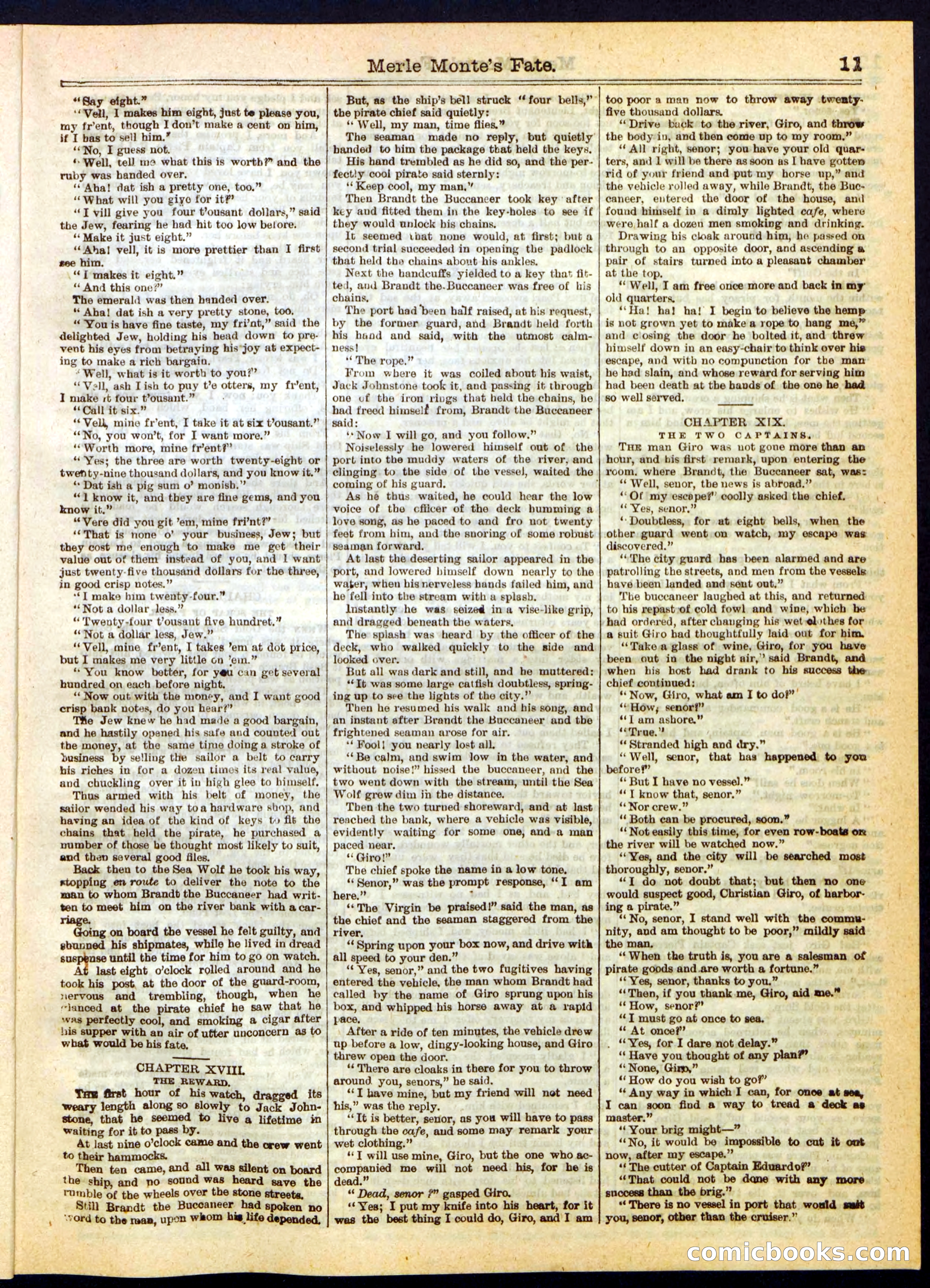
A restored page from Pulp Fiction, 1882. Page through the whole issue in the reader above.
📄 Transcribed text from this page (OCR, searchable)
Machine-transcribed from the original scan — historical spelling and the odd misread are preserved.
“Say eight.” ‘Vell, I makes him eight, just te please you, my fr’ent, though I don’t make a cent on him, if I bas to sell him,” ‘No, I guess not. ‘Well, tell me what this is worth?” and the ruby was handed over. ‘* Aha! dat ish a pretty one, too.” ‘““What will you giye for it?’ ““T vill give you four t’ousant dollars,” said the Jew, fearing he had hit too low belore. “Make it just eight.” ‘Aha! vell, it is more prettier than I first see him. “7 makes it eight.” “ And this one?’ The emerald was then handed over. * Aha! dat ish a very pretty stone, too, “You is have fine taste, my fri’at,” said the delighted Jew, holding his head down to pre- vent his eyes from betraying his*joy at expect- ing to make a rich bargain. ‘Well, what is it worth to you?” “Voll, ash Lish to puy t’e otters, my fr’ent, I make rt four t’ousant.” ; “Call it six.” ‘* Vel, mine fr’ent, I take it at six t’ousant.” ‘No, you won’t, for I want more.” ‘“Worth more, mine fr’ent?” “Yes; the three are worth twenty-eight or twenty-nine thousand dollars, and you know it.” ‘Dat ish a pig sum o’ monish.” ‘*] know it, and they are fine gems, and you know it.” “Vere did you git ’em, mine fri’nt?” ‘That is none o’ your business, Jew; but they cost me enough to make me get their value out of them instead of you, and 1 want just twenty-five thousand dollars for the three, in good crisp notes.” ‘‘T make him twenty-four.” ‘‘Not a dollar Jess.” “Twenty-four t’ousant five hundret,” ‘Not a dollar less, Jew.” ‘Vell, mine fr’ent, I takes ’em at dot price, but I makes me very little on ’ein.” * You know better, for yeu can get several hundred on each before night, “‘ Now out with the money, and I want good crisp bank notes, do you hear?” T&e Jew knew he had made a good bargain, and he hastily opened his safe and counted out the money, at the same time doing a stroke of vusiness by selling the sailor a belt to carry his riches in for a dozen times its real value, and chuckling over it in high glee to himself, Thus armed with his belt of money, the sailor wended his way toa hardware shop, and having an idea of the kind of keys ty fit the chains that held the pirate, he purchased a number of those be thought most likely to suit, and then several good files. Back then to the Sea Wolf he took his way, stopping en route to deliver the note to the man to whom Brandt the Buccaneer had writ- ten to meet him on the river bank with acar- Cine on board the vessel he felt guilty, and gbunned his shipmates, while he lived in dread suspense until the time for him to go on watch, Af last eight o’clock rolled around and he took his post, at the door of the guard-room, nervous and trembling, though, when he “lanced at the pirate chief he saw that he was perfectly cool, and smoking a cigar after his supper with an air of ufter unconcern as to what would be his fate, CHAPTER XVIIL THE REWARD. Taw frst hour of his wa dra its weary length along so slowly to Jack John- stone, that he seemed to live a lifetime in waiting for it to pass by. At last pine o’clock came and the crew went to their hammocks. Then ten came, and all was silent on board the ship, and no sound was heard save the rumble of the wheels over the stone streeta, Still Brandt the Buccaneer had spoken no , ‘ord to the maa, upon wom his life depended, Ai 4 Merle Monte’s Fate. | et te ee But, as the ship’s bell struck “four bells,” the pirate chief said quietly: ‘* Well, my man, time flies.” The seaman made no reply, but quietly banded to him the package that held the keys. His hand trembled as he did so, and the per- fect!y cool pirate said sternly: ‘* Keep cool, my man,” Then Brandt the Buccaneer took key ‘after key aud fitted them in the key-holes to see if they would unlock bis chains. It seemed tbat none would, at first; but a second trial succeeded in opening the padlock that held the chains about his ankles. Next the bandcuffs yielded to a key that fit- ted, and Brandt the. Buccaneer was free of his chains, The port had been half raised, at his request, by the former guard, and Brandt held forth his haod and said, with the utmost calm- ness! ‘The rope,” From where it was coiled about his waist, Jack Johnstone took it, and passing it through one uf the iron rings that held the chains, he had freed himself from, Brandt the Buccaneer said: ‘* Now I will go, and you follow,” Noiselessly he lowered himself out of the port into the muddy waters of the river, and clinging to the side of the vessel, waited the coming of his guard. As he thus waited, he could hear the low voice of the cfliicer of the deck bumming a love song, as he paced to and fro not twenty feet from him, and the snoring of some robust seaman forward. At last the deserting sailor appeared in the port, and lowered himself down nearly to the water, when bis nerveless hands failed him, and he fell into the stream with a splasb. Instantly he was seized ina vise-like grip, and dragged beneath the waters, The splash was heard by the officer of the deck, who walked quickly to the side and looked over. , But all was dark and still, and he muttered: ‘*Tt was some large catfish doubtless, spring- ing up to see the lights of the city.” Then he resumed his walk and his song, and an instant after Brandt the Buccaneer and tbe frightened seaman arose for air. ‘* Fool! you nearly lost all, ** Be calm, and swim Jow in the water, and without noise!” hissed the buccaneer, and the two went down with the stream, until the Sea Wolf grew dim in the distance, Then the two turned shoreward, and at last reached the bank, where a vehicle was visible, evidently waiting for some one, and a man paced near, ** Giro!” The chief spoke the name in a low tone, ‘‘ Senor,” was the prompt response, “I am here.” ’ ‘‘The Virgin be praised!” said the man, as the chief and the seaman staggered from the river, “Spring upon your box now, and drive with all speed to your den.” ‘¢ Yes, senor,” and the two fugitives having entered the vehicle, the man whom Brandt had called by the name of Giro sprung upon his box, and whipped his horse away at a rapid pace, After a ride of ten minutes, the vehicle drew up before a low, dingy-looking house, and Giro threw open the door. ‘There are cloaks in there for you to throw around. you, senors,” he said. ‘‘T have mine, but my friend will net need his,” was the reply. ‘It is better, senior, as you will have to pass through the cafe, aud some may remark your wet clothing.” ‘‘T will use mine, Giro, but the one who ac- companied me will not need his, for he is dead.” “ Dead, senor ?” gasped Giro, ‘‘Yesa; I put my knife into his heart, for it was the best thing I could do, Giro, and I am ro 12 too poor a man now to throw away twenty- five thousand dollars. aT “Drive back to the river, Giro, and throw the body in, and then come up to my room,” ‘* All right, senor; you have your old quar- ters, and 1 will be there as soon as | have gotten rid of your friend and put my horse up,” and the vehicle rolled away, while Brandt, the Bue- eaneer, evtered the door of the house, ani found himself in a dimly lighted cafe, where were half a dozen men smoking and drinking. Drawing his cloak around him, he passed on through to an opposite door, and ascending a pair of stairs turned into a pleasant chamber at the top. “Well, I am free once more and back in my old quarters, L ie ‘‘Ha! ha! ha! I begin to believe the hemp | is not grown yet to make a rope to hang me,” and closing the door he bolted it, and threw himself down in an easy-chair to think over his escape, and with no compunction for the man he had slain, and whose reward for serving him had been death at the bands of the one he had so well served. CHAPTER XIX. THE TWO CAPTAINS, Tue man Giro was not gone more than an hour, and bis first remark, upon entering the room. where Brandt, the Buccaneer sat, was: ‘* Well, senor, the news is abroad.” “Of my escepef"’ coolly asked the chief. ‘‘ Yes, senor,” ‘Doubtless, for at eight bells, when the other guard went on watch, my escape was discovered.” ‘“'The city guard has been alarmed and are patrolling the streets, and men from the vesselg have been landed and sent out,” The buceaneer laughed at this, and returned to his repast:of cold fowl and wine, which he had ordered, after changing his wetelothes for. a suit Giro had thoughtfully laid out for him, “Take a glass of wine, Giro, for you have been out in the night air,’ said Brandt, and when his host had drank to his success the, | chief continued: “Now, Giro, what am I to dof”’ ‘“How,; senor!” ‘‘] am ashore.” “a “True.” . ** Stranded high and dry.” ‘Well, senor, that has happened to you before!” ‘* But I have no vessel.” ‘‘T know that, senor.” G4 ‘*Nor crew.” \ ‘* Both can be procured, soon.” ‘‘Not easily this time, for even row-boats or , the river will be watched now.” ris) ‘Yes, and the city will be searched most thoroughly, senor.” “JT do not doubt that; but then mo one ~ would suspect good, Christian Giro, of harbor- ing a pirate.” ‘No, senor, I stand well with the commu- . nity, and am thought to be poor,” mildly said ‘‘When the truth is, you are a salesman of pirate goods and are worth a fortune.” 7 ‘Yes, senor, thanks to you.” o, “Then, if you thank me, Giro, aid me.” ‘* How, senor?’ ““T must go at once to sea. ‘* At once?” op. . “Yes, for I dare not delay.” is. ‘“‘ Have you thought of any plan?’ -_ ‘‘None, Gino,” “How do you wish to go?” ‘‘ Any way in which I can, for once at sea, I can soon find a way to tread a deck as master.” ‘‘ Your brig might—” ‘No, it would be impossible to cut it ont now, after my escape.” “The cutter of Captain Eduardo?” — “That could not ne dane with any more. f that would suit 7 “There is no vessel in ‘ : , ri » ae . r ae _ f= a a a ~ €omicboo