
Pulp Fiction, 1882 · page 10 of 16
Beadle's Half Dime Library No. 280 — page 10: what you’re looking at
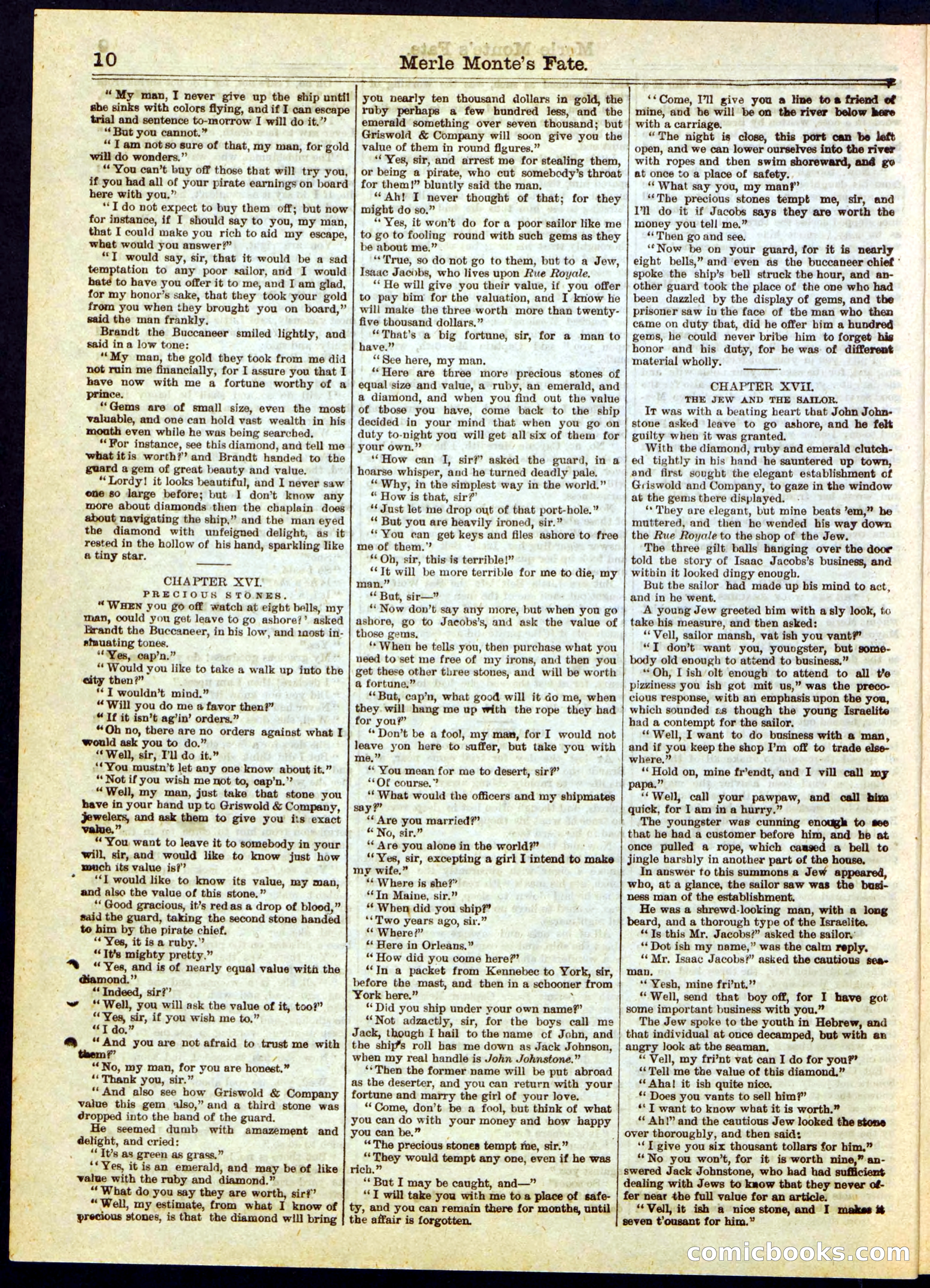
A restored page from Pulp Fiction, 1882. Page through the whole issue in the reader above.
📄 Transcribed text from this page (OCR, searchable)
Machine-transcribed from the original scan — historical spelling and the odd misread are preserved.
*~ ’ 10 “My man, I never give up the ship until she sinks with colors flying, and if I can escape trial and sentence to-morrow I will do it.” “But you cannot.” “‘T am notso sure of that, my man, for gold will do wonders.”’ “You can’t buy off those that will try you, if you had all of your pirate earnings on board here with you,” “I do not expect to buy them off; but now for instance, if I should say to you, my man, that I could make you rich to aid my escape, whet would you answer?” “T would say, sir, that it would be a sad temptation to any poor sailor, and I would haté¢ to have you offer it to me, and I am glad, for my honor’s sake, that they took’your gold from you when they brought you on board,” said the man frankly. Brandt the Buccaneer smiled lightly, and said in a low tone: ““My man, the gold they took from me did not ruin me financially, for I assure you that I have now with me a fortune worthy of a prince. “‘Gems are of small size, even the most valuable, and one can hold vast wealth in his mouth even while he was being searched, “For instance, see this diamond, and tell me what itis worth?’ and Brandt handed to the guard a gem of great beauty and value. “Lordy! it looks beautiful, and I never saw ene so large before; but I don’t know any more about diamonds then the chaplain does about navigating the ship,” and the man eyed the diamond with unfeigned delight, as it rested in the hollow of his hand, sparkling like a tiny star. CHAPTER XVI. PRECIOUS STONES. “WHEN you go off watch at eight bells, my man, could you get leave to go ashore?’ asked Frandt the Buccaneer, in bis low, and most in- stmuating tones. “Wes, cap’n.” “Would you like to take a walk up into the eity then?” **T wouldn’t mind.” “Will you do me a favor then?” “If it isn’t ag’in’ orders.” “Oh no, there are no orders against what I would ask you to do.” ‘‘Well, sir, I'll do it.” “You mustn’t let any one know about it.” “Not if you wish me not to, cap’n.”’ “Well, my man, just take that stone you have in your hand up to Griswold & Company, Jewelers, and ask them to give you its exact “You want to leave it to somebody in your will, sir, and would like to know just how much its value is?” ‘*I would like to know its value, my man, and also the value of this stone.” “Good gracious, it’s red as a drop of blood,” said the taking the second stone handed to him by the pirate chief. “Yes, it is a ruby.” “Tt's mighty pretty.” “Yes, and is of nearly equal value with the “‘ Indeed, sir?’ ~ “Well, you will ask the value of it, too?” “Yes, sir, if you wish me to.” “ae I do. ” “And you are not afraid to trust me with ’’ “No, my man, for you are honest,” “Thank you, sir.” “And also see how Griswold & Company value this gem also,” and a third stone was dropped into the band of the guard. He seemed dumb with amazement and delight, and cried: “It’s as green as grass,” ‘* Yes, it isan emerald, and may be of like walue with the ruby and diamond.” “What do you say they are worth, sir?” “Well, my estimate, from what I know of precious stones, is that the diamond will bring / + we ee - a ee you nearly ten thousand dollars in gold, tlie ruby perhaps a few hundred less, and the emerald something over seven thousand; but Griswold & Company will soon give you the value of them in round figures.” ‘Yes, sir, and arrest me for stealing them, or being a pirate, who cut somebody’s throat for them!” bluntly said the man, “Ah! I never thought of that; for they might do so.” “Yes, it won’t do fora poor sailor like me to go to fooling round with such gems as they be about me.” “True, so do not go to them, but to a Jew, Isaac Jacobs, who lives upon Rue Royale, ** He will give you their value, if you offer to pay him for the valuation, and I know he will make the three worth more than twenty- five thousand dollars.” “That's a big fortune, sir, for a man to have.” ‘See here, my man, “Here are three more precious stones of equal size and value, a ruby, an emerald, and a diamond, and when you find out the value of tbose you have, come back to the ship decided in your mind that when you go on duty to-night you will get all six of them for your own.” ‘“How can I, sirf’ asked the guard, in a hoarse whisper, and he turned deadly pale. “Why, in the simplest way in the world.” “ How is that, sir?’ ** Just let me drop out of that port-hole.” *“* But you are heavily ironed, sir.” “You can get keys and files ashore to free me of them.” ** Oh, sir, this is terrible!” “‘It will be more terrible for me to die, my man.” “ Bat, sir—” ** Now don’t say any more, but when you go ashore, go to Jacobs’s, and ask the value of those gems, ** When he tells you, then purchase what you ueed to'set me free of my irons, and then you get these other three stones, and will be worth a fortune.” “‘But, cap’n, what good will it do me, when they will hang me up with the rope they had for you?” “Don’t be a fool, my man, for I would not leave yon here to suffer, but take you with me.” *“‘ ‘You mean for me to desert, sir?’ **Of course.” ‘What would the officers and my shipmates say?’ ** Are you married?” “ No, sir.” ‘Are you alone in the world?” “Yes, sir, excepting a girl I intend to my wife.” ** Where is she?” **In Maine, sir.” “ When did you ship?” ‘*Two years ago, sir.” ‘* Where?” “ Here in Orleans,” “ How did you come here?’ “In a packet from Kennebec to York, sir, before the mast, and then in a schooner from York here.” . “Did you ship under your own name?” “Not adzactly, sir, for the boys call mes Jack, though I hail to the name cf Jobn, and the ships roll bas me down as Jack Johnson, when my real handle is John Johnstone.” ‘*Then the former name will be put abroad as the deserter, and you can return with your fortune and marry the girl of your love. ““Come, don’t be a fool, but think of what you can do with your money and how happy you can be.” “The precious stones tempt rhe, sir.” Pe “They would tempt any one, even if he was ch,” ‘“* But I may be caught, and—” “TI will take you with me toa place of safe- ty, and you can remain there for months, until the affair is forgotten. a make Merle Monte’s Fate. **Come, I'll give you a line to mine, and he will be on the river below with a carriage. “The night is close, this port can be open, and we can lower ourselves into the river with ropes and then swim shoreward, and go at once to a place of safety. ‘‘ What say you, my man?” “The precious stones tempt me, sir, and I'll do it if Jacobs says they are worth the money you tell me.” “Then go and see. ‘‘Now be on your guard, for it is nearly eight bells,” and even as the buccaneer chief * spoke the ship’s bell struck the hour, and an- other guard took the place of the one who had been dazzled by the display of gems, and the prisoner saw iv the face of the man who then came on duty that, did he offer him a hundreg gems, he could never bribe him to forget his honor and his duty, for be was of different material wholly. CHAPTER XVII. THE JEW AND THE SAILOR. IT was with a beating heart that John John- stone asked leave to go ashore, and he felt guilty when it was granted. With the diamond, ruby and emerald clutch- ed tightly in his hand he sauntered up town, and first sought the elegant establishment of Griswold and Company, to gaze in the window at the gems there displayed. “They are elegant, but mine beats ’em,” he muttered, and then he wended his way down the Rue Royale to the shop of the Jew. The three gilt balls hanging over the door told the story of Isaac Jacobs’s business, and witbin it looked dingy enough. But the sailor had made up bis mind to act, and in he went. A young Jew greeted him with a sly look, fo take his measure, and then asked: ‘Vell, sailor mansh, vat ish you vant?’ “T don’t want you, youngster, but some- body old enough to attend to business,” “Oh, [ish olt enough to attend to all te pizziness you ish got mit us,” was the preco- cious response, with an emphasis upon the you, which sounded es though the young Israelite had a contempt for the sailor. “Well, I want to do business with a man, and if you keep the shop I’m off to trade else- where,” ; ‘‘ Hold on, mine fr’endt, and I vill call my ” ‘‘Well, call your pawpaw, and call bim quick, for I am in a hurry.” The youngster was cunning enough to see that he had a customer before him, and he at once pulled a rope, which caused a bell to jingle barshly in another part of the house, In answer fo this summons a Jew a who, at a glance, the sailor saw was the basi- ness man of the establishment. He was a shrewd-looking man, with a long beard, and a thorough type of the Israelite. “Is this Mr. Jacobs?” asked the sailor, ‘* Dot ish my name,” was the calm reply, “Mr, Isaac Jacobs?” asked the cautious sea- man. ‘* Yesh, mine fri’nt.”’ “Well, send that boy off, for I have got some important business with you.” The Jew spoke to the youth in Hebrew, and that individual at once decamped, but with an angry look at the seaman, “Vell, my fri’nt vat can I do for you?” ‘Tell me the value of this diamond,” ** Aha! it ish quite nice. ** Does you vants to sell him?’ ‘‘T want to know what it is worth.” ‘* Ah!” and the cautious Jew looked the stone over thoroughly, and then said: ‘‘T give you six thousant tollars for him,” “No you won't, for it is worth nine,” an- swered Jack Johnstone, who had had sufficient dealing with Jews to know that they never of- fer near the full value for an article. “Vell, it ish a nice stone, and I makes # seven t’ousant for him.” JOOKS: GO Gomme =) <<»