
Pulp Fiction, 1878 · page 4 of 16
Beadle's Half Dime Library No. 24 — page 4: what you’re looking at
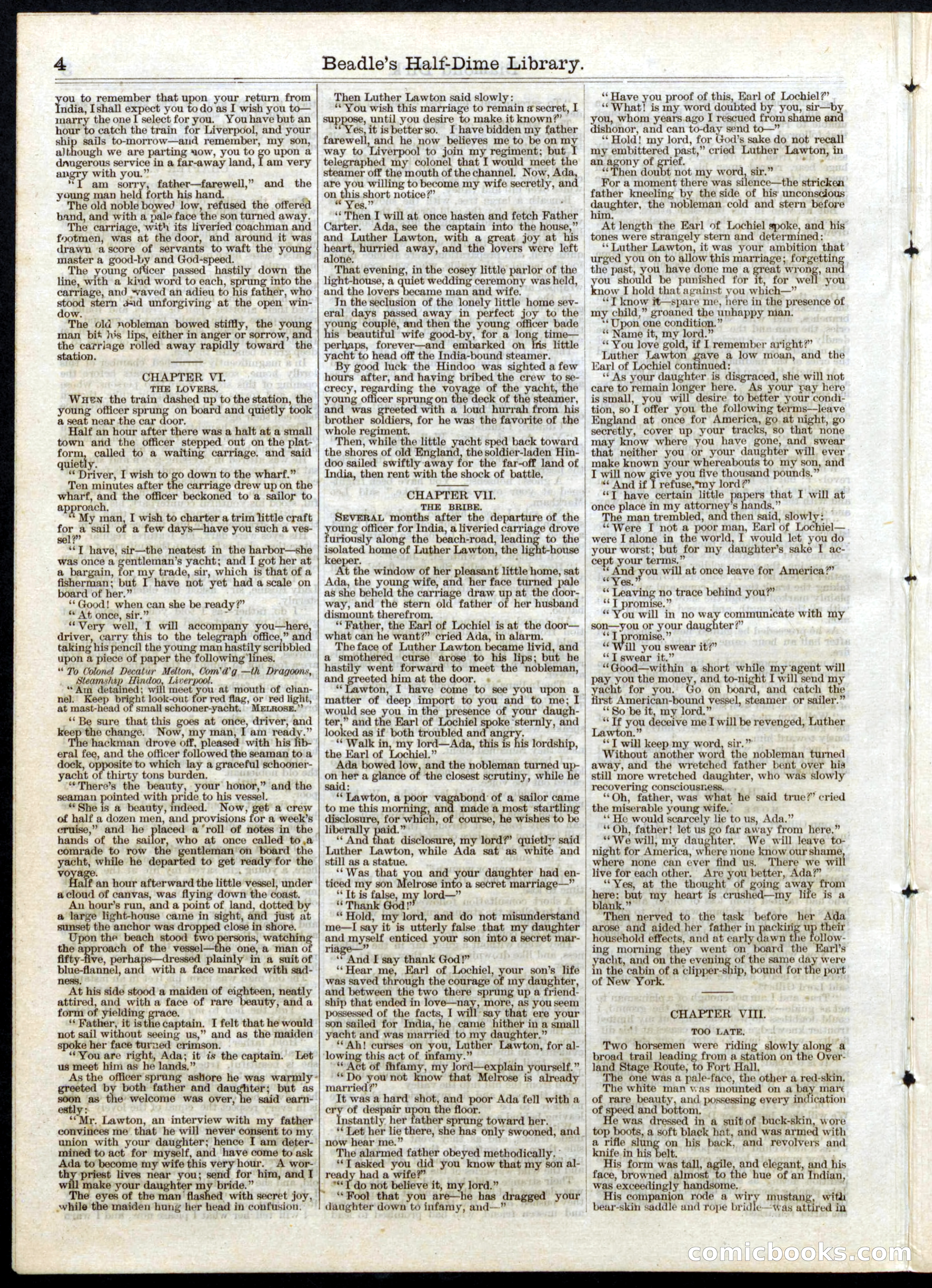
A restored page from Pulp Fiction, 1878. Page through the whole issue in the reader above.
📄 Transcribed text from this page (OCR, searchable)
Machine-transcribed from the original scan — historical spelling and the odd misread are preserved.
“4 ee —- -> — -— a _- —— — -—— oe — . -— —_— ou to remember that upon your return from india. Ishall expect you todo as I wish you to— marry the onel select for you. Youhave but an hour to catch the train for Liverpool, and your ship sails to-morrow—aud remember, my son, although we are parting sow, you to go upon a dnugerous service in a far-away land, | am very angry with you.” . am sorry, father—farewell,” and _ the young man held forth his hand. : The old noble bowed low, refused the offeréd band, and with a pale face the son turned away. The carriage, with its liveried coachman and footmen, was at the door, and around it was drawn ascore of servants to waft the young master a good-by and God-speed. The young officer passed hastily down the line, with a kind word to each, sprung into the carriage, and ~vaved an adieu to his father, who pas stern dd unforgiving at the open win- ow. The old nobleman bowed stiffly, the youn man bit his lips, either in anger or sorrow, an the carriage rolled away rapidly toward the station. CHAPTER VI. THE LOVERS, Wuewn the train dashed up to the station, the young officer sprung on board and quietly took a seat near the car door. Half an hour after there was a halt at a small town and the officer stepped out on the plat- form, called to a waiting carriage. and said uietly. 6 Driver, I wish to go down to the wharf.” Ten minutes after the carriage drew up on the wharf, and the officer beckoned to a sailor to approach, My man, I wish to charter a trim little craft :-* a sail of a few days—have you such a ves- sel? ‘*T have, sir—the neatest in the harbor—she was once a gentleman’s yacht; and I got her at a bargain, for my trade, sir, which is that of a fisherman; but I have not yet had ascale on board of her.” ‘*Good! when can she be ready?” rn = once, ed ‘om ; " ery well, accompany you—here driver, carry this to the telegraph office,” and taking his pencil the young man hastily scribbled upon a piece of paper the following lines. “To Colonel Decatur Melton, Com’a@’g —th Dragoons, Steamship Hindoo, Liverpool. “Am detained; will meet you at mouth of chan- nel. Keep bright look-out for red flag, or red light, at mast-head of small schooner-yacht. MELROSE.”’ “Be sure that this goes at once, driver, and ae change. Now, my man, I am ready.” e hackman drove off, pleased with his lib- eral fee, and the officer followed the seaman to a dock, 0 ite to which lay a graceful schooner- yacht of thirty tons burden, “There’s the beauty, your honor,” and the seaman pointed with pride to his vessel. “She is a beauty, indeed. Now, get a cre of half a dozen men, and provisions for a week’s cruise,” and poh oe gow a ‘roll of notes in the hands of the sailor, who at once called to,a comrade to row the gentleman on bo the yacht, while he departed to get ready for the Halt an hour afterward the little vessel, under a cloud of canvas, was flying down the coast. An hour’s run, and a point of land, dotted by as light-house came in sight, and just at et the anchor was dropped close in shore. Upon the beach stood two ahi watchin the approach of the vessel—the one, a man o fifty-five, perha plainly in a suit of blue-flannel, and with a face marked with sad- ness. At his side stood a maiden of eighteen, neatly attired, and with a face of rare uty, and a form of yielding . ‘* Father, it isthe captain. I felt that he would not sail without seeing us,” and as the maiden spoke her facé turned crimson. ‘*You are right, Ada; it is the captain. Let us meet him as he lands.” As the officer sprung asHore he was warmly- by both father and daughter; but as > as the welcome was over, he said earn- ‘*Mr. Lawton, an interview with my father “es me that he will never consent to my union with your daughter; hence I am deter- mined to act for myself, and have come to ask Ada to become my wife this very hour. A wor- priest lives near you; send for him, and I wit e your daughter my bride.” eyes of the man fiz with secret joy, while the maiden hung her head in confusion. Beadle’s Half-Dime Library. ‘lowi ee ‘“‘Have you proof of this, Earl of Lochiel?’ ‘What! is my word doubted by you, sir—by you, whom years.ago I rescued from shame and dishonor, and can to-day send to—” ‘Hold! my lord, for God’s sake do not recall my embittered past,” cried Luther Lawton, in an agony of grief. aye ““Then doubt not my word, sir.” For a moment there was silence—the stricken father kneeling by the side of his unconscious Gauge the nobleman cold and stern before m. At length the Earl of Lochiel spoke, and his tones were strangely stern and determined: ‘* Luther Lawton, it was your ambition that urged you on to allow this marriage; forgettin the past, you have done me a great wrong, an you should be punished for it, for well you know I hold that against you which—” ‘*T know it—spare me, here in the presence of my child,” groaned the unhappy mian. cs n one condition.” = Nanas it, my lord.” ‘You love gold, if Lremember aright?” Luther Lawton gave a low moan, and the Earl of Lochiel continued: ‘‘ As your daughter is disgraced, she will not care to remain longer here. As your vay here is small, you will desire to better your condi- tion, so I offer you the following terms—-leave England at once for America, go. at night, go secretly, cover up your tracks, so that none sped may know where you have gone, and swear the shores of old England, the soldier-laden Hin- | that neither you or your daughter will ever doo sailed swiftly away for the far-off land of | make known your whereabouts to my son, and India, then rent with the shock of battle, _ I will now give you five thousand pounds.” | “* And if Y cataestny lord?” CHAPTER VII. | “T have certain little papers that I will at THE BRIBE. "once place in my attorney’s ands,” | SEVERAL months after the departure of the | The man trembled, and then said, slowly: young officer for India, aliveried carriage drove ‘‘ Were I not a poor man, Earl of Lochiel— uriously along the beach-road, leading to the | were I alone in the world, 1 would let you do isolated home of Luther Lawton, the light-house | your worst; but for my daughter’s sake I ac- eeper. cept your terms.” At the window of her pleasant little home, sat ‘‘ And you will at once leave for America?” Ada, the young wife, and her face turned pale | Then Luther Lawton said slowly: *“You wish this marriage to remain asecret, I PERC, until you desire to make it known?’ ‘Yes, it isbetterso. I have bidden my father farewell, Mra’ he poy A gti me to 4 ve 3 way to Liverpool to join my regiment; bu telegraphed my colonel that I would meet the steamer off the mouth of the channel, Now, Ada are you willing to become my wife secretly, and on t is short notice?” ‘Then I will at once hasten and fetch Father Carter. Ada, see the captain into the house,” and Luther Lawton, with a great joy at his posh hurried away, and the lovers were left one. That evening, in the cosey little parlor of the light-house, a quiet wedding ceremony was held, and the lovers me man and wife. Jn the seclusion of the lonely little home sev- eral days passed away in perfect joy to the oung couple, and then the young officer bade is beautiful wife good-by, for a long time— perhaps, forever—and embarked on little | yacht to head off the India-bound steamer. By good luck the Hindoo was sighted a few hours after, and having bribed the crew to se- crecy, regarding the voyage of the yacht, the young officer sprung on the deck of the steamer, and was greeted with a loud hurrah from his brother soldiers, for he was the favorite of the whole regiment. Then, while the little yacht back toward i; ec Yes.’ as she beheld the carriage draw up at the door- “ Leaving no trace behind you?” way, and the stern old father of her husband ‘**T promise.” | dismount therefrom. i ae You will in no way communicate with my “Father, the Earl of Lochiel is at the door— | son—you or your daughter?” what can he want?” cried Ada, in alarm. | i ‘**T promise.” The face of Luther Lawton became livid, and ‘“ Will you swear it?” a smothered curse arose to his lips; but he ‘I swear it.” hastily went forward to meet the nobleman, and ted him at the door, + “Lawton, I have come to see you upon a_ matter of deep import to you and to me; I- would see you in the presence of your daugh- | ter,” and the Earl of Lochiel spoke ‘sternly, and | looked as if both troubled and angry. | “Walk in Sy ee ee this is his lordship, | the Earl of Lochiel.” Ada bowed low, and the nobleman turned u ist md a glance of the closest scrutiny, while he Sal . ** Lawton, a poor vagabond’ of a sailor came | to me this mo , and made a most startling disclosure, for which, of course, he wishes to be Berg 5 pe gt ‘‘ And that disclosure, my lord?’ quietly said Luther Lawton, while Ada sat as white and | “‘Good—within a short while my agent will pay you the money, and to-night I will send my acht for you. Go on board, and catch the t American-bound vessel, steamer or sailer.” ‘So be it, my lord.” 7 “Tf you deceive me I will be revenged, Luther Lawton.” ‘““T will keep my word, sir.” Without another word the nobleman turned away, and the wretched father bent over his still more wretched daughter, who was slowly recovering consciousness... . “Oh, father, was what he said true?” cried the miserable young wife. ‘* He would scarcely lie to us, Ada.” ‘Oh, father! let us go far away from here.” “We will, my daughter. We will leave to- night for America, where none know our shame still as a statue. | where none can ever find us, There we will ‘*Was that you and your daughter had en- live for each other. Are you better, Ada?” ticed my son Melrose into a secret marriage—” ‘Yes, at the thought of going away from It is false, my lord—” here: but my heart is crushed—my life is a Thank God!’ blank,” - “ Hold, my lord, and do not misunderstand me—I say it is utterly false that my daughter and myself enticed your son into a secret mar- % And I say thank God!” ‘‘Hear me, Earl of Lochiel, your son’s life was saved through the courage of my daughter, and between the two there sprung up a friend- Then nerved to the task before her Ada | ship that ended in love—nay, more, as you seem arose and aided her father in packins up their household effects, and at early dawn the follow- ing morning they went on board the Earl’s yacht, and on the evening of the same day were in the cabin of a clipper-ship, bound for the port of New York. CHAPTER VIII. TOO LATE, Two horsemen were riding slowly along a broad trail leading from a station on the Over- land Stage Route, to Fort Hall, : The one was a pale-face, the other a red-skin, The white man was mounted on a bay mare possessed of the facts, I will sa that ere your son sailed for India, he came hither in a small yacht and was married to my daughter.” ‘*Ah! curses on you, Luther Lawton, for al- this act of infamy.” | ~* Act of fthfamy, my lord—explain yourself.” **Do you not know that Melrose is already married?” | It was a hard shot, and poor Ada fell with a of rare beauty, and possessing every indication ory of despair upon the floor. of A ees and bottom, nstantly her father sprung toward her. | e was dressed in a suitof buck-skin, wore ‘* Let her lie there, she has only swooned, and | top boots, a soft black hat, and was armed with now hear me.” a rifle slung on his back, and revolvers and The alarmed father obeyed methodically, __|_ knife in his belt. : “‘Tasked you did you know that my sonal- His form was tall, agile, and elegant, and his needy had a wife?” . _ face, browned almost to the hue of an Indian, “1 do not believe it, my lord.” ' . Was exceedingly handsome, . * ‘““Fool that you are—he has dragged your His companion rode a wiry mustang, with daughter down to infamy, and—" = | bear-skin saddle and rope bridle—was attired in JOO <eom (E CS} (E@)