
Pulp Fiction, 1882 · page 6 of 16
Beadle's Half Dime Library, No. 237 — page 6: what you’re looking at
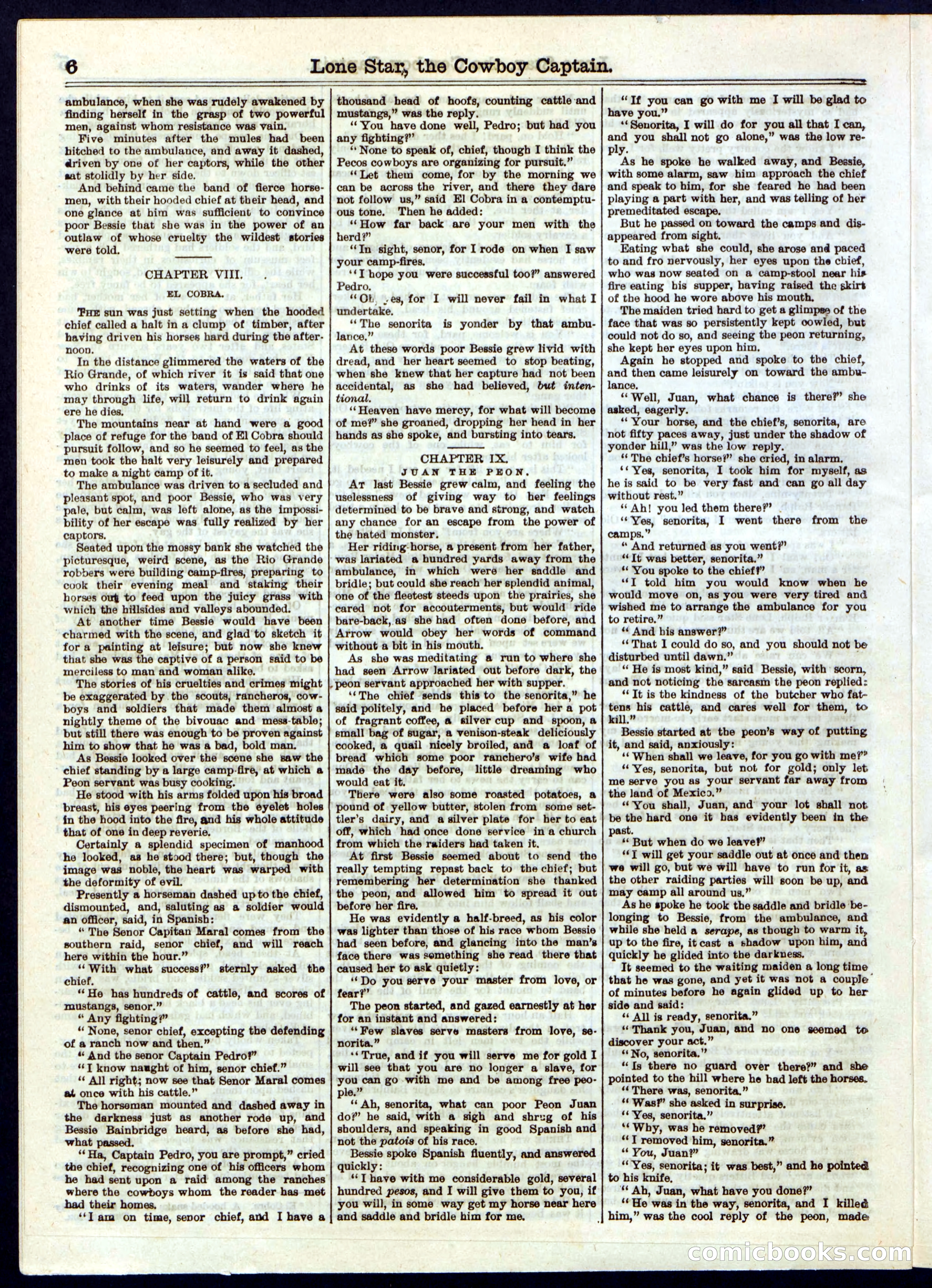
A restored page from Pulp Fiction, 1882. Page through the whole issue in the reader above.
📄 Transcribed text from this page (OCR, searchable)
Machine-transcribed from the original scan — historical spelling and the odd misread are preserved.
ambulance, when she was rudely awakened by finding herself in the grasp of two powerful men, against whom resistance was vain. Five minutes after the mules had been hitched to the ambulance, and away it dashed, driven by one of her captors, while the other saat stolidly by her side. And behind came the band of fierce horse- men, with their hooded chief at their head, and one glance at him was sufficient to convince poor Bessie that she was in the power of an outlaw of whose cruelty the wildest stories were told. CHAPTER VIII. EL COBRA, THE sun was just setting when the hooded chief called a halt ina clump of timber, after having driven his horses hard during the after- noon. In the distance glimmered the waters of the Rio Grande, of which river it is said that one who drinks of its waters, wander where he may through life, will return to drink again ere he dies, The mountains near at hand were a good place of refuge for the band of El Cobra should ' pursuit follow, and so he seemed to feel, as the men took the halt very leisurely and prepared to make a night camp of ib. The ambulance was driven to a secluded and pleasant spot, and poor Bessie, who was very pale, but calm, was left alone, as the impossi- bility of her escape was fully realized by her captors, Seated upon the mossy bank she watched the picturesque, weird scene, as the Rio Grande robbers were building camp-fires, preparing to cook their evening meal and staking their horses owy to feed upon the juicy grass with which the hillsides and valleys abounded. At another time Bessie would have been charmed with the scene, and glad to sketch it fora painting at leisure; but now she knew that she was the captive of a person said to be merciless to man and woman alike. The stories of his cruelties and crimes might be exaggerated by the scouts, rancheros, cow- boys and soldiers that made them almost a nightly theme of the bivouac and mess-table; but still there was enough to be proven against him to show that he was a bad, bold man. As Bessie looked over the scene she saw the chief standing by a large camp-fire, at which a Peon servant was busy cooking. He stood with his arms folded upon his broad breast, his eyes peering from the eyelet holes in the hood into the fire, and his whole attitude that of one in deep reverie. Certainly a splendid specimen of manhood he looked, as he stood there; but, though the image was noble, the heart was warped with the deformity of evil. Presently a horseman dashed upto the chief, dismounted, and, saluting as a soldier would an officer, said, in Spanish: | “ The Senor Capitan Maral comes from the southern raid, senor chief, and will reach here within the hour.” ‘With what success?” sternly asked the chief. ‘‘He has hundreds of cattle, and scores of mustangs, senor.” “ Any fighting?” “None, senor chief, excepting the defending of a ranch now and then.” “ And the senor Captain Pedro?” “‘T know naught of him, senor chief.” ‘¢ All right; now see that Senor Maral comes at once with his cattle.” The horseman mounted and dashed away in the darkness just as another rode up, and Bessie Bainbridge heard, as before she had, what passed. “‘Ha, Captain Pedro, you are prompt,” cried the chief, recognizing one of his officers whom he had sent upon a raid among the ranches where the cowboys whom the reader has met had their homes, ‘‘T am on time, sepor chief, and I have a thousand head of hoofs, counting cattle and mustangs,” was the reply. ‘You have done well, Pedro; but had you any fighting?’ ‘* None to speak of, chief, though I think the Pecos cowboys are organizing for pursuit.” ‘‘Let them come, for by the morning we can be across the river, and there they dare not follow us,” said El Cobra in a contemptu- ous tone. Then he added: ‘‘How far back are your men with the herd?” “In sight, senor, for I rode on when I saw your camp-fires. ‘*T hope you were successful too?” answered ‘Ob, es, for I will never fail in what I undertake. ‘The senorita is yonder by that ambu- lance,”’ At these words poor Bessie grew livid with dread, and her heart seemed to stop beating, when she knew that her capture had not been accidental, as she had believed, but inten- tional, ‘‘Heaven have mercy, for what will become of me?” she groaned, dropping her head in her hands as she spoke, and bursting into tears. CHAPTER IX, JUAN THE PEON, At last Bessie grew calm, and feeling the uselessness of giving way to her feelings determined to be brave and strong, and watch any chance for an escape from the power of the hated monster. Her riding-horse, a present from her father, was lariated a hundred yards away from the ambulance, in which were her saddle and bridle; but could she reach her splendid animal, one of the fleetest steeds upon the prairies, she cared not for accouterments, but would ride bare-back, as she had often done before, and Arrow would obey her words of command without a bit in his mouth. As she was meditating a run to where she had seen Arrow Jariated out before dark, the peon servant approached her with supper. ‘‘The chief sends this to the senorita,” he said politely, and he placed before her a pot of fragrant coffee, a silver cup and spoon, a small bag of sugar, a venison-steak deliciously cooked, a quail nicely broiled, and a loaf of bread which some poor ranchero’s wife had made the day before, little dreaming who would eat it. There were also some roasted potatoes, a pound of yellow butter, stolen from some set- tler’s dairy, and a silver plate for her to eat off, which had once done service in a church from which the raiders had taken it. At first Bessie seemed about to send the really tempting repast back to the chief; but remembering her determination she thanked the peon, and allowed him to spread it out before her fire. He was evidently a half-breed, as his color was lighter than those of his race whom Bessie had seen before, and glancing into the man’s face there was something she read there that caused her to ask quietly: ‘‘Do you serve your master from love, or fear?’ The peon started, and gazed earnestly at her for an instant and answered: ‘*Few slaves serve masters from love, se- norita.” ‘¢True, and if you will serve me for gold I will see that you are no longer a slave, for you can go with me and be among free peo- ple.” ‘‘ Ah, senorita, what can poor Peon Juan do?’ he said, with a sigh and shrug of his shoulders, and speaking in good Spanish and not the patois of his race. Bessie spoke Spanish fluently, and answered quickly: ‘‘T have with me considerable gold, several hundred pesos, and I will give them to you, if you will, in some way get my horse near here and saddle and bridle him for me. Lone Star, the Cowboy Captain. “Tf you can go with me I will be glad to have you.” ‘‘Senorita, I will do for you all that I can, and you shall not go alone,” was the low re- ply. As he spoke he walked away, and Bessie, with some alarm, saw him approach the chief and speak to him, for she feared he had been playing a part with her, and was telling of her premeditated escape, But he passed on toward the camps and dis- appeared from sight. Eating what she could, she arose and paced to and fro nervously, her eyes upon the chief, who was now seated on a camp-stool near his fire eating bis supper, having raised the skirt of the hood he wore above his mouth, The maiden tried hard to get a glimper of the face that was so persistently kept oowled, but could not do so, and seeing the peon returning, she kept her eyes upon him, Again he stopped and spoke to the chief, and then came leisurely on toward the ambu- lance. ‘‘ Well, Juan, what chance is there?’ she asked, eagerly. ‘* Your horse, and the chief’s, senorita, are not fifty paces away, just under the shadow of yonder hill,” was the low reply. ** The chief’s horse?’ she cried, in alarm. ‘¢ Yes, senorita, I took him for myself, as he is said to be very fast and can go all day without rest.” ‘‘ Ah! you led them there?” | ‘‘'Yes, senorita, I went there from the camps.” “ And returned as you went?” “‘It was better, senorita.” ** You spoke to the chief?” “IT told him you would know when he would move on, as you were very tired and wished me to arrange the ambulance for you to retire.” ** And bis answer?” ‘‘That 1 could do so, and you should not be disturbed until dawn.” . “He is most kind,” said Bessie, with scorn, and not noticing the sarcasm the peon replied: ‘It is the kindness of the butcher who fat- tens his cattle, and cares well for them, to kill.” Bessie started at the peon’s way of putting it, and said, anxiously: ‘¢ When shall we leave, for you go with me?” ‘‘-Yes, senorita, but not for gold; only let me serve you as your servant far away from the land of Mexico.” , ‘You shall, Juan, and your lot shall not. be the hard one it bas evidently been in the st. a? But when do we leave?’ ‘‘Y will get your saddle out at once and then we will go, but we will have to run for it, as the other raiding parties will soon be up, and may camp all around us.” As he spoke he took the saddle and bridle be- longing to Bessie, from the ambulance, and while she held a serape, as though to warm it, up to the fire, itcast a shadow upon him, and quickly he glided into the darkness. It seemed to the waiting maiden a long time that he was gone, and yet it was not a couple of minutes before he again glided up to her side and said: ‘+ All is ready, senorita.” “Thank you, Juan, and no one seemed to discover your act.” ‘‘ No, senorita,” “Is there no guard over there?” and she pointed to the hill where he had left the horses. ‘* There was, senorita,” ** Was?” she asked in surprise. ‘* Yes, senorita,” ‘Why, was he removed?’ “1 removed him, senorita.” “You, Juan?” ‘Yes, senorita; it was best,” and he pointed to his knife, “Ah, Juan, what have you done?” ‘* He was in the way, senorita, and I killed | him,” was the cool reply of the peon, made GOmicdoo (C cS Col