
Pulp Fiction, 1882 · page 5 of 16
Beadle's Half Dime Library, No. 237 — page 5: what you’re looking at
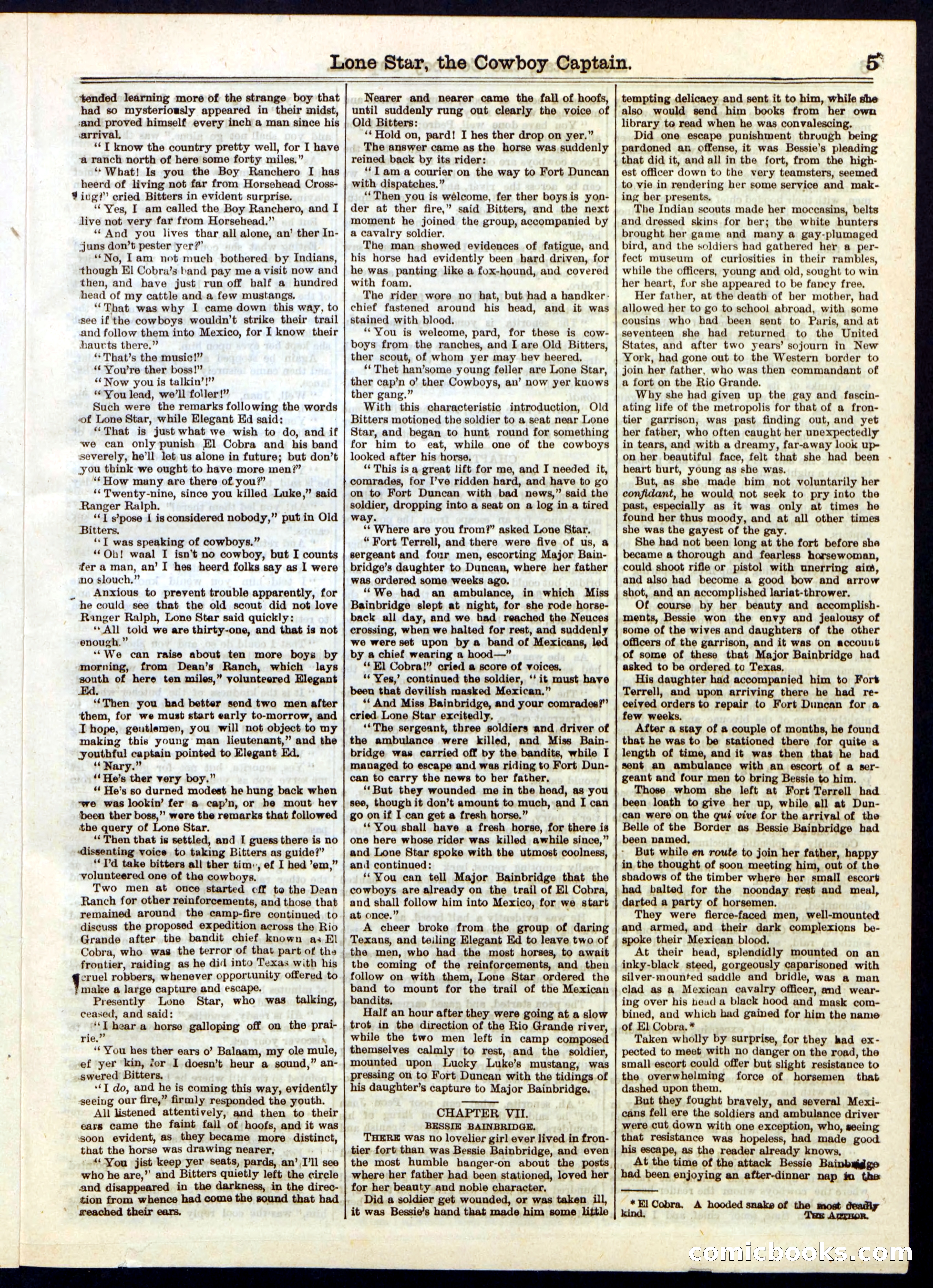
A restored page from Pulp Fiction, 1882. Page through the whole issue in the reader above.
📄 Transcribed text from this page (OCR, searchable)
Machine-transcribed from the original scan — historical spelling and the odd misread are preserved.
Lone Star, the Cowboy Captain. tended learning more of the strange boy that had so mysteriously appeared in their midst, ‘and proved himself every inch a man since his arrival. ‘*T know the country pretty well, for I have ‘a ranch north of here some forty miles.” ‘‘ What! Is you the Boy Ranchero I has heerd of living not far from Horsehead Cross- Y¥iug?” cried Bitters in evident surprise. ‘‘- Yes, I am called the Boy Ranchero, and I live not very far from Horsehead.”’ ‘‘ And you lives thar all alone, an’ ther In- juns don’t pester yer?’ ‘No, Lam not much bothered by Indians, though El Cobra’s band pay me a visit now and then, and have just run off balf a hundred head of my cattle and a few mustangs. “That was why I came down this way, to see if the cowboys wouldn’t strike their trail and follow them into Mexico, for I know their haurts there.” **That’s the music!” *€ You’re ther boss!” “Now you is talkin’!”’ “You lead, we’ll foller!” Such were the remarks following the words of Lone Star, while Elegant Ed said: “That is just what we wish to do, and if we can only punish El Cobra and his band severely, he'll let us alone in future; but don’t you think we ought to have more men?” “How many are there of you?’ ‘‘Twenty-nine, since you killed Luke,” said Ranger Ralph. ‘1 s’pose | is considered nobody,” put in Old Bitters. ‘‘T was speaking of cowboys.” ‘‘Oh! waal I isn't no cowboy, but I counts fer a man, an’ I hes heerd folks say as I were no slouch,” _ Anxious to prevent trouble apparently, for he could see that the old scout did not love Ranger Ralph, Lone Star said quickly: ‘‘ All told we are thirty-one, and that is not enough.” ‘““We can raise about ten more boys by morning, from Dean’s Ranch, which lays south of here ten miles,” volunteered Elegant Ed. “Then you had better send two men after them, for we must start early to-morrow, and I hope, geutlemen, you will not object to my making this young man lieutenant,” and the youthful captain pointed to Elegant Ed, 44 Nary. ” ‘‘He’s ther very boy.” “‘ He’s so durned modest he hung back when "we was lookin’ fer a cap’n, or be mout hev been ther boss,” were the remarks that followed the query of Lone Star. “Then that is settled, and I guess there is no ‘dissenting voice to taking Bitters as guide?” ‘I'd take bitters all ther tim:, ef I hed ’em,” volunteered one of the cowboys. Two men at ouce started off to the Dean Ranch for other reinforcements, and those that remained around the camp-fire continued to discuss the proposed expedition across the Rio Grande after the bandit chief known as El Cobra, who was the terror of that part of the frontier, raiding as he did into Texas with his cruel robbers, whenever opportunity offered to ee a large capture and escape. Presently Lone Star, who was talking, ceased, and said: : ‘‘T hear a horse galloping off on the prai- rie,” . ‘‘You hes ther ears o’ Balaam, my ole mule, ef yer kin, Zor I doesn’t heur a sound,” an- swered Bitters, ‘‘T do, and he is coming this way, evidently seeing our fire,” firmly responded the youth. All listened attentively, and then to their ears came the faint fall of hoofs, and it was soon evident, as they became more distinct, that the horse was drawing nearer, You jist keep yer seats, pards, an’ I’ll see who he are,” and Bitters quietly left the circle and disappeared in the darkness, in the direc- ‘tion from whence had come the sound that had weached their ears. Nearer and nearer came the fall of hoofs, until suddenly rung out clearly the voice of Old Bitters: ‘* Hold on, pard! I hes ther drop on yer.” The answer came as the horse was suddenly reined back by its rider: ‘‘I am a courier on the way to Fort Duncan with dispatches.” ‘‘Then you is wélcome, fer ther boysis yon- der at ther fire,” said Bitters, and the next moment he joined the group, accompanied by a cavalry soldier. The man showed evidences of fatigue, and his horse had evidently been hard driven, for he was panting like a fox-hound, and covered with foam. The rider wore no hat, but had a handker- chief fastened around his head, and it was stained with blood. **You is welcome, pard, for these is cow- boys from the ranches, and I are Old Bitters, ther scout, of whom yer may hev heered. ‘**Thet han’some young feller are Lone Star, ther cap’n o’ ther Cowboys, an’ now yer kuows ther gang.” With this characteristic introduction, Old Bitters motioned the soldier to a seat near Lone Star, and began to hunt round for something for him to eat, while one of the cowboys looked after his horse, “This is a great lift for me, and I needed it, comrades, for I’ve ridden hard, and have to go on to Fort Duncan with bad news,’ said the soldier, dropping into a seat on a log in a tired way. ‘‘ Where are you from?” asked Lone Star. “Fort Terrell, and there were five of us, a sergeant and four men, escorting Major Bain- bridge’s daughter to Duncan, where her father was ordered some weeks ago. “We bad an ambulance, in which Miss Bainbridge slept at night, for she rode horse- back all day, and we had reached the Neuces crossing, when we halted for rest, and suddenly we were set upon by a band of Mexicans, led by a chief wearing a hood—” ‘* El Cobra!” cried a score of voices. ‘* Yes,’ continued the soldier, ‘ it must have been that devilish masked Mexican,” ‘And Miss Bainbridge, and your comrades?” cried Lone Star excitedly. ‘*The sergeant, three soldiers and driver of the ambulance were killed, and Miss Bain- bridge was carried off by the bandits, while I managed to escape and was riding to Fort Dun- can to carry the news to her father, ‘‘But they wounded me in the head, as you see, though it don’t amount to much, and I can go on if I can get a fresh horse.” | ‘* You shall have a fresh horse, for there is one here whose rider was killed awhile since,” and Lone Star spoke with the utmost coolness, and continued: | ‘‘ You can tell Major Bainbridge that the cowboys are already on the trail of El Cobra, and shall follow him into Mexico, for we start at once.” A cheer broke from the group of daring Texans, and teiling Elegant Ed to leave two of the men, who had the most horses, to await the coming of the reinforcements, and then follow on with them, Lone Star ordered the band to mount for the trail of the Mexican bandits, Half an hour after they were going at a slow trot in the direction of the Rio Grande river, while the two men left in camp composed themselves calmly to rest, and the soldier, mounted upon Lucky Luke’s mustang, was pressing on to Fort Duncan with the tidings of his daughter’s capture to Major Bainbridge. CHAPTER VII. BESSIE BAINBRIDGE. THERE was no lovelier girl ever lived in fron- tier fort than was Bessie Bainbridge, and even the most humble banger-on about the posts. where her father had been stationed, loved her for her beauty and noble character, Did a soldier get wounded, or was taken ill, it was Bessie’s hand that made him some little 5 tempting delicacy and sent it to him, while she also would send him books from her own library to read when he was convalescing. Did one escape punishment thruugh being pardoned an offense, it was Bessie’s pleading that did it, and all in the fort, from the high- est officer down to the very teamsters, seemed to vie in rendering her some service and mak- ing ber presents. The Indian scouts made her moccasins, belts and dressed skins for ber; the white hunters brought her game and many a gay-plumaged bird, and the soldiers had gathered her a per- fect museum of curiosities in their rambles, while the officers, young and old, sought to win her heart, fur she appeared to be fancy free, Her father, at the death of ber mother, had allowed her to go to school abroad, with some cousins who had been sent to Paris, and at seventeen she had returned to the United States, and after two years’ sojourn in New York, had gone out to the Western border to join her father, who was then commandant of a fort on the Rio Grande. Why she had given up the gay and fascin- ating life of the metropolis for that of a fron- tier garrison, was past finding out, and yet her father, who often caught her unexpectedly in tears, and witb a dreamy, far-away look up- on her beautiful face, felt that she had been .- heart hurt, young as she was. But, as she made him not voluntarily her confidant, he would not seek to pry into the past, especially as it was only at times he found her thus moody, and at all other times she was the gayest of the gay. She had not been long at the fort before she became a thorough and fearless harsewoman, could shoot rifle or pistol with unerring aim, and also had become a good bow and arrow shot, and an accomplished lariat-thrower. Of course by her beauty and accomplish- ments, Bessie won the envy and jealousy of some of the wives and daughters of the other officers of the garrison, and it was on account of some of these that Major Bainbridge had asked to be ordered to Texas. His daughter had accompanied him to Fort Terrell, and upon arriving there he had re- ceived orders to repair to Fort Duncan for a few weeks. After a stay of a couple of months, he found that he was to be stationed there for quite a length of time, and it was then that he had sent an ambulance with an escort of a ser- geant and four men to bring Bessie to him. Those whom she left at Fort Terrell had been loath to give her up, while all at Dun- can were on the qui vive for the arrival of the Belle of the Border as Bessie Bainbridge had been pamed, | But while en route to join her father, happy in the thought of soon meeting him, out of the shadows of the timber where her small escort had balted for the noonday rest and meal, darted a party of horsemen. They were flierce-faced men, well-mounted and armed, and their dark complexions be- spoke their Mexican blood. At their bead, splendidly mounted on an inky-black steed, gorgeously caparisoned with silver-mounted saddle and bridle, was a man clad as a Mexican cavalry officer, and wear- ing over his bead a black hood and mask com- bined, and which had gained for him the name of El Cobra. * | Taken wholly by surprise, for they had ex- pected to meet with no danger on the road, the small escort could offer but slight resistance to the overwhelming force of horsemen that dashed upon them, But they fought bravely, and several Mexi- cans fell ere the soldiers and ambulance driver were cut down with one exception, who, seeing that resistance was hopeless, had made good his escape, as the reader already knows, At the time of the attack Bessie Bainbaigge had been enjoying an after-dinner nap in the —_—_—_—_—_— *E] Cobra. A hooded snake of the most | =e deadly —eee ‘ <€om 0)(0\(6) (C <S (E(0)