
Pulp Fiction, 1877 · page 26 of 32
Beadle's Half Dime Library, No. 16 — page 26: what you’re looking at
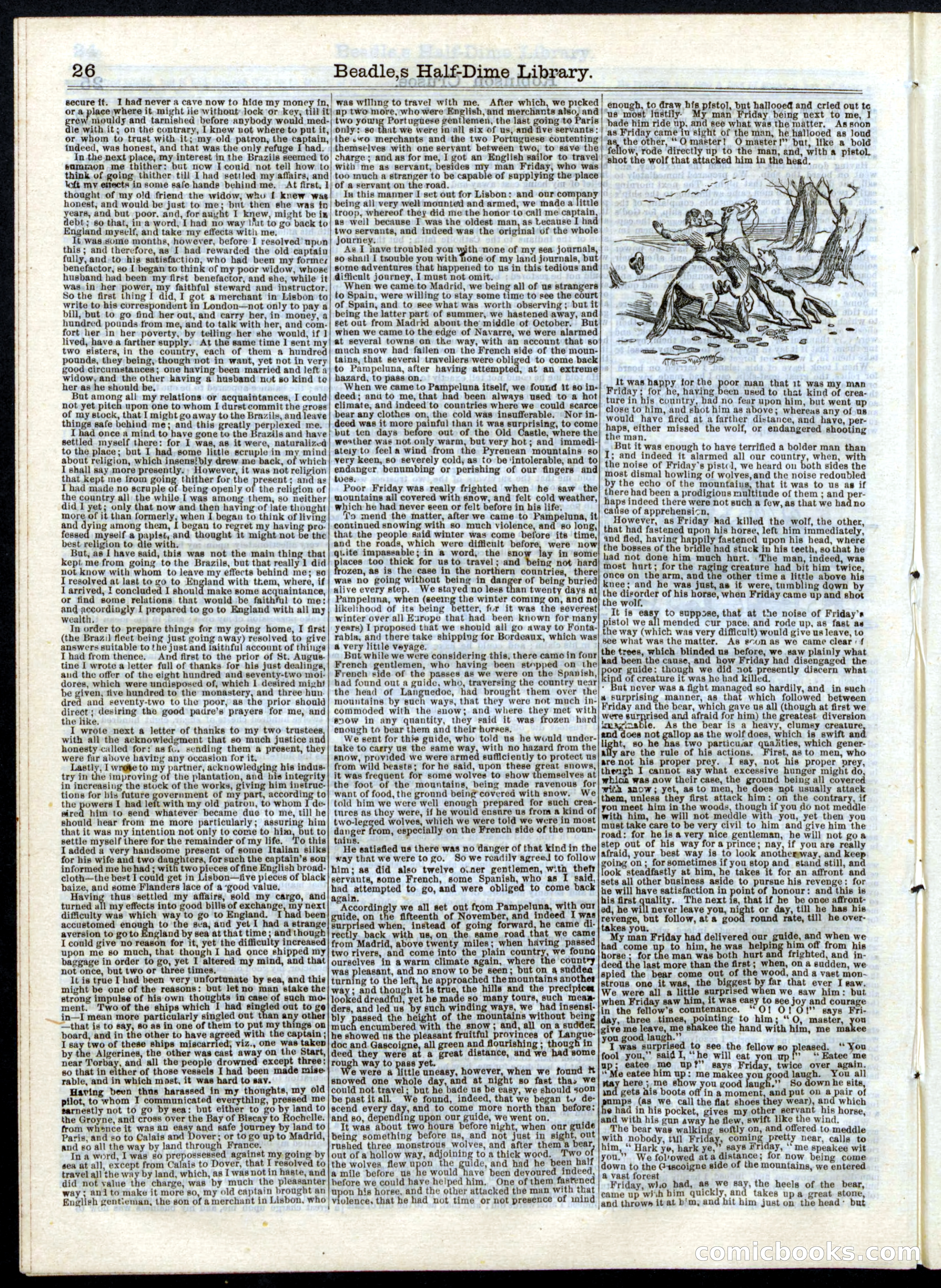
A restored page from Pulp Fiction, 1877. Page through the whole issue in the reader above.
📄 Transcribed text from this page (OCR, searchable)
Machine-transcribed from the original scan — historical spelling and the odd misread are preserved.
| | rj ~-+- ~- —~»-- — —_ _—_ — —— ——— + oe ee a - —_—- - eo +e ee —~—— ee ee ee ee ee + , ee ee ee eee - —s i ee | + 26 ————$ ———e Beadle,s Half-Dime Library. secure it. I had never a cave now to hide my mone in, | was willing to travel with me. After which, we picked or a place where it might iie without lock or key, till it rew mouldy and tarnished before anybody would med- le with it; on the contrary, I knew not where to put it, or whom to trust with it; my old patron, the captain, indeed, was honest, and that was the only refuge I had. In the next place, my interest in the Brazils seemed to samimon me thither: but now I could not tell how to think of going thither till I had settled my affairs, and loft my eitects in some safe hands behind me. At first, | thought of my old friend the widow, whu [ knew was honest, and would be just to me; brut then she was fn ears, and but poor. and, for auyht I knew, might be is ebt; so that, in a word, I had no way !/ut to go back to England myself, and take my effects with me. It was some months, however, before I resolved’ upun this; and therefore, as I had rewarded the old captain fully, and to his satisfaction, who had been my formes benefactor, so I began to think of my poor widow, whose husband had been my first benefactor, and she, while it was. in her power my, faithful steward and instructor. So the first thing | did, I got a merchant in Lisbon to write to his correspondent in London—not only to pay a bill, but to go find her out, and carry her, in money, a hundred pounds trom me, and to talk with her, and com- fort her in her poverty, by telling her she would, if 1 lived, have a farther supply. At the same time I sent my two sisters, in the country, each of them a hundred pounds, they being, though not in want, yet not in very good circumstances; one having been married and left a widow, and the other having a husband nut so kind te her as he should be, But oe all my relations or acquaintances, I could not yet pitch upon one to whom I durst commit the gross of my stock, that I might go away to the Brazils, and leave things safe behind me; and this greatly perplexed me. I had once a mind to have gone to the Brazils and have settled myself there: for I was, as it were, naturalized to the place; but I had. some little scruple in my mind about religion, which insens! bly drew me back, of which I shall say more presently. However, it was not religion that kept me from going thither for the yee and as| to I had made no scruple of being openly of the religion of the country all the while | was among them, so neither did I yet; only that now and then haying of late thought more of it than formerly, when I began to think of living sod dying among them, I began to ~ my having pro. fes myself a papist, and thought it might not a the best religion to die with. But, as I have said, this was not the main thing that kept. me from going tothe Brazils, but that really 1 did not. know with whom to leave my effects behind me; se I resolved at last to go to England with them, where, if I arrived, I concluded I should make some acquaintance, or find some relations that would be faithful to me: ws pam I prepared to go to England with all my wealth. In order to prepare things for my going home, I first (the Braz.) fleet being just going away) resolved to give answers suitable to the just and taithful account of things I had from thence. And first to the prior of St. Augus- tine | wrote a letter full of thanks for his just dealings, and the offer of the eight hundred and seventy-two moi- dores, which were undisposed of, which | desired might iven, tive hundred to the monastery, and three hun. dred and seventy-two to the poor, as the prior should direct; desiring the good padre’s prayers for me, and the hike. I wrote next a letter of thanks to my two trustees with all the acknowledgment that so much justice an honesty called for: as fv. sending them a present, they were far above havirg any occasion for it. Lastly, | wre@te to my partner, acknowled ing his indus- try in the improving of the plantation, and his integrity in increasing the stock of the works, giving him inetruc- tions for bis future fhe ate 9 of my part, according to the powers I had left with my old patron, to whom I de- mired him to send whatever became due to me, till he should hear from me more particularly; assuring him that it was my intention not only to come to him, but to settle myself there for the remainder of my life. To this I added a very handsome present of some Italian silks for his wife and two —— - jreemy for such the captain’s son informed me he had ; with two pieces of fine English broad- cloth—the best I could get in Lisbon—five pieces of black baize, and some Flanders lace of a*good value, Having thus settled my affairs, sold my cargo, and turned ull my effects into good bills of exchange, my next difficulty was which way to go to England. I been accustomed enough to the sva, aud yet I had a strange aversion to goto England by sea at that time; and though I could give no reason for it, yet the difficulty increased upon me so much, that though I had once shipped my baggage in order to go, yet I altered my mind, and that not once, but two or three times. lt is true I had been very unfortunate by sea, and thie might be one of the reasons: but let no man stake the strong impulse of his own thoughts in case of such mo- ment. Twoof the ships which I had singled out to ge in—I mean more particularly singled out t any other —that is to say, 80 as in one of them to put my th on board, and in the other to ate ee with the captain ; I a“? two of these ships mi ne viz., one was takep by the Algerines, the other was cast away on the Start, near Torbay, and all the people drowned except three: so that in either of those vessels I had been made mise rable, and in which most, it was hard to say. Ha been thus harassed in my thonghts, my old pilot, to whom I communicated everything, pressed me sarnestly not to go by sea: but either to go by land to the Groyne, and cross over the Bay of Biscay to Rochelle. from whence it was an bin yy Ana safe journey by land to Paris, and so to Calais and Dover; or to go up to Madrid, and go all the way by land through France. In a word, I was 80 prepossessed against my going by sea at all, except from Calais to Dover, that I resolved to travel all the wa y by land, which, as I was not in haste, and did not value the charge, was by much the pleasanter way ; ani to make it more so, my old captain brought an Englieh gentieman, the son of a merchant in Lisbon, who! np two more, who were English, and merchants also, and two owe eee uguese gentlemen, the last going to Paris only: so thut we were in all six of us, and five servants: the .~o merchants and the two Portuguese contenting themselves with one seryant between two, to save the charge ; and as for me, I got an English sailor to travel with me as servant, besides man Friday, who was too much a stranger to be capable of supplying the place of a servant on the road. Iu this manner I set out for Lisbon: and our company being all very well mounted and armed, we made a little troop, whereof they did me the honor to call me captain as well because I was the oldest man, as Lecause I had i servants, and indeed was the original of the whole ourney. As I nave troubled you Co none of my sea journals, 80 shail I trouble you with hone of my land journals, but some adventures that happened to us in this tedious and difficult journey, I must not omit. When we came to Madrid, we being all of us st ers to Spain, were willing to stay some time to see the court of Spain, and to see what was worth observing; but it being the latter part of summer, we hastened away, and eet out from Madrid about the middle of October. But when we came to the edge of Navarre, we were alarmed at several towns on the way, with an account that so much snow had fallen on the French side of the moun- tains, that several travellers were obliged to come back to Pampeluna, after having attempted, at an extreme bazard, to pass on. When we came to Pampeluna itself, we found it so in- deed; anu to me, that had been always used to a hot climate, and indeed to countries where we could scarce bear any clothes on, the cold was insufferable. Nor in- deed was it more painful than it was sur rising, to come but ten days before out of the Old tle, where the westher was not only warm, but very hot; and immedi- ateiy to feela wind from the Pyrenean mountains so very keen, 80 severely cold, as to be ‘intolerable, and to endanger benumbing or perishing of our fingers and es. Poor Friday was really frighted when he saw the mountains all covered with snow, and felt cold weather, which he had never seen or felt before in his life. To mend the matter, after we came to Pampeluna, it continued snowing with so much violence, and so long, that the people said winter was come before its time, and the roads, which were difficult before, were now gt.ite impassable ; in a word, the sno lay in some laces too thick for usto travel; and being not hard zen, as is the case in the northern countries, there was no going without being in danger of being buried alive every step. We stayed no lexs than twenty days at Pampeluna, when arene the winter coming on, and no likelihood of its being better, fur it was the severest winter over all Europe that had been known for many years) I proposed that we should all go away to Fonta- rabia, and here take shipping for Bordeaux, which was a very little veyazge. But while we were considering this, there camo in four French gentlemen, who having been stepped on the French side of the passes as we were on the Spanish, had found out a guide, who, traversing the country uear the head of Languedoc, had brought them over the mountains by such ways, that they were not much in- commoded with the snow; and where they met with enow in any quantity, they said it was frozen hard enough to bear them and their hurses, We sent for thie guide, who told us he would under- take to carry us the same way, with no hazard from the anow, provided we were armed sufficiently to protect us from wild beasts; for he said, upon these great snows, it was frequent for some wolves to show themselves at the foot of the mountains, being made ravenous for want of food, the gronnd being’covered with snow. We told him we were well enough prepared for such crea- tures as they were, if he would ensure us from a kind of two-legged wolves, which we were told we were in most danger fron, especially on the French side of the moun- tains. He satisfied us there was no danger of that kind in the way that we were to go. So we readily agreed to follow him; as did also twelve o.ner gentlemen, with thefr servants, some French, some Spanish, who as I said, rem attempted to go, and were obliged to come back ain. wee ly we all set out from Pampeluna, with our guide, on the fifteenth of November, and indeed I was surprised when, instead of going forward, he came di- rectly back with us, on the same road that we came from Madrid, above twenty miles; when having passed two rivers, and come into the plain country, we founa ourselves in a warm climate again, where the country was pleasant, and no snow to be seen; but on a sunddea turning to the = he approached the mountains anothet way; and though it is true, the hills and the precipicer looked dreadful, yet he made so many tours, such meaa- ders, and led us by such winding ways, we had insensi- bly passed the height of the mountains without bein mach encumbered with the snow; and, all on a sudd he showed ne the pleasant fruitful provinces of Langue- doc and Gagooiene, all green and flourishing ; though in deed they were at a great distance, and we had some rongn way to pags yet. e were & little uneasy, however, when we found fw snowed one whole day, and at night so fast tha, we could not travel; but he bade us be easy, we should soon be past it all. e found, indeed, that we began tu de- scend every day, and to come more north than before: and so, depending upon our guide, we went on. It was about two hours before night, when our guide being something before us, and not just in sigh , out rushed three monstrous wolves, and after them a bear out of a hollow way, adjoining to a thick woed. Two 0 the wolves flew upon the guide, and had he been half a mile before us he would have been devoured indeed, before we could have helped him. One of them fastened upon his horee, and the other attacked the man with that olence, that he had not time or not presence of mind 7 |him, “ Hark ye, hark ye,” says # ' j enough, to draw his pistol, Vat dalicoed and cried out te us most Instily My man day being next to me, | bade him ride oy and see what was the matter. Assoon as Friday came in sight of the man, he hallooed as loud Bathe other, “O master! O master!” but, like a bold fellow, rode directly up to the man, and, with a pistol. shot the wolf that attacked him in the head. it was happy Friday; for he, haying been used to that kind of crea- ture in his country, had no fear upon him, but went up close to him, and shot him as above; whereas any of us would have fired at a farther distance, and have, per- fe either missed the wolf, or endangered shooting e man. But it was enough to have terrified a bolder man than I; and indeed it alarmed all our rate” when, with the noise of Friday's pistol, we heard on both sides the most dismal howling of wolves,and the noise redoubled by the echo of the mountaius, that it was to us ae if there had been a prodigious multitude of them ; and per- mops indeed there were not such a few, as that we had no calise of apprehensicn, However, as Friday had killed the wolf, the other, that had fastened upon his horse, left him immediately, and fled, having happily fastened upon his head, where the bosses of the bridle had stuck in his teeth, so that he Lad not done him much hurt. The man, indeed, was most hurt; for the ng creature had bit him twice, once on the arm, and the other time a little above his knee; and he was just, as it were, tumbling down by on co Rg 3 of his horse, when Friday came up and shot e wolf, It is Saar to suppose, that at the noise of Friday's pistol we all mended cur pace. and rode up, as fast as the way (which was very difficult) would give us leave, to see what was the matter. As econ as we came clear : f the trees, which blinded us before, we saw plainly what had been the cause, and how Friday had disengaged the pos guide: though we did not presently diacern what ind of creature it was he had killed. * But never was a fight managed so hardily, and in such % poprieing manner, as that which followed between Friday and the bear, which gave us all (though at first we were surprised and afraid for him) the greatest diversion ; inable. As the bear is a heavy, clumsy creature and does not gallop as the wolf does, which is swift an light, so he wo particusr ere which gener- y are the rule of his actions. ret, as to men, who are not his proper prey. I say, not his proper prey, theigh I cannot say what excessive hunger might do whica was aow their case, the ground being all cover with anow; yet, as to men, he does not usually attack unless they first attack him: on the contrary, if you meet him in the woods, though if you do not meddle with him, he will not meddle with you, yet then you must take care to be very civil to him and give him the road; for he is a very nice gentleman, he will not goa step out of his way fora prince; nay, if you are really afraid, your best way is to look anothemway, and kee oing on; for sometimes if you stop and stand still, an ook steadfastly at him, he takes it for an affront and sets all other business aside to pursue his revenge: for he will have satisfaction in ngs of honour: and this is his first quality. The next is, thatif he be once affront- ed, he never leave you, night or day, till he has his ree but follow, ata g round rate, till he over- you. My man Friday had delivered our guide, and when we had come up to him, he was helping him off from his horse; for the man was both hurt and frighted, and in- deed the last more than the first; when, on a sudden, we spied the bear come out of the wood, and a vast mon- strous one it was, the Dianees Ri far that ever I eaw. We were all a little surprised when we saw him: but when Friday saw it was easy to see joy and courage in the fellow’s countenance. “O! O! O!" says Fri- day, three times, pointing to him; “O, master, Bip give me leave, me 8 the hand with him, me makee you good laugh. I was surprised to see the fellow so pleased. ‘ You fool you,” said I, “he will eat you up!" “ Eatee me up; eatee mo up?’ says Friday, twice over_again. Me eatee him up: me makee you good laugh. You all ay here ; me show you good laugh,” So down he sits, and gets ais boots off in a moment, and put on a pair of mps (a8 we call the flat shoes they wear), and which e had in his pocket, gives my other servant his horse, and with his gun away he flew, swift like the wind. The bear was walking softly on, and offered to meddle with nobody, till Friday, coming pretty near, calle to riday, ‘* me speakee wit you.” We foltowed ata distance; for now being come down to the G4scoigne side of the mountains, we entered & vast forest Friday, wo had, a8 we say, the heels of the bear, eame up wiih bim quickly, and takes upa great stone, and throws it at b'm, and hit him just on the head: but tor the pos man that 1t was my man EORMIECLOOOKS (E (E(0) Oe ee ee ee