
Pulp Fiction, 1877 · page 25 of 32
Beadle's Half Dime Library, No. 16 — page 25: what you’re looking at
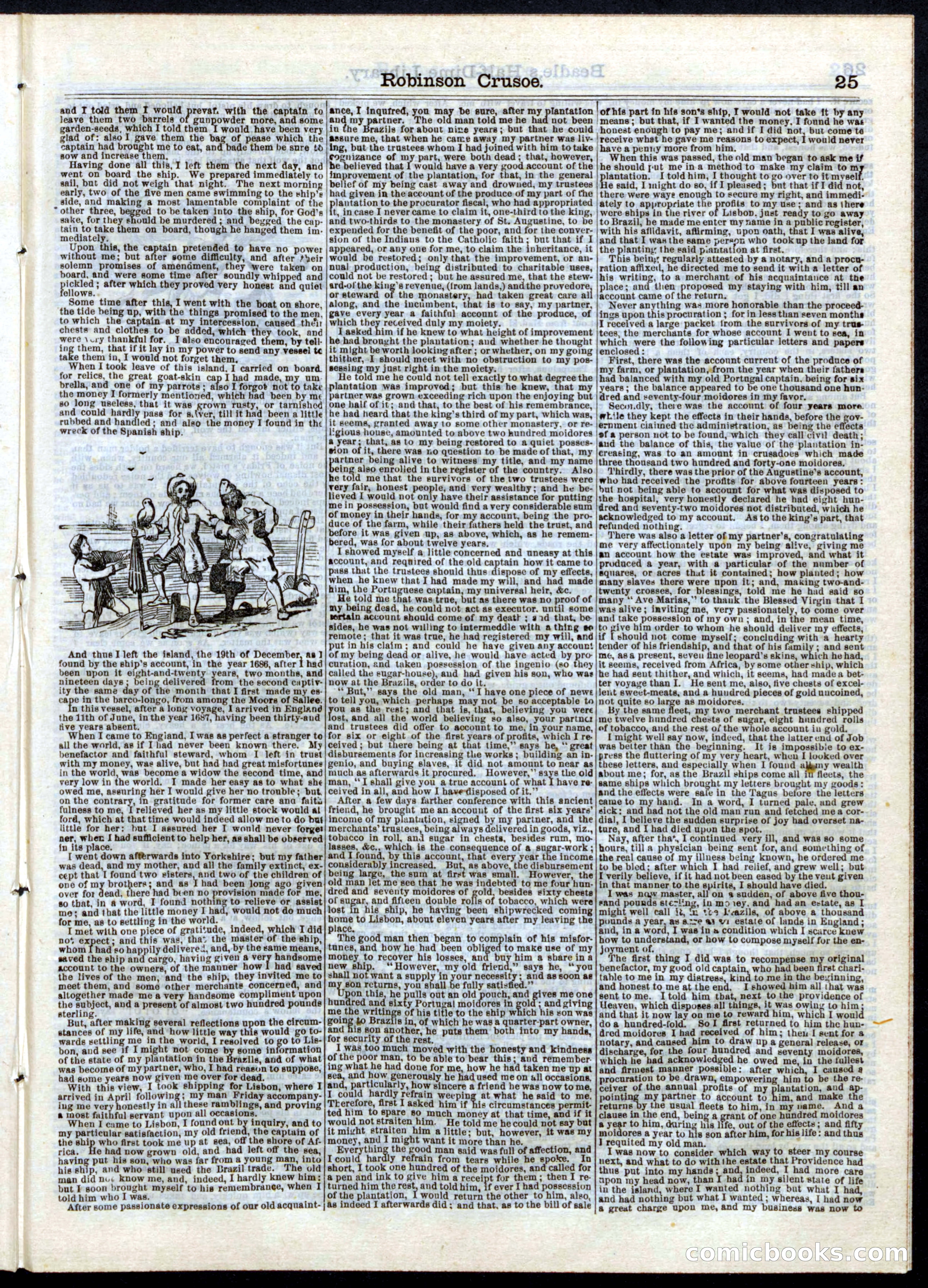
A restored page from Pulp Fiction, 1877. Page through the whole issue in the reader above.
📄 Transcribed text from this page (OCR, searchable)
Machine-transcribed from the original scan — historical spelling and the odd misread are preserved.
and I told them I would prevaf. with the captain to leave them two barrels o Sei abe more, and some garden-seeds, which I told them I would have been very glad of: alaoI gave them the bag of pease which the captain had brought me to eat, and bade them be snre to sow and increase them, Having done all this, I left them the next day, and went on board the ship. We prepared immediately to sail, but did not weigh that night. The next morning early, two of the five men came swimming to the ship's side, and making a most lamentable complaint of the | other three, begged to be taken into the ship, for God's sake, for they should be murdered ; and begged the cap- tain to take them on board, though he hanged them im. mediately. Upon this, the captain pretended to have no power without me; but after some difficulty, and after *beir solemn promises of amendment, they ‘were taken on board, and were some time after soundly whipped and eee ; after which they proved very honest and quiet ellows.. Some time after this, I went with the boat on shore, the tide being up, with the things promised to the men. to which the captain at my intercession, caused thei: chests and clothes to be added, which they took, and were \.ry thankful for. I also encouraged them, by tell- ing them, that if it lay in my power to send any vessel tc take them in, I would not forget them, When I took leave of this island, I carried on board. for relics, the great goat-skin cap I had made, my um. brella, and one of my parrots; also I forgot not to take the money I formerly mentioned, which had been by mc 80 long useless, that it was grown rusty, or tarnished and could hardly pase for a,(ver, till it had been a little rubbed and handled; and aleo the money I found in the wreck of the Spanish ship. And thue I left the island, the 19th of December, as ] found by the ship's account, in the year 1686, after i had been upon it eight-and-twenty years, two months, and nineteen days ; being delivered from the second captiv- ity the same day of the month that I first made my es- cape in the barco-longo, from among the Moors of Sallee. n this vessel, after a long voyage, I arrived in England the 11th of June, in the year 1687, having been thirty-and tive years absent. When I came to Engiand, I wae as perfect a etranger to all the world, as if Ihad never been known there. My benefactor and faithful steward, whom I left in trust with my money, was alive, but had had great misfortunee in the world, was become a widow the second time, and very low in the world. I made her easy as to what she owed me, aseuring her I would give her no trouble; but. on the contrary, in gratitude for former care ana faits fulness to me, I relieved her as my little stock would al ford, which at that time would indeed allow meto do but little for her: but I assured her I wonld never forget oon sa I had sufficient to he)p her, as shall be observed in its place. [ went down afttrwards into Yorkshire; but my father was dead, and my mother, and all the family extinct, ex- cept that I found two visters, and two of the children of one of my brothers; and as J had been long ago given over for dead, there had been no vision made for me, so that, in a word, I found nothing to relieve or assist me; and that the little mage ae , would not do much for me, as to settling in the world. I met with one niece of gratitude, indeed, which TI did no* expect; and this was, tha the master of the ship, whom I had so happily delivere2, and, by the same means, saved the ship and cargo, having given a ve handsome account to the owners, of the manner how | had saved the lives of the men, and the ship, they invited me to meet them, and some other merchants concerned, and altogether made me a very handsome compliment upon the wnaee? and a present of almost two hundred pounds sterling. But, ‘after making several reflections upon the circum- stances of my life, and how little way thie would go to- wards settling me in the world, I resolved to go to Lis- bon, and see if Imight not come some information of the state of my plantation in the Brazils, and of what was become of my partner, who, I had reason to suppose, had sume years now given me over for dead. With this view, I took shipping for Lisbon, where I arrived in April following; my man Friday accompany- ing me very honestly in all these ramblings, and proving a inost faithful servant upon all occasions. When I came to Lisbon, I found ont by inquiry, and to my particular satisfaction, my old friend, the captain of the ship who first took me up at sea, off the shore of Af- rica. He had now grown old, and had left off the sea, having put his son, who was far from a young man, into hia ship, and who still used the Brazil trade. The old man did nur know me, and, indeed, I hardly knew him; but F soon brought myself to his remembranee, when I told him who I was. ; After some passionate expressions of our old acquaint- | Robinson Crusoe. _—— 25 ~ ance, I inqufred, you may be sure, after my plantation | or his part in his son's ship, I would not take it by any = my partner. The old man told me he not been iu the Brazils for about nize yeare; but that he could assure me, that when he came away my partner was liv- ing, but the trustees whom I had join ¢ognizance of my part, were both dead; that, however, he believed that I would have a very good account of the finprovement of the plantation, for that, in the general belief of my being cast away and drowned, my trustees had given in the aceount of the produce of my part of the lantation to the procurator fiscal, who had appropriated t, in case I never came to claim it, one-third to the king, and two-thirds to the monastery of St. Augustine, to be expended for the benefit of the poor, and for the conver- sion of the Indiaus to the Catholic faith; but that if I appeared, or any one for me, to claim the inheritance, it would be restored; only that the improvement, or an- nual production, being distributed to charitable uses, could not be restored; but he assured me, that the stew- ard-ol the king's revenue, (from lands,) andthe provedore or steward of the monastery, had taken great care al along, and the incumbent, that is to say, my partner, gave every year a faithful account of the produce, of which they received duly my moiety. I asked him if he knew to what height of improvement he had brought the plantation; and whether he thought it might be worth looking after ; or whether, on my going thither, I should meet with no obstruction to my pos- sessing my just right in the moiety. He told me he could not tell exactly to what degree the plantation was improved; but this he knew, that my partner was grown exceeding rich upon the enjoying but one half of it; and that, to the best of his remembrance, he had heard that the king's third of my part, which was, it seems, granted away to some other monastery, or re- gious house, amounted to above two hundred moidores a year; that, as to my being restored to a quiet posses- pion of it, there was no question to be made of that, my perenne being alive to witness my title, and my name ing also enrolied in the register of the country. Also he told me that the survivors of the two trustees were very fair, honest people, and very wealthy; and he be- lieved I would not only have their assistance for nee mein possession, but would find a very considerable sum of money in their hands, for my account, being the pro- duce of the farm, while their fathers held the trust, and before it was given up, as above, which, as he remem- bered, was for about twelve years. I showed myself a little concerned and uneasy at this account, and reqnired of the old captain how it came to puss that the trustees should thus ispose of my effects, when he knew that I had made my will, and had made him, the Portuguese captain, my universal heir, &c. He told me that was true, but as there was no proof of my being dead, he could not act as executor. until some account should come of my deatt ; 21d that, be sides, he was not willing to intermeddle with a thing ee remote; that it was true, he had registered my will, and put in his claim; and could he have given any account of my being dead or alive, he would have acted by pro curation, and taken possession of the ingenio (so they called the sugar-house), aud had given his son, who was now at the Brazils, order to do it. ** But,’’ says the old man, “I have one piece of newe to tell you, which perhaps may not be so acceptable to ou as the rest; and that is, that, believing you were ost, and all the world believing so also, your partnc: and trustees did offer to account to me, in your name, for six or eight of the first years of profits, which I re. ceived; but there being at that time,”’ says he, ‘ great disbursements for anchenerhs the works ; building an in- genio, and buying slaves, it did not amount to near as much as afterwards it procured, However,” says the old man, ‘‘I shall give you a true account of what I have re- ceived in all, and how I havevdlisposed of it.” After a few days farther conference with this ancient friend, he brought mean account of the first six years’ income of my plantation, signed by my partner, and the merchants’ trustees, being always delivered in goods, viz., tobacco in roll, and sugar in chests, besides rum, mo- lasses, &c,, which is the consequence of a sugar-work ; and I found, by this account, that every year the income considerably increased, But, as above, the disbursement being large, the sum at first was small. However, the old man let me see that he was indebted to me four hun- dred and seventy moidores of gold, besides sixty chests of sugar, and fifteen double rolls of tobacco, which were lost in his ship, he having been shipwrecked coming me, to Lisbon, about eleven years after my leaving the place. The good man then began to complain of his misfor- tunes, and how he had been obliged to make use of my money to recover his losses, and buy him a sbare ina new ship. ‘However, my old friend,” says he, “you shall not want a supply in your necessity; and as soon ae my son returns, you shall be fully satisfied.” on this, he pe out an old pouch, and gives me one hundred and six y Portngal moidores in go} ; and giving me the wri of his title to the ship which his son was going 40 Brazils in, of which he was a quarter-part owner, and his fon another, he puts them both into my hands, for security of the rest, I was too much moved with the honesty and kindness of the poor man, to be able to bear this; and remember. ing what he had done for me, how he had taken me up at or a how generously he had used me on all occasions, and, particularly, how sincere a friend he was now to me, I could hardly refrain teil § at what he said to me. Tkerefore, first Il asked him if his circumstances ted him to spare 80 much money at that time, and if it would not straiten him. He told me hecould not say but it might straiten him a little; but, however, it was my money, and I might want it more than he. Everything the good man said was full of affection, and Icould hardly refrain from tears while yp sere In short, I took one hundred of the moidores, and called for a pen and ink to give him a receipt for them; then I re- turned him the rest, and told him, if ever I had possession of the plantation, 1 would return the other to him, also, as indeed I afterwards did; and that, as to the bill of sale ‘means; but that, if I wanted the money, I found he was honest enough to pay me; and if I did not, but come te ‘receive what he gave me reasons to expect, I would never with him totake have a penny more from him. When this was passed, the old man began to ask me if he should y-ut me ina method to make my claim to m ome I told him, I thought to go over to it mveelf. e said, I might do so, if I pleased; but that if I did not, to secure my right, and immedi- ately to appropriate t cane to my use; and as there were ships in the river of Lisbon, just ready to go away to Brazil, he made me entcr my name in a public register, with his aflidavit, affirming, upon oath, that I was alive, and that I was the same person who took up the land for the planting: the said p.antation at first. This bein, regularly attested by a notary, and a procu- ration affixed, he directed me to send it with a letter of his writing, to a merchant of his acquaintance at the place; and then asses my staying with him, till an account came of the return, Never anything was more honorable than the proceed- ings upon this procuration ; for in less than seven months I received a large packet from the survivors of my trus- tees, the merchants for whose account I went to sea, in which were the following particular letters and papers enclosed : First, there was the account current of the produce of my farm, or plantation,from the year when their fathers had balanced with my old Portagal captain, being for six years ; the balance appeared to be one thousand one hun- dred and seventy-four moidores in my favor. Secor.dly, there was the account of four years more. Lile they kept the effects in their hands, before the rov- ernment ciaiwned the administration, as being the effects ofa person not to be found, which they call civil death; aud the balance of this, the value of the plantation in- creasing, was to an amount in crusadoes which made three thousand two hundred and forty-one moidores. Thirdly, there was the prior of the Augustine's account, who had received the profits for above fourteen years: but not being able to account for what was disposed to the hospital, very honestly declared he had eight hun- dred and seventy-two moidores not distributed, which he acknowledged to my account. As to the king’s part, that refunded nothing. There was also a letter of my partner's, congratulating me very affectionately upon my being alive, giving me an account how the estate was improved, and what it produced a year, with a particular of the number of squares, or acres thut it contained; how planted; how many slaves there were upon it; and, making two-and- twenty crosses, for blessings, told me he had said so many *‘ Ave Marias,’’ to thank the Blessed Virgin that I was alive; inviting me, very passionately, to come over and take possession of my own ; and, in the mean time, to xe him order to whom he should deliver my effects, if I should not come myself; concluding with a hearty tender of his friendship, and that of his family ; and sent m6, a8 4 present, seven fine leopard’s skins, which he had, it seems, received from Africa, by some other ship, which he had sent thither, and which, it seems, had made a bet- ter voyaye than I. He sent me, also, five chests of excel- lent sweet-meats, and a huudred pieces of gould uucoined, not quite so large as moidores. By the same fleet, my two merchant trustees shipped me twelve hundred chests of sugar, eight hundred rolls of tobacco, and the rest of the whole account iu gold. [ might well say now, indeed, that the latter end of Job was better than the beginning. It is impossibie to ex- press the fluttering of my very heart, when I louked over these letters, and especially when I found ny wealth about me; for, as the Brazil ehips come all iff fleets, the same ships which brought my letters brought my goods: and the effects were sale in the Tagus before the letters came to my hand. In a word, I turned pale, and grew sick: and bad not the old man run and fetched mea cor- dial, I believe the sudden surprise of joy had overset na- ture, and I had died upon the spot. Nay, after tha*, I continued very ill, and was so some hours, till a physician being sent for, and something of the real cause of my illness being known, he ordered me to be bled; after which I had relief, and grew well; but I verily believe, if it had not been eased by the veut given in that manner to the spirits, I should have died. I was nay master, all on a sudden, of above five thou- feand pourds ste-"ng, in mo ey. and had an ertate, as I might well call it, “nx tte I'cazils, of above a thousand pounds a year, as s.cre a3 vi estate of lands in England; and, ina word, I was in » condition which I scarce knew how to understand, or how to compose myself for the en- snymees of, he first thing I did was to recompense my original benefactor, my good old captain, who had been first chari- table to me in my distress, kind to me in the bevinning, and honest to me at the end, I showed him all that was sent tome. I told him tbat, next to the providence of Heaven, which disposes all things, it was owing Lo him; and that it now lay on me to reward him, which I would doa hundred-fold. Sol firat returned to him the hun- dred moidores I had received of him; then I sent for a notary, and ca to draw up a general release, or discharge, for the four hundred and seventy moidores, which he had acknowledged he owed me, in the fullest and firmest manner possible: after which, I caused a procuration to be drawn, empowering him to be the re- ceiver of the annual profits of my plantation, and ap- pointing, ay 8 gotent to account to him, and make the returns by the usual fleets to him, in my vame. And a clause in the end, being a grant of one hundred moidores a year to him, during his life, out of the effects; and fifty moidores a year to his son after him, for his life: and thus J requited my old man. I was now to consider which way to steer my course next, and what to do with the estate that Providence had thus put into my hands; and, indeed, I had more care upon my head now, than I had in my silent state of life in the island, where I wanted nothing but what J had, and had nothing but what I wanted ; whereas, I had now @ great charge upon me, and my business was now to there were waye mnnes 1e EOMMIE NOOO KS (C —— eee eee ee (E() —