
Pulp Fiction, 1880 · page 4 of 16
Beadle's Half Dime Library, No. 145 — page 4: what you’re looking at
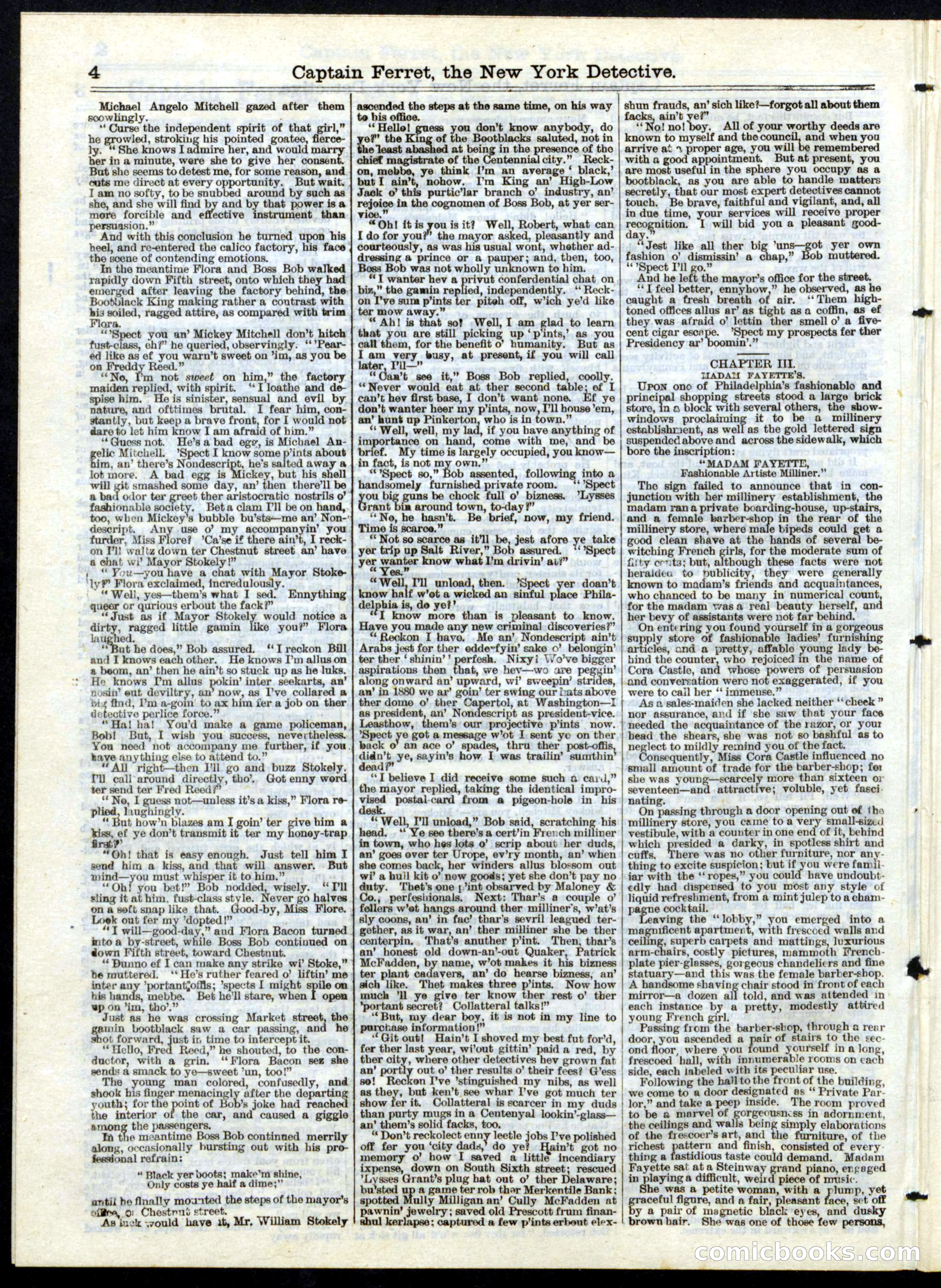
A restored page from Pulp Fiction, 1880. Page through the whole issue in the reader above.
📄 Transcribed text from this page (OCR, searchable)
Machine-transcribed from the original scan — historical spelling and the odd misread are preserved.
eee ee Michael Angelo Mitchell gazed after them scowlingly. : _ the independent spirit of that girl,” he growled, pte, his pointed goatee, fierce- ly. “She knows lLadmire her, and would m her in a minute, were she to give her consen But she seems to detest me, for some reason, and euts me direct at every opportunity. But wait. I am no softy, to be snubbed around by such as she, and she will find by and by that power isa mere forcible and effective ent than persuasion.” And with this conclusion he turned upon his heel, and re-entered the calico factory, his face the scene of contending emotions. In the meantime Flora and Boss Bob walked rapidly down Fifth street, onto which they had emerged after leaving the factory behind, the Boobtblack King making rather a coutrast with s soiled, ragged attire, as compared with trim ora. “Spect you an’ Mickey Mitchell don’t hitch tust-class, eh?’ he queried, observingly. ‘‘’Pear- ed like as ef you warn’t sweet on ’im, as you be on cage Reed.” ““No, Pm not sweet on him,” the factory maiden replied, with spirit. ‘“‘I loathe and de- spise him. He is sinister, sensual and evil by nature, and ofttimes brutal. I fear him, con- stantly, but keep a brave front, for I would not dare to let him know I am afraid of him.” ‘*Guess not. He’s a bad ege, is Michael An- elic Mitchell. ’Spect I know some bee about m, an’ there’s Nondescript, he’s salted away a lot more. A bad egg is Mickey, but his shell will git smashed some day, an’ then there'll be a bad odor ter greet ther aristocratic nostrils o’ fashionable society. Beta clam Ill be on hand, too, when Mickey’s bubble bu’sts—me an’ Non-’ descript. Any use 0’ my accompanyin’ you furder, Miss Flore? ’Ca’se if there ain’t, I reck- on I’l! waltz down ter Chestnut street an’ have a chat wi’ Mayor Stokely!” , ‘* You—you have a chat with Mayor Stoke ‘ly? Flora exclaimed, incredulously. “ Well, yes—them’s what I sed. Ennything queer or qurious erbout the fack?” “Just as if Mayor Stokely would notice a dirty, ragged little gamin like you?” Flora laughed. But he does,” Bob assured. ‘I reckon Bill and I knows each other. He knows I’m allus on a beom, an’ then he ain’t so stuck up as he luks. He knows I’m allus pokin’ inter seekarts, an’ nosin’ eut deviltry, an’ now, as I’ve collared a big fmd, ’'m a-goin to ax him fer a job on ther detective perlice force.” Ha! ha! Bob! But, I wish you success, nevertheless. You need not accompany me further, if you, have anything else to attend to.” " right—then J’ll go and buzz Stokely. Pll call around directly, tho’. Got enny werd ter send ter Fred Reed? “No, I guess not—unless it’s a kiss,” Flora re- plied, laughingly. “ But how’n blazes am I goin’ ter pin cf ye don’t transmit it ter my give bim a oney-trap “Oh! that is easy enough. Just tell him I send him a kiss, and that will answer. But mind—you must whisper it to him.” “Oh! you bet!” Bob nodded, wisely. ‘Ill sling it at him, fust-class style. Never go halves on a seft snap like that. Good-by, Miss Flore. Loek out fer my ’'dopted!” “‘T will—good-day,” and Flora Bacon turned into a by-street, while Boss Bob continued on. down Fifth street, toward Chestnut. ‘* Dunno ef I can make any strike wi’ Stoke,” he muttered. ‘‘ He’s ruther feared o’ liftin’ me inter any ’portantjoffis; ’spects I might spile on his hands, mebbe. Bet he'll stare, when I open ¥p on ’im, tho’.” Just as he was crossing Market ere . 3) min bootblack saw a car passing, an ot forward, just in time to intercept it. “Hello, Fred Reed,” he shouted, to the con- ductor, with a grin. ‘Flora Bacon sez she sends a smack to ye—sweet ’un, too!” The young man colored, confusedly, and shook his finger menacingly after the departin ng youth; for the point of Bob’s joke had reach the interior of the car, and caused a giggle among the passengers, Im the meantime Boss Bob continued merrily along, occasionally bursting out with his pro- fessional refrain: “ Black yer boots; make’m shine, Only costs ye haif a dime;”’ antil he finally mounted the steps of the mayor's oilira, ©: estrus street. As inck would have at, Mr, William Stokely that You’d make a game policeman, | Leasth at being in the presence of tho chief magistrate of the Centennial city.” Reck- on, mebbe, ye think I’m an average ‘ black,’ but I ain’t, nohow. I’m King an’ High-Low Jack o’ this purtic’lar branch o’ industry, an’ rejoice in the cognomen of Boss Bob, at yer ser- vice. “Oh! itis you is it? Well, Robert, what can I do for you?’ the mayor asked, pleasantly and courteously, as was his usual wont, whether ad- dressing a prince or a pauper; and, then, too, Bob was not wholly unknown to him. “T wanter hev a privut conferdential chat on biz,” the gamin papsed, independently. ‘ Reck- on I’ve sum p’ints ye’d like ter mow away. “ Ah! is that sof Well, I am glad to learn r piteh off, w’ic ou are still picking up ‘p’ints,’ as you call them, for the benefit o’ humanity. But as I am very busy, at present, if you will call later, ll “Gan’t see it,” Boss Bob replied, coolly. “Never would eat at ther second table; ef I can’t hev first base, I don’t want none. Ee ye don’t wanter heer my p’ints, now, [ll house ’em, an’ Wall, 2 su my lad. ea is - tye 9 ‘ . well, my if you have anything o importance on hand, come with me, and be brief. My time is largely occupied, you know— in fact, is not ig Fetpa *'Spect so,” Bob assented, following into a handsomely furnished private room. ‘‘ ’Spect ou big guns be chock full o’ bizness. ‘Lysses rant bim around town, to-day?’ “No, he hasn’t. Be brief, now, my friend. © is scarce.” ** Not so scarce as it’ll be, jest afore ye take yer trip up Salt River,” Bob assured. * *Spect yer wane know what I’m drivin’ av?” es. “Well, I'll unload, then. ’Spect yer doan’t know half w’ot a wicked an sinful place Phila- delphia is, do ye?’ *"I know more than is pleasant to know. Have you made any new criminal discoveries?” “ Reckon I havo. Me an’ Nondescript ain’t Arabs jest fer ther edde~fyin’ sake ©’ belongin’ ter ther ‘shinin’’ perfesh. Nixyi \Vo’ve bigger aspirations then that, we hev—wo are peggin’ along onward an’ upward, wi’ sweepin’ atalies, an’ in 1880 we ax’ goin’ ter swing our Lats above ther dome o’ ther separ iol, at Washington—l as president, an’ Nondescript as president-vice. ow, them’s our projective p’ints now. back o’ an ace o’ spades, thru ther post-offis pet ye, sayin’s how I was trailin’ sumthin’ ea “I believe I did receive some such a card,” the mayor replied, taking the identical impro- vised postal-card from a pigeon-hole in his desk. “Well, I'll unload,” Bob said, scratching his head, ‘‘ Ye see there’s a cert’in French milliner in town, who hes lots o’ scrip about her duds, an’ goes over ter Urope, ev’ry month, an’ when she comes back, her winders allus blossom out wi’ a hull kit o’ new goods; yet she don’t pay no duty. Thet’s one p’int obsarved by Maloney & Co.; perfesiionals. Next: Thar’s a couple o’ fellers w’et hangs around ther milliner’s, w’at’s sly coons, an’ in fac’ thar’s sevril leagued ter- gether, as it war, an’ ther milliner she be ther centerpin. That’s anuther p’int. Then, thar’s an’ honest old down-an’-out Quaker, Patrick McFadden, by name, w’ot makes it his bizness ter plant cadavers, an’ do hearse bizness; an’ sich like. Thet makes three p’ints. Now how much 'll ye give ter know ther rest o’ ther | ‘portant secret? Collatteral talks!” “But, my dear boy, it is not in my line to hase information!” “Git out! Hain’t I shoved my best fut for’d, fer ther last year, wi’out gittin’ paid a red, by | ther city, where other detectives hev grown fat | an’ portly out o’ ther results o’ their fees? G’ess | se! Reckon I’ve ’stinguished my nibs, as well | as they, but ken’t see whar I’ve got much ter show fer it. Collatteral is scarcer in my duds | than purty mugs in a Centenyal lookin’-glass— | an’ them’s solid facks, too, | “ Don’t reckolect enny leetle jobs I’ve polished off fer you ‘city dads,’ do ye Hain’t got no memory ©’ how I saved a little incendiary ixpense, down on South Sixth street; rescued Ly sses Grant’s plug bat out o’ ther Delaware; bu’sted up a game ter rob thor Merkentile Bank; spotted Mully Milligan an’ Cully McFadden at pawnin’ jewelry; saved old Prescott frum finan- shul kerlapse; captured a few p’ints erbeut elex- —_—~— ascended the steps at the same time, on his way te his office. ‘“‘ Helle! guess you don’t know anybody, do eadith- King of he Bootblacks saluted, not in © "Spect ye got a message w’ot I sent ye on ther o Captain Ferret, the New York Detective. shun frauds, an’ sich like?—forgot all about them Mer ain’t a ‘‘No! no! boy. All of your worthy deeds are known to myself and the council, and when you arrive at 1 proper age, you will be remembered with a good appointment. But at present, you are most useful in the sphere you occupy as a bootblack, as you are able to handle matters secretly, that our most expert detectives cannot touch. Be brave, faithful and vigilant, and, all in due time, your services will receive proper recognition. I will bid you a pleasant good- day. x Jest like all ther bi baie yer own fashion o’ dismissin’ a chap,” Bob muttered. *“Spect Pil £o.. And he left the mayor’s office for the street. ‘TI feel better, ennyhow,” he observed, as he caught a fresh breath of air. ‘‘Them high- toned offices allus ar’ as tight asa coffin, as ef they was afraid o’ lettin ther smell o’ a five- cent cigar escape. ’ my prospects fer ther Presidency ar’ min’,”’ CHAPTER IIL. MADAM FAYETTE’S. Upon ono of Philadelphia’s fashionablo and haa gg shopping, streets stood a large brick store, in a block with several others, the show- windows at gnengone it to be a_ millinery establishment, as well as the gold lettered sign suspended above and across the sidewalk, which bore the inscription: “MADAM FAYETTE, Fashionable Artiste Milliner.”’ The sign failed to announce that in con- junction with her millinery establishment, the madam ran a private boarding-house, up-stairs, and a female barber-shop in the rear of the millinery store, where male bi could get a good clean shave at the hands of several be- witching French dir for the moderate sum of fitty cents; but, although these facts were not heraidea to publicity, they were generally known to madam’s friends and acquaintances, who chanced to be many in numerical count for the madam asa real beauty herself, an her bevy of assistants were not far behind. On entering you found yourself in a gorgeous supply store of fashionable ladies’ furnishing icles, and a pretty, affable young lady be- bind the counter, who rejoiced in the name of Cora Castle, and whose powers of persuasion and conversation wero not exaggerated, if you were to call her “‘ immense.” As a sales-maiden she lacked neither ‘‘ cheek ” nor assurance, and if she saw that your face needed the acquaintance of the razor, or your head the shears, she was not so bashful as to neglect to mildly remind you of the fact. nsequently, Miss Cora e influenced no small amount of trade for the barber-shop; for she was youn G0: more than sixteen or seventeen—and attractive; voluble, yet fasci. nating. : On passing through a door opening out of tho millinery store, you came to a very small-sized vestibule, with a counter in one end of it, behind which presided a darky, in spotless shirt and cuffs. There was no other furniture, nor any- thing to excite suspicion; but if you were famil- iar with the ‘‘ ropes,” you could have undoubt- edly had dispensed to you most any style of liquid refreshment, from a mint julep to a cham- pagne cocktail. aving the “lobby,” you emerged into a magnificent apartment, with frescoed walls and — superb carpets and mattings, luxurious arm-chairs, costly pictures, mammoth ['rencb- plate pier-glasses, gorgeous chandeliers and fine statuary—and this was the female barber-shop. A handsome shaving chair stood in front of each mirror—a dozen all told, and was attended in each instance by a pretty, modestly attired young French girl. Passing from the barber-shop, through a rear door, you ascended a pair of stairs to the sec- ond floor, where you found yourself in a long, frescoed hall, with innumerable rooms on cach side, each iabeled with its peculiar use. Following the hall to the front of the building, | we come to a door designated as “ Private Par- lor,” and take a peep inside. The room proved to be a marvel of orgeousncess in adornment, the ceilings and walls being simply elaborations of the frescoer’s art, and the furniture, of the richest ie and finish, consisted of every- thing a fastidious taste could demand. Madam Fayette sat ata ae rghen and piano, engaged in playing a difficult, weird piece of music. he was a petite woman, with a plump, yet a figure, and a fair, pleasant fate, set off y a pair of magnetic black eyes, and dusky brown hair. She was one of those few persons, (COMMINCE “SEO JOO