
Pulp Fiction, 1880 · page 3 of 16
Beadle's Half Dime Library, No. 145 — page 3: what you’re looking at
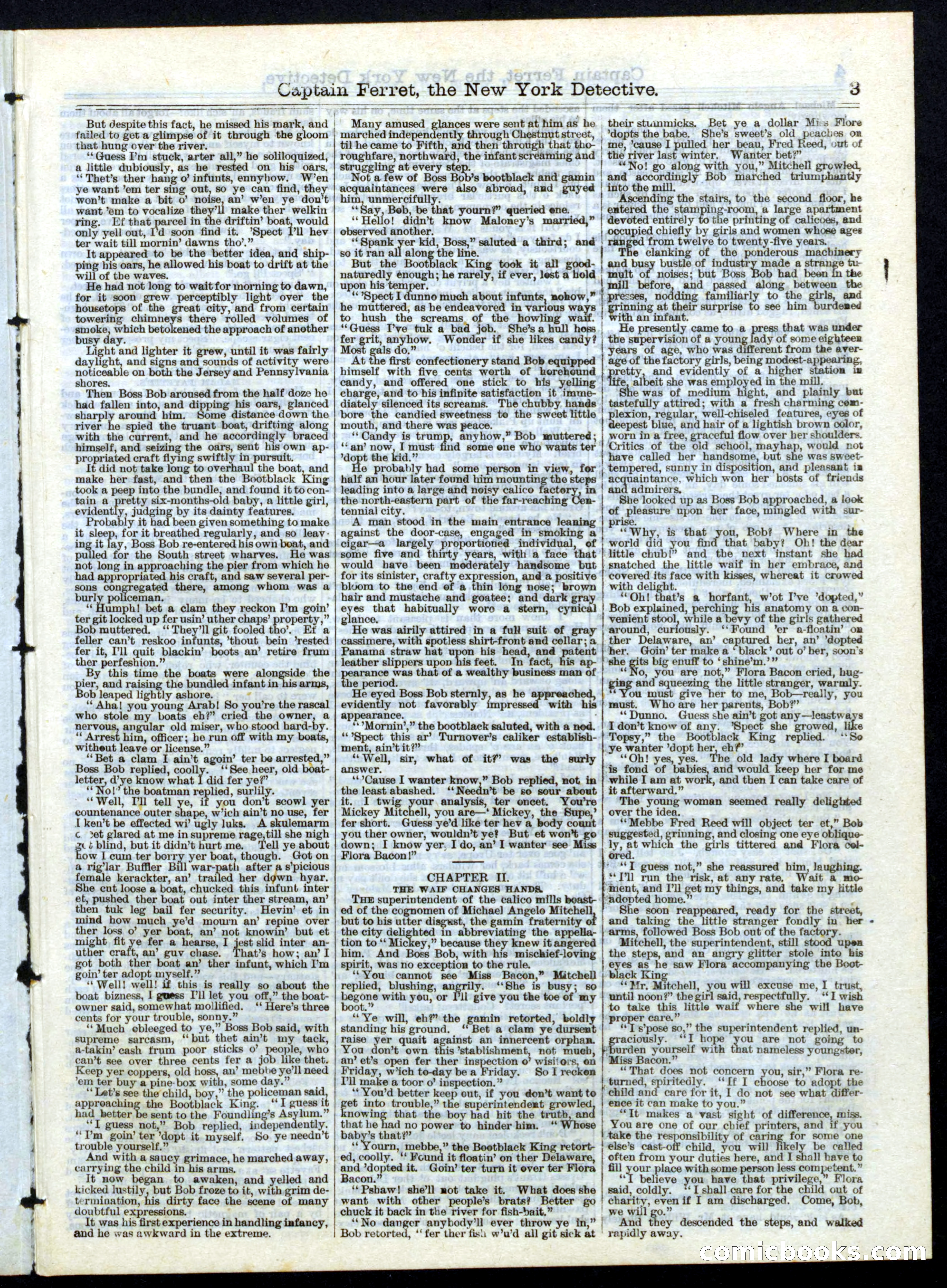
A restored page from Pulp Fiction, 1880. Page through the whole issue in the reader above.
📄 Transcribed text from this page (OCR, searchable)
Machine-transcribed from the original scan — historical spelling and the odd misread are preserved.
_——-- A failed to get a glimpse of it through the gloom that hung over the river. ‘*Guess I’m stuck, arter all,” he soliloquized, a little dubiously, as he rested on his oars, ‘Thet’s ther hang o’ infunts, ennyhow. W’en ye want ’em ter sing out, so ye can find, they won’t make a bit o’ noise, an’ w’en ye don’t want ’em to vocalize they’ll make ther welkin ring. Ef that parcel in the driftin’ boat, would only yell out, I'd soon find it. “Spect PU hev ter wait till ee ite ah - ens It appeared to the better idea, and ship- ping his oars, he allowed his boat to drift at the will of the waves. He had not long to wait for morning to dawn, for it soon grew perceptibly light over the housetops of the great city, and from certain towering chimneys there rolled volumes of smoke, which betokened the approach of anether busy day. Light and lighter it grew, until it was fairly daylight, and signs and sounds of activity were — e on both the Jersey and Pennsylvania shores. Then Boss Bob aroused from the half doze he had fallen into, and ore his oars, glanced sharply around him. me distance down the river he spied the truant boat, drifting along with the current, and he accordingly braced himself, and seizing the oars, sent his own ap- propriated craft flying swiftly in pursuit. It did not take long to overhaul the boat, and make her fast, and then the Bootblack King took a peep into the bundle, and found it to con- tain a pretty six-months-old baby, a little girl, evidently, judging by its dainty features. Proba ly it had been given something to make it sleep, for it breathed regularly, and so leay- ing it lay, Boss Bob re-entered his own boat, and pulled for the South street wharves. He was not long in approaching the pier from which he appropriated his craft, and saw several per- sons Congregeiey there, among whom was a burly policeman, ‘‘Humph! bet a clam they reckon I’m goin’ ter git locked up fer usin’ uther chaps’ property, Bob muttered. ‘‘ They’ll git fooled tho’. Ef a feller can’t reskoo infunts, *thout bein ’rested fer it, Pll quit blackin’ boots an’ retire frum ther perfeshion.” By this time the boats were alongside the ets and raising the bundled infant in his arms, ob leaped lightly ashore. 4 ‘‘ Aha! you young Arab! So you’re the rascal who stole my boats eb?” cried the owner, a nervous, angular old miser, who stood hard-by. ‘* Arrest him, officer; he run off with my boats, witheut leave or license.” ‘“‘Bet a clam I ain’t in’ ter be arrested,” Boss Bob replied, coolly. ‘‘See heer, old boat- letter, d’ye know what 4 did fer ye?” ‘No!’ the boatman replied, surlily. ‘Well, Pll tell ye, if you don’t scowl yer countenance outer shape, w’ich ain’t no use, fer I ken’t be effected wi’ ugly luks. A skulemarm c et glared at me in supreme rage,till she nigh x & blind, but it didn’t hurt me. Tell ye about how I cum ter borr yer boat, though. Got on a rig’lar Buffler Bull wanget 1 after a s’picious female kerackter, an’ trailed her dgwn hyar. She cut loose a boat, chucked this infunt inter et, pushed ther boat out inter ther stream, an’ then tuk leg bail fer security. Hevin’ et in mind how much ye’d mourn an’ repine over ther loss 0’ yer boat, an’ not knowin’ but et might fit ye fer a hearse, I jest slid inter an- uther craft, an’ guv chase. That’s how; an’ I got both ther boat an’ ther infunt, which I’m goin’ ter adopt myself.” ‘‘ Well! well! if this is really so about the boat bizness, | guess I'll let you off,” the boat- owner said, somewhat mollified. ‘ Here’s three cents for your trouble, sonny.” ‘‘Much ebleeged to ye,” Boss Bob said, with supreme sarcasm, ‘‘but thet ain’t my tack, a-takin’ cash frum poor sticks 0’ people, who can’t see over three cents fer a job like thet. Keep yer coppers, old hoss, an’ mebbe ye’ll need ‘em ter buy a pine-box with, some day.” ‘‘ Let’s see the child, boy,” the policeman said approaching the Bootblack King. “I guess it had better be sent to the Foundling’s Asylum.” ‘I guess not,” Bob replied, independently. “Tm goin’ ter dopt it myself. So ye needn’t trouble yourself.” And with a saucy grimace, he marched away, carrying the child in his arms. It now began to awaken, and yelled and kicked lustily, but Bob froze to it, with grim de- termination, hi face the scene of many doubtful expressions. It was his first experience in handling infancy, and he was awkward in the extreme. Captain Fe a ‘ret, _———— = marched independently through Chestnut street, mm ee ee ee - - - - Ot the New York Detective. 3 - —_—-—--— But despite this fact, he missed his mark, and | Many amused glances were sent at him as he , their stuunmicks. Bet ye a dollar Mics Flore _ *dopts the babe. She’s sweet’s old peaches on til he came to Fifth, and then through that tho- | me, ’cause I pulled her_beau, Fred Reed, out of roughfare, northward, the infant screaming and struggling at every ke ; Not a few of Boss Bob’s bootblack and gamin acquaintances were also abroad, aud guyed him, unmercifully. ‘“Say, Beb, be that yourn?’ queried ene. “Hello! didn’t know Maloney’s married,” observed another. ee aan kid, Boss,” saluted a third; and so it ran all along the line. But the Bootblack King took it all good- naturedly énough; he rarely, if ever, lest a hold upon his temper. ‘“"Spect I dunno much about infunts, nohow,” | he muttered, as he endeavored in various hg to hush the screams. of the howling waif. “Guess I’ve tuk a bad job. She’s a hull hoss fer grit, anyhow. Wonder if she likes candy? wat fret d Bob equipped t the first confectionery stand Bob eq himself with five cents werth of herehound candy, and offered one stick to his yelling eharge, and to his infinite satisfaction it imme- diately silenced its screams. The chubby. hands devoted entirely | and bus | maar of noises: but Boss | the river last winter. Wanter bet?” “No! go along with you,” Mitchell growled, ‘and accordingly Bob marched triumphantly | into the mill. Ascending the stairs, to the second floor, he | entered the stamping-room, a large apartment the printing of calicoes, and | occupied chiefly by girls and women whose ages ; sa ign from twelve to twenty-five years. The clanking of the ponderous machinery bustle of industry made a stra tu- b had been in the before, and passed along. between the presses, nodding familiarly to the girls, and inning at their surprise to see him burdemed ith an infant. | He presently came to a ress that was under | the supervision of a young lady of some eighteer years of age, who was different from the aver- age of the factory girls, being modest-appearing, retty, and evidently of a higher station i» Tite albeit she was employed in the mill. e was of medium hight, and plainly but tastefully attired; with a fresh charming cem- bore the candied sweetness te the sweet little | plexion, regular, well-chiseled features, eyes of mouth, and there was peace. ‘*Candy is trump, anyhow,” Bob muttered; ‘* an’ now, I must find some ene who wants ter ’dopt the kid.” e probably had some person in view, for half an hour later found him mounting the ste leading into a large and noisy calico factery, In the north-eastern part of the far-reaching Cen- tennial city. A man stood in the main entrance leaning against the door-case, engaged in smoking a cigar—a largely proportioned individual, of some five and thirty years, with a face that would have been moderately handsome but for its sinister, crafty expression, and a positive bluom to the end of a thin long nose; brown hair and mustache and goatee; and dark gray eyes that habitually wore a stern, cynical glance. He was airily attired in a full suit of gray cassimere, with spotless shirt-front and collar; a Panama straw hat — his head, and patent leather slippers upop his feet. In fact, his ap- pesenne | was that of a wealthy business man of e period. He eyed Boss Bob sternly, as he appreached, evidently not favorably tertiaanell with his appearance. ‘*’Mornin’,” the bootblack saluted, with a ned. “Spect this ar’ Turnover’s caliker establish- ment, ain’t it?” “Well, sir, what of it?’ was the surly "ht Gaddeasl weaaterhinow,*Siul lied, not, in ‘**’Cause I wanter know oO ied, no the least abashed. ‘‘Needn’t be pi green about, it. I twig your analysis, ter onecet. You're Mickey Mitchell, you are— Mickey, the Supe,’ fer short. Guess ye’d like ter hev a body count you ther owner, wouldn’t ye? But et won't go down; I know yer. I do, an’ I wanter see Miss Flora Bacon!” CHAPTER II. THE WAIF CHANGES HANDS THE superintendent of the calico mills beast- ed of the cognomen of Michae) Angelo enn but to bis utter aw at the gamin fraternity the city d ighted n abbreviating the appella- tion to “* Mickey,” because they knew it angered him. And Boss Bob, with his mischief-loving spirit, was no exception to the rule. ‘“You cannot see Bacon,” Mitchell replied, blushing, angrily. ‘‘She is busy; so pecs with you, or lll give you the toe of my 0 “Ye will, eh?’ the gamin retorted, boldly standing his ground. “ Bet a clam ye dursent raise yer quait against an innercent orphan. You don’t own this ’stablishment, not mueb, an’ et’s open fer ther in tion 0 wisi‘ors, on Friday, w’ich to-day be a Friday. So I recken Pll make a toor o’ inspection.” ‘'You’d better keep out, if you don’t want to et into trouble,” the superintendert growled nowing that the boy had hit the truth and that he no power to hinder him. ‘“ Whose baby’s that?” ‘* Yourn, mebbe,” the Beetblack King retort- ed, coolly. ‘‘ Found it floatin’ on ther Delaware, and ’dopted it. Goin’ ter turn it over ter Flora Bacon.” ‘*Pshaw! she'll not take it. What does she want with other people’s brats? Better chuck it back in the river for fish-bait,” ‘‘No danger anybody’ll ever throw ye in,” “burden yourself with — go | charity, even if I am discharged deepest blue, and hair of a lightish brown color, worn in a free, graceful flow over her shoulders. Critics of the old school, mayhap, would not have called her handsome, but she was sweet- , tempered, sunny in disposition, and pleasant is Pa uaintance,. which won her hosts of friends ' and admirers, She looked up as Boss Bob approached, a look of pleasure upon her face, mingled with sur- rise. : “Why, is that you, Bob? Where in the world did you find that baby? Oh! the dear little chub!” and the next instant she had snatched the little waif in her embrace, and covered its face with kisses, whereat it crowed with delight. “Oh! that’s a horfant, w’ot I’ve ‘dopted,” Bob explained, perching his anatomy on a con- venient stool, while a bevy of the girls gathered around, curiously. ‘Found ’er a-floatin’ om ther Delaware, an’ captured her, an’ ’dopted her. Goin’ ter make a ‘ black’ out o’ her, soon’s she gits big enuff to ‘shine’m.’”’ ‘“*No, you are not,” Flora Bacon cried, bug- ging and squeezing the little stranger, warmly. ‘You must give her to me, Bob—really, you must. Who are her parents, Bob?’ “Dunno. Guess she ain’t got any—leastways I don’t know of any. Spect she growed, like Topsy,” the Bootblack King replied. ‘‘Se ye wanter ’dopt her, eh?’ “*Oh! yes, yes. The old gd where I board ‘is fond of babies, and would keep her for me while I am at work, and then I can take care of afterward.” it The young woman seemed really delighted over the idea. **Mebbe Fred Reed will object ter et,” Bob suggested, grinning, and closing one eye oblique- ly, at which the girls tittered and Flora cel- ‘*T guess not,” she reassured him, laughing. “ll run the risk, at any rate, Wait a mo Ment, and V’l get my things, and take my little “adopted home.” ; She soon reap ready for the street, and taking the little stranger fondly in her arms, followed Boss Bob out of the factory. Mitchell, the superintendent, still stood upen the steps, and an angry glitter stole into bis eyes as he saw Flora accompanying the Boot- black King ‘Mr. Mitchell, you will excuse me, I trust, until noon?” the girl said, tfully. “I wish to take this little waif where she will have proper care.” ; ‘*T s’pose so,” the superintendent replied, un- aciously. ““T hope _ are not going to that nameless youngster, Miss Bacon.” “That does not concern you, sir,” Flora re- turned, spiritedly. “If I choose to adopt the child and care for it, I do not see what differ- ence it can make to you.” “It mukes a vast sight of difference, miss. You are one of our chief printers, and if you take the responsibility of caring for some one else’s cast-off child, you will likely be called often from your duties here, and I shall have to fill roe place with some person less competent, -- “T believe you have that privilege,” Flora said, coldly. ‘‘I shall care for the child out of Come, Bob, we wil G0. “4 And they descended the steps, and walked Bob retorted, ‘‘ fer ther fish w’u’d all git sick at | rapidly away. ECORMIGE VOO KS- com