
Pulp Fiction, 1877 · page 7 of 16
Beadle's Half Dime Library, No. 12 — page 7: what you’re looking at
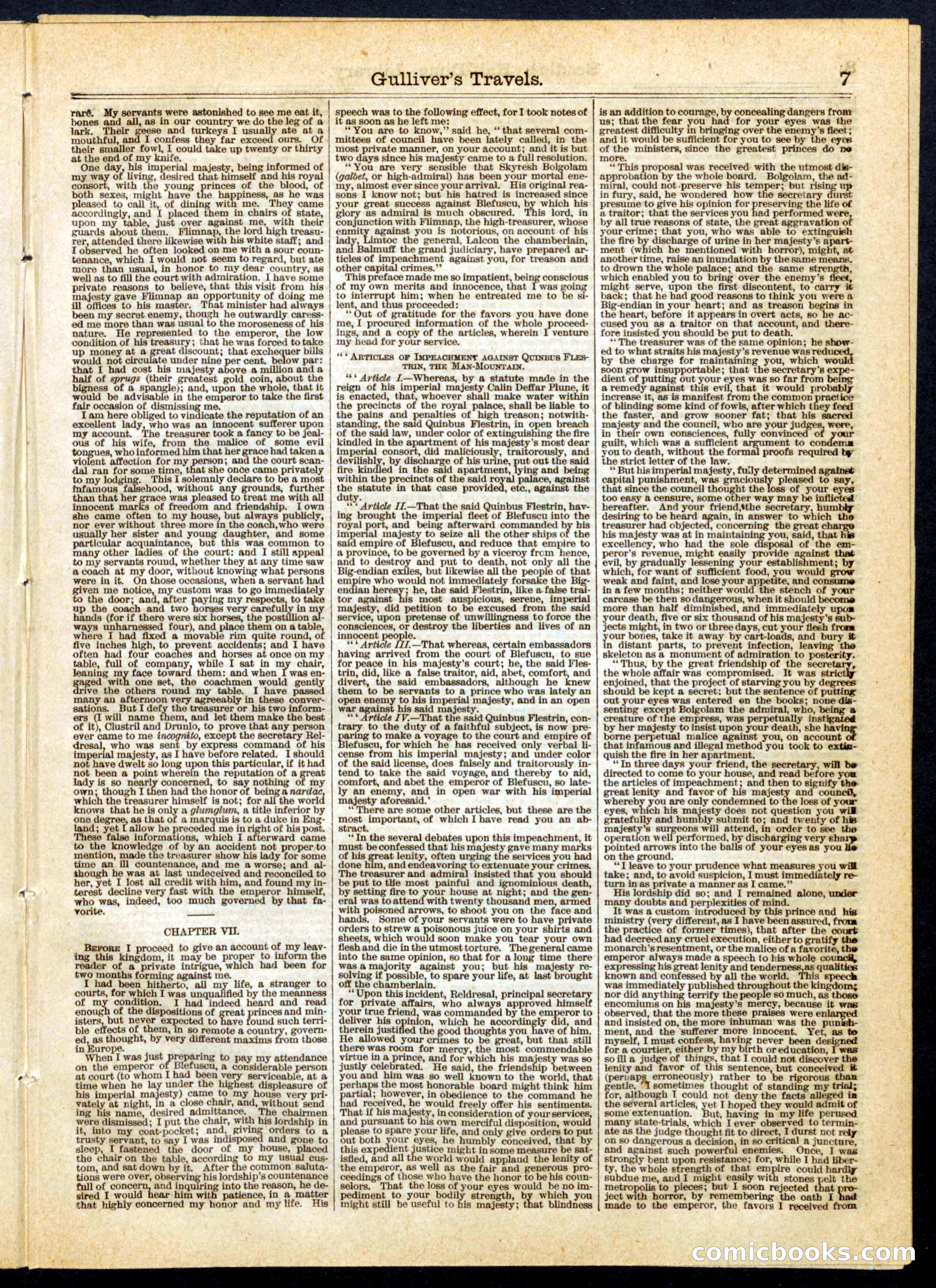
A restored page from Pulp Fiction, 1877. Page through the whole issue in the reader above.
📄 Transcribed text from this page (OCR, searchable)
Machine-transcribed from the original scan — historical spelling and the odd misread are preserved.
—_—————— ee $e $$$ AL CL LL Ne eee — Gulliver’s Travels. raré. My servants were astonished to see me eat it, | speech was to the following effect, for I took notes of bones and all, as in our country we do the leg of a lark. Their geese and turkeys I usually ate at a mouthful, and I confess they far ex their smaller fowl, I could take up twenty or thirty at the end of my knife. One day, his imperial majesty, being informed of my wey of aving, desired that himself and his royal consort, with the young —— of the blood, of both sexes, might have the happiness, as he was pleased to call it, of dining with me. They came accordingly, and I placed them in chairs of state, upon my table, just over against me, with their guards about them. Flimnap, the lord high treasu- rer, attended there likewise with his white staff; and I observed he often looked on me with a sour coun- tenance, which I would not seem to regard, but ate more than usual, in honor to my dear country, as well as to fill the court with admiration. I have some private reasons to believe, that this visit from his majesty gave Flimnap an erway of doing me ill offices to his master. That minister had always been my secret enemy, though he outwardly caress- ed me more than was usual to the moroseness of his nature. He represented to the emperor, the low condition of his treasury; that he was forced to take up money at a eee discount; that exchequer bills would not circulate under nine per cent. below par: that I had cost his majesty above a million anda half of sprugs (their greatest gold coin, about the bigness of a spangle); and, upon the whole, that it would be advisable in the emperor to take the first fair occasion of dismissing me. Iam here obliged to vindicate the reputation of an excellent lady, who was an innocent sufferer upon my account. The treasurer took a fancy to be jeal- ous of his wife, from the malice of some evil tongues, who informed him that her had taken a violent affection for my person; and the court scan- dal ran for some time, that she once came privately to my lod . This I solemnly declare to be a most infamous falsehood, without apy eens further than that her bgp was pleased reat me with all innocent marks of f om and friendship. 1 own she came often to my house, but preen' publicly, nor ever without three more in the coach,who were usually her sister and young daughter, and some particular acquaintance, but this was common to many other ladies of the court: and I still appeal to my servants round, whether they at any time saw a coach at my door, without knowing what persons were in it. On those occasions, when a servant had wren me notice, my custom was to go immediately the door; and, after paying my respects, to take up the coach and two horses very carefully in md hands (for if there were six horses, the postillion al- ways unharnessed four), and place them on a table where I had fixed a movable rim quite round, o five inches high, to prevent accidents; and I have often had four coaches and horses at once on my table, full of company, while I sat in my chair, leaning my face toward them: and when I was en- ga ed with one set, the coachmen would gently ve the others round my table. I have many an afternoon very agreeably in these conver- sations. But I defy the treasurer or his two inform- ers (I will name them, and let them make the best of it), Clustril and Drunlo, to prove that any person ever came to me incognito, except the secretary Rel- dresal, who was sent by express command of his imperial majesty, as I have before related. I should not have dwelt so long upon this particular, if it had not been a point wherein the reputation of a oo lady is so weary concerned, to say nothing of my own; though I then had the honor of being a nardac which the treasurer himself is not; for all the world knows that he is only a glumglum, a title inferior by one degree, as that of a marquis is to a duke in Eng- land; yet [ allow he preceded me in right of his post. These false informations, which I afterward came to the knowledge of by an accident not proper to mention, made the treasurer show his lady for some time an ill countenance, and me a worse; and al- though he was at last undeceived and reconciled to her, yet I lost all credit with him, and found my in- terest decline very fast with the emperor . who was, indeed, too much governed by that fa- vorite. CHAPTER VII. Brrore I proceed to give an account of my leav- ing this kingdom, it may be proper to inform the reader of a private intrigue, which had been for two months forming against me. I had been hitherto, all my life, a stranger to courts, for which I was unqualified by the meanness of my condition. I had indeed heard and_ read enough of the dispositions of great princes and min- isters, but never expected 6 have ound such terri- ble effects of them, in so remote a country, govern- ed, as thought, by very different maxims from those in Europe. : When I was just Pras to pay my attendance on the emperor of Blefuseu, a considerable person at court (to whom I had n very serviceable, at a time when he lay under the highest displeasure of his imperial majesty) came to my house very pri- vately at night, in a close chair, and, without ‘send ing his name, desired admittance. The chairmen were dismissed; I put the chair, with his lordship in it, into my coat-pocket; got ihe. orders to a trusty servant, to say I was indispo and gone to sleep, I fastened the door of my house, placed the chair on the table, according to my Usual cus- tom, and sat down by it. After the common saluta- tions were over, observing his lordship’s countenance full of concern, and inquiring into the reason, he de- sired I would hear him with patience, in a matter that hichly concerned my honor and my life. His ' ; ; it as soon as he left me: : * You are to know,”’ said he, *‘ that several com- ours. Of | mittees of council have been lately called, in the most private manner, on your account; and it is but two days since his a came to a full resolution. ‘You are very sensible that Skyresh Bolgolam (galbet, or high-admiral) has been your mortal ene- my, almost ever since your arrival. His original rea- sons I know not; but his hatred is increased since your great success against Blefuscu, by which his glory as admiral is much obscured. is lord, in conjunction with Flimnap, the high-treasurer, whose enmity against you is notorious, on account of his lad imtoc the general, Lalcon the chamberlain, an uff the grand judiciary, have prepared ar- ticles of impeachment against you, for treason and other capital crimes.”’ This preface made me so impatient, being conscious of my own merits and innocence, that I was going to interrupt him; when he entreated me to be si- lent, and thus proceeded: ‘Out of gratitude for the favors you have done me, [ procured information of the whole proceed- ings, and a copy of the articles, wherein I venture my head for your service. ‘** ARTICLES OF IMPEACHMENT AGAINST QUINBUS F'LES- TRIN, THE MAN-MOUNTAIN. ‘** Article I—Whereas, by a statute made in the reign of his imperial majesty Calin Deffar Plune, it is enacted, that, whoever shall make water within the precincts of the royal palace, shall be liable to the my and penalties of high treason; notwith- standing, the said nbus Flestrin, in open breach of the said law, under color of extinguishing the fire kindled in the apartment of his majesty’s most dear imperial consort, did mer yorecom t traitorously, and pontlg «oe by discharge of his urine, put out the said fire kindled in the said apartment, lying and being within the precincts of the said ete palace, against yo statute in that case provided, etc., against the uty. _ “* Article I[.—That the said Quinbus Flestrin, hav- ing brought the imperial fleet of Blefuscu into the royal port, and being afterward commanded by his imperial majesty to seize all the other ships of the said empire of Blefuscu, and reduce that empire to a province, to be governed by a viceroy from hence, and to destroy and put to death, not only all the Big-endian exiles, but likewise all the people of that empire who would not oe forsake the Big- endian seam he, the said Flestrin, like a false trai- tor against his most auspicious, serene, imperial majesty, did petition to be excused from the said service, upon pretense of unwillingness to force the consciences, or destroy the liberties and lives of an innocent people. ‘** Article 1/7.—That whereas, certain embassadors having arrived from the court of Blefuscu, to sue for peace in his majesty’s court; he, the said Fles- trin, did, like a false traitor, aid, abet, comfort, and divert, the said embassadors, although he knew them to be servants to a prince who was lately an open woe om | to his imperial majesty, and in an open war against his said majesty. *“* Article IV.—That the said Quinbus Flestrin, con- trary to the duty of a faithful subject, is now pre- : to make a voyage to the court and empire of lefuscu, for which he has received only verbal li- cense from his imperial majesty; and under color of the said license, does falsely and traitorously in- tend to take the said voyage, and thereby to aid, comfort, and abet the emperor of Blefuscu, so late- ly an enemy, and in open war with his imperial majesty aforesaid.’ ‘There are some other articles, but these are the ee. important, of which I have read you an ab- stract. ‘In the several debates upon this impeachment, it must be confessed that his majesty gave many marks of his t lenity, often urging the services you had done , and endeavoring to extenuate your crimes. The treasurer and admiral insisted that you should be put to thie most painful and ignominious death, by setting fire to your house at night; and the gen- eral was to attend with twenty thousand men, armed with poisoned arrows, to shoot you on the face and hands. Some of your servants were to have private orders to strew a poisonous juice on your shirts and sheets, which would soon make you tear your own flesh and die in the utmost torture. Thegeneral came into the same opinion, so that for a long time there was amajority against you; but his majesty re- solving if possible, to spare your life, at last brought off the chamberlain. “Upon this incident, Reldresal, principal secreta for private affairs, who always approved himse your true friend, was commanded by the op da to deliver his opinion, which he accordingly did, and therein justified the good thoughts you have of him. He allowed your crimes to be great, but that still there was room for mercy, the most commendable virtue in a prince, and for which his wm omg f was 80 justly celebrated. He said, the friendship between you and him was so well known to the world, that perhaps the most honorable board might think him pa ; however, in obedience to the command he ad received, he would freely offer his sentiments. That if his majesty, in consideration of your vom haenes 7 and pursuant to his own merciful disposition, woul please to spare your life, and only give orders to put out both your eyes, he humbly conceived, that by this expedient justice might in some measure be sat- isfied, and all the world would applaud the lenity of the emperor, as well as the fair and generous pro- ceedings of those who have the honor to be his coun- selors, That the loss of your eyes would be no im- pediment to your bodily strength, by which you might still be useful to his majesty; that blindness 7 re es + — —S__eeeE” — te is an addition to courage, by concealing dangers from us; that the fear you for your eyes was the greatest difficulty in bringing over the enemy’s fleet; and it would be sufficient for you to see by the eyes of the ministers, since the greatest princes do ne more. ‘* This proposal was received with the utmost dis- approbation by the whole board. Bolgolam, the ad- miral, could not-preserve his temper; but rising up in fury, said, he wondered how the secretary durst presume to give his opinion for preserving the life of a traitor; that the services you had performed were by all true reasons of state, the great aggravation o your crime; that you, who was able to extinguish the fire by discharge of urine in her majesty’s apart- ment (which he mentioned with horror), might, at another time, raise an inundation by the same means. to drown the whole palace; and the same stre “ which enabled you to bring over the enemy’s might serve, upon the first discontent, to carry it back; that he had good reasons to think you were a Big-endian in your heart; and as treason begi the heart, before it appears in overt acts, so he ac- cused you as a traitor on that account, and there- fore insisted you should be put to death. ‘** The treasurer was of the same opinion; he show- ed to what straits his majesty’s revenue was redu by the charge for maintaining you, which wo soon grow insupportable; that the secretary's expe- dient of putting out your eyes was so far from being a remedy against this evil, that it would probably increase it, as is manifest from the common b pehog ne of blinding some kind of fowls, after which they feed the faster, and grow sooner fat; that his sacred majesty and the council, who are your judges, were, in their own consciences, fully convin of your guilt, which was a sufficient ment to condemam you to death, without the formal proofs required by the strict letter of the law. ‘“* But his imperial majesty, fully determined capital punishment, was ee | pleased to say, that since the council thought the loss of your eyes too easy a censure, some other way may be inflicted hereafter. And your friend,sthe secretary, humbly desiring to be heard n, in answer to which the treasurer had objected, concerning the great a his majesty was at in maintai you, said, that h excellency, who had the sole of the em- peror’s revenue, might easily provide inst that evil, by gradually lessening your establishment; by which, for want of sufficient food, you would grow weak and faint, and lose your appetite, and consume in a few months; neither would the stench of your carcase be then so dangerous, when it should become more than half diminished, and immediately upom your death, five or six thousand of his majesty’s sub- jects might, in two or three days, cut your flesh from your bones, take it away by cart-loads, and bury & in distant parts, to prevent infection, leaving the skeleton as a monument of admiration to posterity. “Thus, by the great friendship of the secre - the ribose comme was St re It be — enjoined, that the project of starving you by degrees should be kept a secret: but the sentence of putting out your eyes was entered en the books; none dis- senting except Bolgolam the admiral, who, be & creature of the empress, was perpetually ins by her majesty to insist upon your death, she ha borne perpetual malice against you, on account that infamous and illegal method you took to extim- quish the fire in her apartment. ‘‘In three days your friend, the secretary, will be directed to come to your house, and read before you the articles of impeachment; and then to signify the great lenity and favor of his maj and counci, whereby you are only condemned to the loss of your eyes, which his majesty does not question you will gratefully and humbly submit to; and twenty of his majesty’s surgeons will attend, in order to see the operation well performed, by discharging very sha pointed arrows into the balls of your eyesas you on the ground. ‘I leave to your prudence what measures you will take; and, to avoid suspicion, I must immediately re- turn in as private a manner as I came.” His lordship did so; and I remained alone, under many doubts and perplexities of mind. It was a custom introduced by this prince and his ministry (very different, as I have been assured, from the practice of former times), that after the court had decreed any cruel execution, either to gratify the monarch’'s resentment, or the malice of a favorite, the emperor always made a speech to his whole council, expressing his great lenity and tenderness,as qualities known and confessed by all the world. This was immediately published throughout the kingdoms nor did anything terrify the people so much, as those encomiums on his majesty’s mercy, use it was observed, that the more these praises were en and insisted on, the more inhuman was the pun ment, and the ‘sufferer more innocent. Yet, as to myself, I must confess, having never been d for a courtier, either by my birth or education, I was soilla judge of things, that I could not discover the lenity and favor of this sentence, but conceived #% (perbaps erroneously) rather to be rigorous entle, “I sometimes thought of standing my trial; or, although I could not deny the facts alleged in the several articles, yet I hoped they would admit of some extenuation. But, having in my life perused many state-trials, which I ever observed to termin- ate as the judge thought fit to direct, I durst not rely on so dangerous a decision, in so critical a juncture, and against such powerful enemies. Once, I was strongly bent upon resistance; for, while I had liber- ty, the whole strength of that empire could hardly subdue me, and I might easily with stones pelt the metropolis to pieces; but I soon rejected t ro- ject with horror, by remembering the oath I made to the emperor, the favors I received from comichboo ¢s)