
Pulp Fiction, 1877 · page 6 of 16
Beadle's Half Dime Library, No. 12 — page 6: what you’re looking at
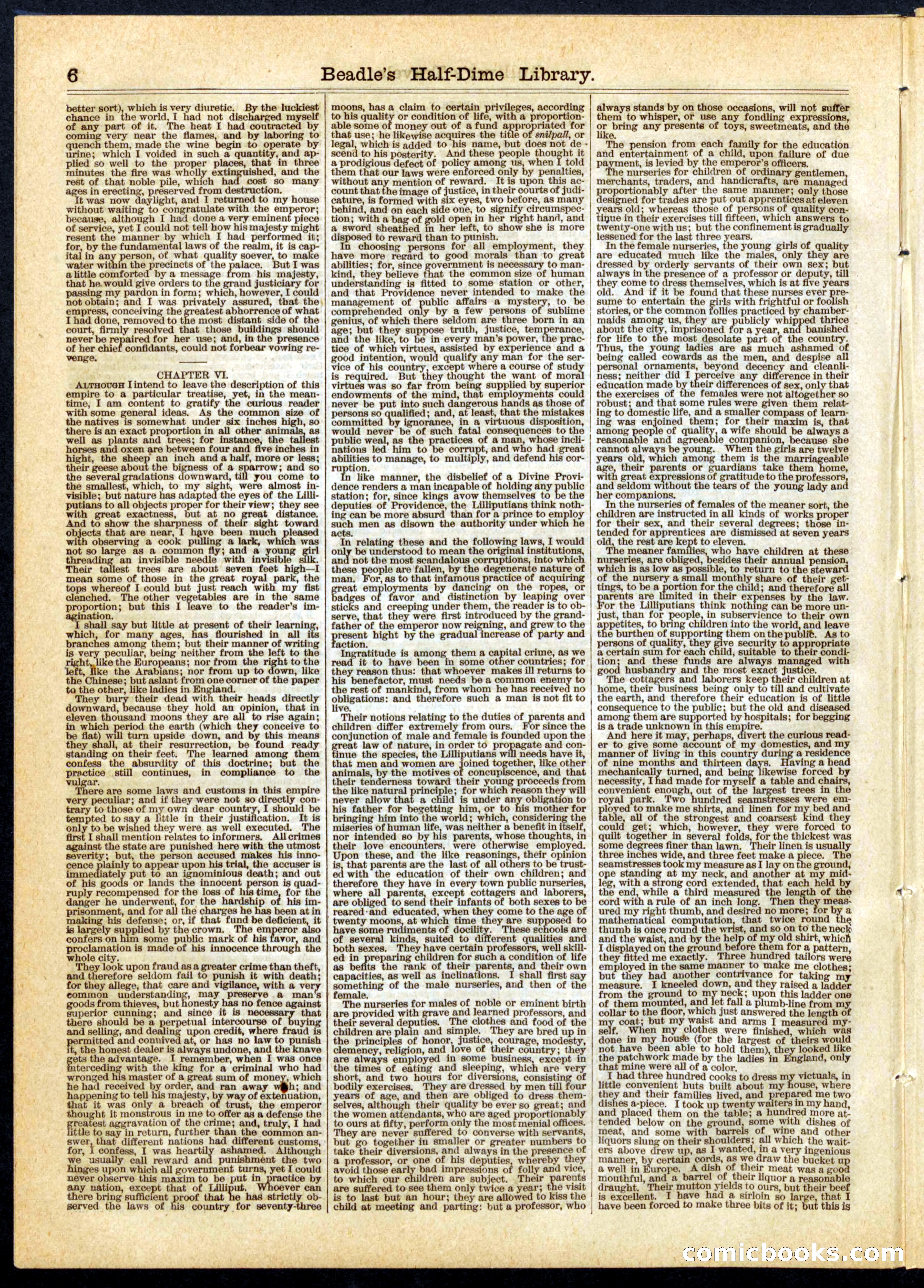
A restored page from Pulp Fiction, 1877. Page through the whole issue in the reader above.
📄 Transcribed text from this page (OCR, searchable)
Machine-transcribed from the original scan — historical spelling and the odd misread are preserved.
6 — ee ee better sort), which is very diuretic. By the luckiest chance in the world, I had not discharged myself of any part of it. The heat I had contracted by coming very near the flames, and by laboring to quench them, made the wine begin to operate by urine; which I voided in such a quantity, and ap- plied so well to the proper places, that in three minutes the fire was wholly e shed, and the rest of that noble pile, which cost sO many es in erecting, preserved from destruction. twas now daylight, and I returned to my house without waiting to congratulate with the emperor; because, although I had done a very eminent piece of service, yet I could not tell how his majesty might resent the manner by which I had performed it; for, by the fundamental laws of the realm, it is cap- italin an rson, of what quality soever, to e water within the precincts of the palace. But I was a little comforted by a message from his majesty, that he. would give orders to the grand justiciary for passing my pardon in form; which, however, I could not obtain; and I was privately assured, that the empress, conceiving the greatest abhorrence of what I had done, removed to the most distant side of the court, firmly resolved that those buildings should never be repaired for her use; and, in the presence of her chief confidants, could not forbear vowing re- venge. CHAPTER VI. Aurnovaa Lintend to leave the description of this empire to a particular treatise, yet, in the mean- time, I am content to gratify the curious reader with some general ideas. As the common size of the natives is somewhat under six inches high, so there is an exact proportion in all other ——— as well as plants and trees; for instance, the est horses and oxen are between four and five inches in hight, the sheep an inch and a half, more or less; their geese about the a of @ sparrow; and so the several lations downward, you come to the smallest, which, to my sight, were almost in- visible; but nature has adapted the eyes of the Lilli- putians to all objects proper for their view; they see with great exactness, but at no great distance. And to show the sharpness of their sight toward objects that are near, I have been much pleased with observing a cook pulling a lark, which was not so large as a common fly; and a oe = ee an invisible needle with invisible . Their est trees are about seven feet high—I mean some of those in the great royal park, the tops whereof I could but just reach with my fist clenched. The other vegetables are in the same proportion; but this I leave to the reader's im- on. shall say but little at eye of their learning, which, for many ages, has flourished in all i branches among them; but their manner of writing is very peculiar, being neither from the left to the right, like the Euro ; nor from the ht to the left, like the Arabians; nor from up to down, like the Chinese; but aslant from one corner of the paper ta the other, like ladies in England. They =e their dead with their heads directly downward, because they hold an opinion, that in eleven thousand moons they are all to rise again; in which period the earth (which they conceive to be flat) will turn upside down, and by this means they shall, at their resurrection, be found ready standing on their feet. The learned among them eonfess the absurdity of this doctrine; but the practice still continues, in compliance to the ar ere are some laws and customs in this empire very peculiar; and if they were not so directly con- trary to those of my own dear pe § I should be tempted to say a little in their justification. It is only to be wished they were as well executed. The first I shall mention relates to informers. All crimes against the state are punished here with the utmost severity; but, the person accused makes his inno- cence ‘peony to = upon his trial, the accuser is imm seen put an ignominious death; and out of his g or lands the innocent person is quad- ruply recompensed for the loss of his time, for the danger he underwent, for the hardship of his im- prisonment, and for all the charges he has been at in making his defense; or, if that fund be deficient, it is largely apyelted by the crown, The emperor also confers on him some public mark of his favor, and proclamation is made of his innocence through the whole city. They look upon fraud asa greater crime than theft, and therefore seldom fail to punish it with death; for they allege, that care and vigilance, with a very common understanding, may preserve a man’s from thieves, but honesty has no fence against superior cunning; and since it is cmap 5 that there should be a perpetual intercourse of buying and selling, and dealing upon credit, where fraud is rmitted and connived at, or has no law to punish it, the honest dealer is always undone, and the knave gots the advantage. I remember, when I was once terced with the king for a criminal who had wronged his master of a great sum of money, which he had received by order, and ran away wh; and happening to tell his majesty, by way of extenuation, that it was Na a breach of trust, the emperor thought it monstrous in me to offer as a defense the fs t aggravation of the crime; and, truly, I had ittle to say in return, further than the common an- swer, that different nations had different customs, for, i confess, I was heartily ashamed. Although we usually call reward and punishment the two § upon which all government turns, yet I could never observe this maxim to be put in practice by any nation, i that of Fory Sag oever can there bring sufficient proof that he has strictly ob- served the laws of his country for seventy- moons, has a claim to certain privileges, according to his quality or condition of life, with a proportion- able some of money out of a fund appropriated for that use; he likewise acquires the title of sni/pall, or legal, which is added to his name, but does not de scend to his posterity. And these people thought it a prodigious defect of policy among us, when I told them that our laws were enforced only by penalties, without any mention of reward. It is upon this ac- count that the image of justice, in their courts of judi- cature, is formed with six eyes, two before, as many nd, and on each side one, to signify circumspec- tion; with a bag of gold open in her right hand, and a sword sheathed in her left, to show she is more to reward than to punish. In choosing persons for all employment, they have more regard to good morals than to great abilities; for, since government is necessary to man- kind, they believe that the common size of human understanding is fitted to some station or other, and that Providence never intended to make the management of public affairs a mystery, to be comprehended only by a few persons of sublime genius, of which there seldom are three born in an age; but they suppose truth, justice, temperance, and the like, to be in every man’s power, the prac- tice of which virtues, assisted by experience and a good intention, would qualify any man for the ser- vice of his country, except where a course of study is required. But they thought the want of moral virtues was so far from being supplied by superior endowments of the mind, that employments could never be put into such dangerous hands as those of persons so qualified; and, at least, that the mistakes committed ignoranee, in a virtuous disposition, would never be of such fatal consequences to the nations led him to be corrupt, and who had great om to manage, to multiply, and defend his cor- ruption. like manner, the disbelief of a Divine Provi- dence renders a man incapable of holding any public station; for, since kings avow themselves to be the deputies of Providence, the Lilliputians think noth- ing can be more absurd than for a prince to eng such men as disown the authority under which he In relating these and the following laws, I would — be understood to mean the original institutions, and not the most scandalous corruptions, into which ple are fallen, by the degenerate nature of man. For, as to that infamous practice of acquiring at employments by dancing on the ropes, or bad es of favor and distinction by leaping over sticks and creeping under them, the reader is to ob- serve, that they were first introduced by the grand- father of the emperor now reigning, and w to the resent hight by the gradual increase of party and these action. a cer ang is among them a —— crime, as we it to have been in some other countries; for they reason thus: that whoever makes ill returns to his benefactor, must needs be a common enemy to the rest of mankind, from whom he has received no obligations: and therefore such a man is not fit to ve. Their notions relating to the duties of parents and children differ extremely from ours. For since the conjunction of male and female is founded upon the preat law of nature, in order to propagate and con- nue the species, the Lilliputians needs have it, that men and women are Joined together, like other animals, by the motives of concupiscence, and that their tenderness toward their young proceeds from the like natural apex for which reason they will never allow that a child is under any obligation to his father for begetting him, or to his mother for bringing him into the world; which, considering the miseries of human life, was neither a benefit in itself, nor intended so by his parents, whose thoughts, in their love encounters, were otherwise employed. Upon these, and the like ee etn their opinion is, that parents are the last of all others to be trust- ed with the education of their own children; and therefore they have in every town public nurseries, where all parents, except cottagers and laborers, are obliged to send their infants of both sexes to be -reared:and educated, when they come to the age of twenty moons, at which time they are sup to have some rudiments of a These schools are of several kinds, suited to different qualities and both sexes. They have certain professors, well skill- ed in preparing children for such a condition of life as befits the rank of their parents, and their own capacities, as well as inclinations. I shall first say —- of the male nurseries, and then of the female. The nurseries for males of noble or eminent birth are provided with ve and learned professors, and their several de es. The clothes and food of the children are plain and simple. They are bred up in the principles of honor, justice, courage, modesty, clemency, religion, and love of their country; they are always employed in some business, except in the times of eating and sleeping, which are very short, and two hours for diversions, —, of bodily exercises. They are dressed by men till four years of age, and then are obliged to dress them- selves, although their quality be ever so great; and | the women attendants, who are aged proportionably | to ours at fifty, perform only the most menial offices. They are never 5 | | | | | | public weal, as the practices of a man, whose incli- Beadle’s Half-Dime Library. ee Le eee ee ee | | rr | | uffered to converse with servants, | but go together in smaller or greater numbers to — take their diversions, and always in the presence of a professor, or one of his deputies, whereby they | avoid those earl to which our children are subject. Their parents are suffered to see them only twice a year; the visit is to last but an hour; they are allowed to kiss the bad impressions of folly and vice, | child at meeting and parting: but a professor, who | always stands by on those occasions, will not suffer them to whisper, or use any fondling expressions, or bring any presents of toys, sweetmeats, and the e The pension from each family for the education and entertainment of a child, upon failure of due payment, is levied by the emperor's officers. e nurseries for children of ordinary gentlemen merchants, traders, and handicrafts, are managed pi rtionably after the same manner; only those esigned for trades are put out apprentices at eleven years old; whereas those of persons of quality con- tinue in their exercises till fifteen, which answers to twenty-one with us; but the confinement is gradually lessened for the last three years. In the female nurseries, the young girls of quality are educated much like the males, only they are dressed by orderly servants of their own sex; but always in the presence of a professor or deputy, till they come to dress themselves, which is at five years old. And if it be found that these nurses ever pre- sume to entertain the girls with frightful or foolish stories, or the common follies practiced by chamber- maids among us, they are » angpagioe A whip thrice about the city, imprisoned for a year, and banished for life to the most desolate part of the country. Thus, the young ladies are as much ashamed of being called cowards as the men, and despise all personal ornaments, beyond decency and cleanli- ness; neither did I perceive any difference in their education made by their differences of sex, only that the exercises of the females were not altogether sO robust; and that some rules were given them relat- ing to domestic life, and a smaller compass of learn- ing was me worn them; for their maxim is, that among ple of quality, a wife should be always a reasonable and agreeable companion, because she cannot always be young. When the girls are twelve years old, which among them is the marriageable age, their parents or guardians take them home, with great expressions of gratitude to the professors and seldom without the tears of the young lady and her companions, In the nurseries of females of the meaner sort, the children are instructed in all kinds of works proper for their sex, and their several de ; those in- tended for apprentices are disn at seven years old, the rest are kept to eleven. The meaner fam es, who have children at these nurseries, are obliged, besides their annual pensio which is as low as possible, to return to the stew of the nursery a small monthly share of their get- tings, to be a portion for the child; and therefore all gp are limited in their expenses by the law. or the Lilliputians think nothing can be more un- just, than for people, in subservience to their own aprencens to bring children into the world, and leave the burthen of supporting them on the publit. As to persons of quality, they give security to appropriate ace sum for each child, suitable to their condi- tion; and these funds are always managed with husbandry and the most exact justice. The cottagers and laborers keep their children at home, their business being only to till and cultivate the earth, and therefore their education is of little consequence to the public; but the old and di among them are supported by hospitals; for begging is a trade unknown in this empire. And here it may, perhaps, divert the curious read- er to give some account of my domestics, and my manner of living in this country during a residence of nine months and thirteen days. Having a head map ent § turned, and be ikewise forced by necessity, I had made for myself a table and chairs, convenient enough, out of the largest trees in the royal park. Two hundred seams were em- loyed to make me shirts, and linen for woe and ble, all of the strongest and coarsest kind they could get; which, however, they were forced to quilt together in several folds, for the thickest was some d finer than lawn. Their linen is usually three inches wide, and three feet make a piece, The seamstresses took my measure as I lay on the ground, ope standing at my neck, and another at my mid- leg, with a strong cord extended, that each held by the end, while a third measured the ip. of the cord with a rule of an inch long. Then t °y meas- ured my right thumb, and desired no more; for by a mathematical stacy ee that twice round th thumb is once round the wrist, and so on to the neck oodele hbo and by the help of iy ~~ shirt, wach on the groun ore them for a pattern they fitted me exactly. Three hundred tailors were employed in the same manner to make me clothes; but they had another contrivance for taking measure. I kneeled down, and they raised a ladder from the ground to g4 neck; upon this ladder one of them mounted, and let fall a plumb-line from my collar to the floor, which just answered the length of my coat; but my waist and arms I measu my- self. When my clothes were finished, which was done in my house (for the largest of theirs would not have been able to hold them), they looked like the patchwork made by the ladies in England, only that mine were all of a color. I had three hundred cooks to dress my victuals, in little convenient huts built about my house, where they and their families lived, and prepared me two dishes a-piece. I took up twenty waiters in my hand, and placed them on the table; a hundred more at- tended below on the ground, some with dishes of meat, and some_ with parrels of wine and other liquors slung on their shoulders; all which the wait- ers above drew up, as I wanted, in a very ingenious manner, by certain cords, as we draw the bucket u a well in Europe, A dish of their meat was pg mouthful, and a barrel of their liquor a reasonable draught. Their mutton yields to ours, but their beef is excellent. I have had a sirloin so large, that I have been forced to make three bits of it; but this is Ecboo com cs (E(0) _