
Pulp Fiction, 1862 · page 56 of 100
Beadle's Dime Novels No. 47: Tim Bumble's Charge — page 56: what you’re looking at
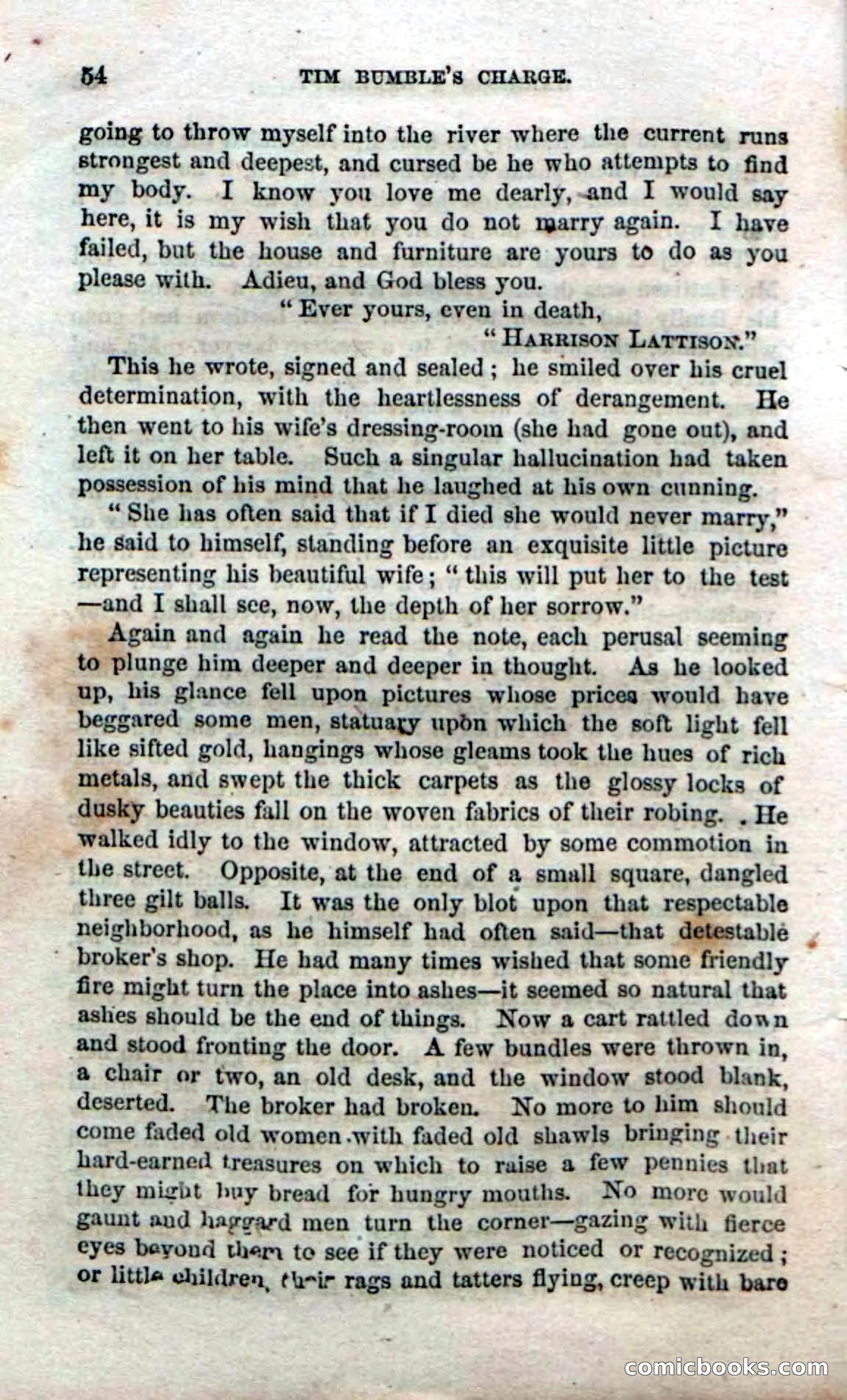
A restored page from Pulp Fiction, 1862. Page through the whole issue in the reader above.
📄 Transcribed text from this page (OCR, searchable)
Machine-transcribed from the original scan — historical spelling and the odd misread are preserved.
BA TIM BUMBLE’S CHARGE. going to throw myself into the river where the current runs strongest and deepest, and cursed be he who attempts to find my body. I know you love me dearly,-and I would say here, it is my wish that you do not marry again. I have failed, but the house and furniture are yours to do as as you please with. Adieu, and God bless you. “ Ever yours, eyen in death, “ Harrison Lattison.” This he wrote, signed and sealed; he smiled over his cruel determination, with the heartlessness of derangement. He then went to his wife’s dressing-room (she had gone out), and left it on her table. Such a singular hallucination had taken possession of his mind that he laughed at his own cunning. “She has often said that if I died she would never marry,” he said to himself, standing before an exquisite little picture representing his beautiful wife; “ this will put her to the test —and I shall see, now, the depth of her sorrow.” a. and again he read the note, each perusal seeming lunge him deeper and deeper in thought. As he looked up, his glance fell upon pictures whose pricey would have some men, statuagy upon which the soft light fell like sifted gold, hangings whose gleams took the hues of rich metals, and swept the thick carpets as the glossy locks of dusky beauties fall on the woven fabrics of their robing. , He walked idly to the window, attracted by some commotion in _ the street. Opposite, at the. end of a small square, dangled three gilt balls, It was the only blot upon that ectable neighborhood, as he himself had often sid—that detestable ' broker's shop. He had many times wished that some friendly fire might turn the place into ashes—it seemed so natural that ashes should be the end of things. Now a cart rattled down and stood fronting the door. A few bundles were thrown in, a chair or two, an old desk, and the window stood blank, deserted. The broker had broken. No more to him should come faded old women.with faded old shawls bringing -their hard-earned treasures on which to raise a few pennies that they migbt buy bread for hungry mouths. No more would gaunt aud haggard men turn the corner—gazing with fierce eyes beyond therm te see if they were noticed or recognized ; or littl« children, their rags and tatters flying, creep with bare comichooks;com 7 —_— Se