
Pulp Fiction, 1862 · page 41 of 120
Beadle's Dime Novels No. 38: The Wrong Man — page 41: what you’re looking at
A restored page from Pulp Fiction, 1862. Page through the whole issue in the reader above.
📄 Transcribed text from this page (OCR, searchable)
Machine-transcribed from the original scan — historical spelling and the odd misread are preserved.
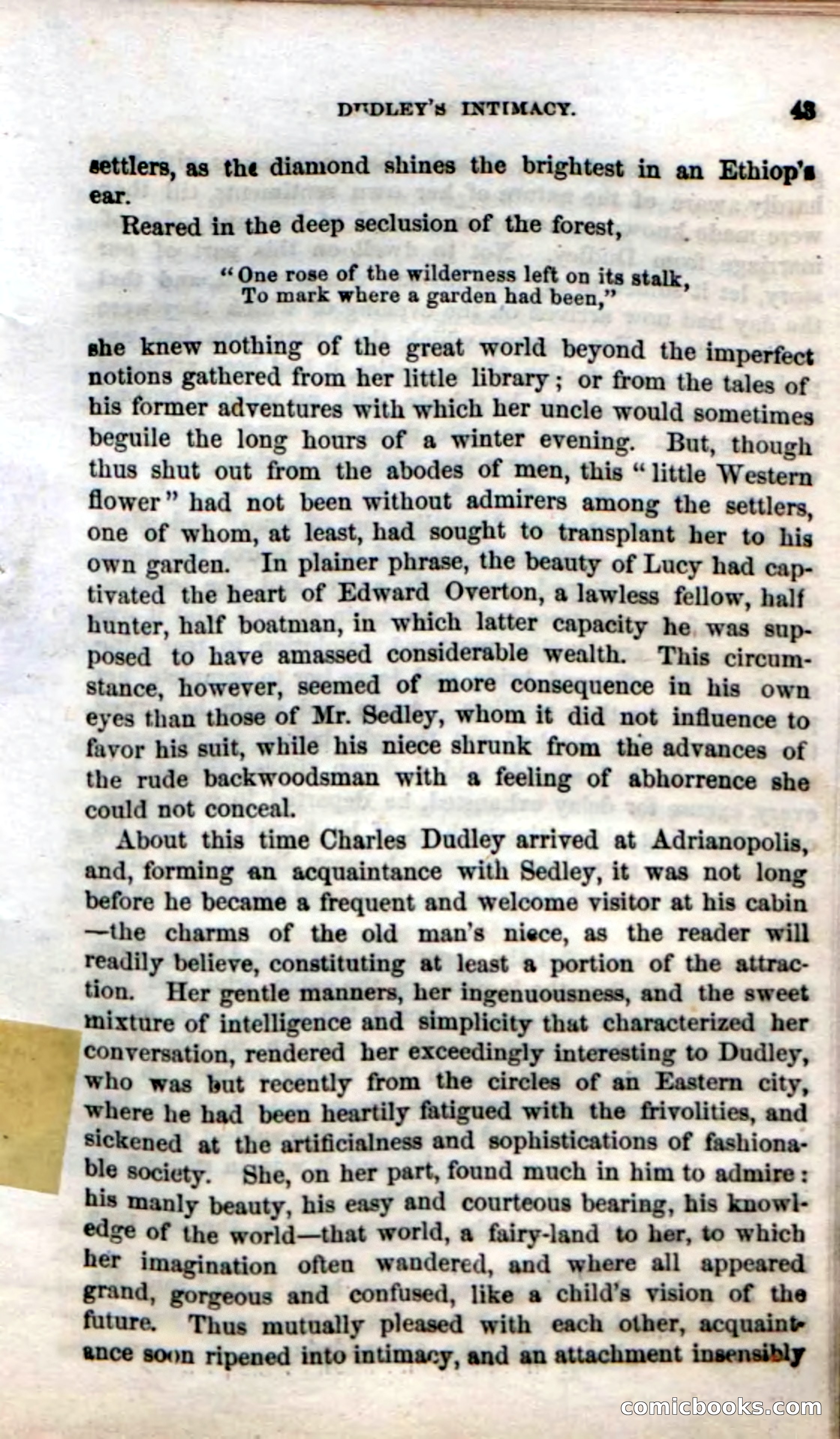
D"DLEY'’S INTIMACY. 48 settlers, as the diamond shines the brightest in an Ethiop's ear. Reared in the deep seclusion of the forest, “One rose of the wilderness left on its To mark where a garden had been,” mae she knew nothing of the great world beyond the imperfect notions gathered from her little library; or from the tales of his former adventures with which her uncle would sometimes beguile the long hours of a winter evening. But, though thus shut out from the abodes of men, this “little Western flower” had not been without admirers among the settlers, one of whom, at least, had sought to transplant her to his own garden. In plainer phrase, the beauty of Lucy had cap- tivated the heart of Edward Overton, a lawless fellow, half hunter, half boatman, in which latter capacity he. was sup- posed to have amassed considerable wealth. This circum- Stance, however, seemed of more consequence in his own eyes than those of Mr. Sedley, whom it did not influence to favor his suit, while his niece shrunk from the advances of the rude backwoodsman with a feeling of abhorrence she could not conceal. About this time Charles Dudley arrived at Adrianopolis, and, forming an acquaintance with Sedley, it was not long before he became a frequent and welcome visitor at his cabin —the charms of the old man’s niece, as the reader will readily believe, constituting at least a portion of the attrac- tion. Her gentle manners, her ingenuousness, and the sweet mixture of intelligence and simplicity that characterized her conversation, rendered her exceedingly interesting to Dudley, who was but recently from the circles of an Eastern city, where he had been heartily fatigued with the frivolities, and at the artificialness and sophistications of fashiona- ble society. She, on her part, found much in him to admire: his manly beauty, his easy and courteous bearing, his knowl- edge of the world—that world, a fairy-land to her, to which her imagination often wandered, and where all appeared grand, gorgeous and confused, like a child’s vision of the future. Thus mutually pleased with each other, acquainé &nce soon ripened into intimacy, and an attachment insensibly conmiclooolks.conn