
Pulp Fiction, 1862 · page 40 of 120
Beadle's Dime Novels No. 38: The Wrong Man — page 40: what you’re looking at
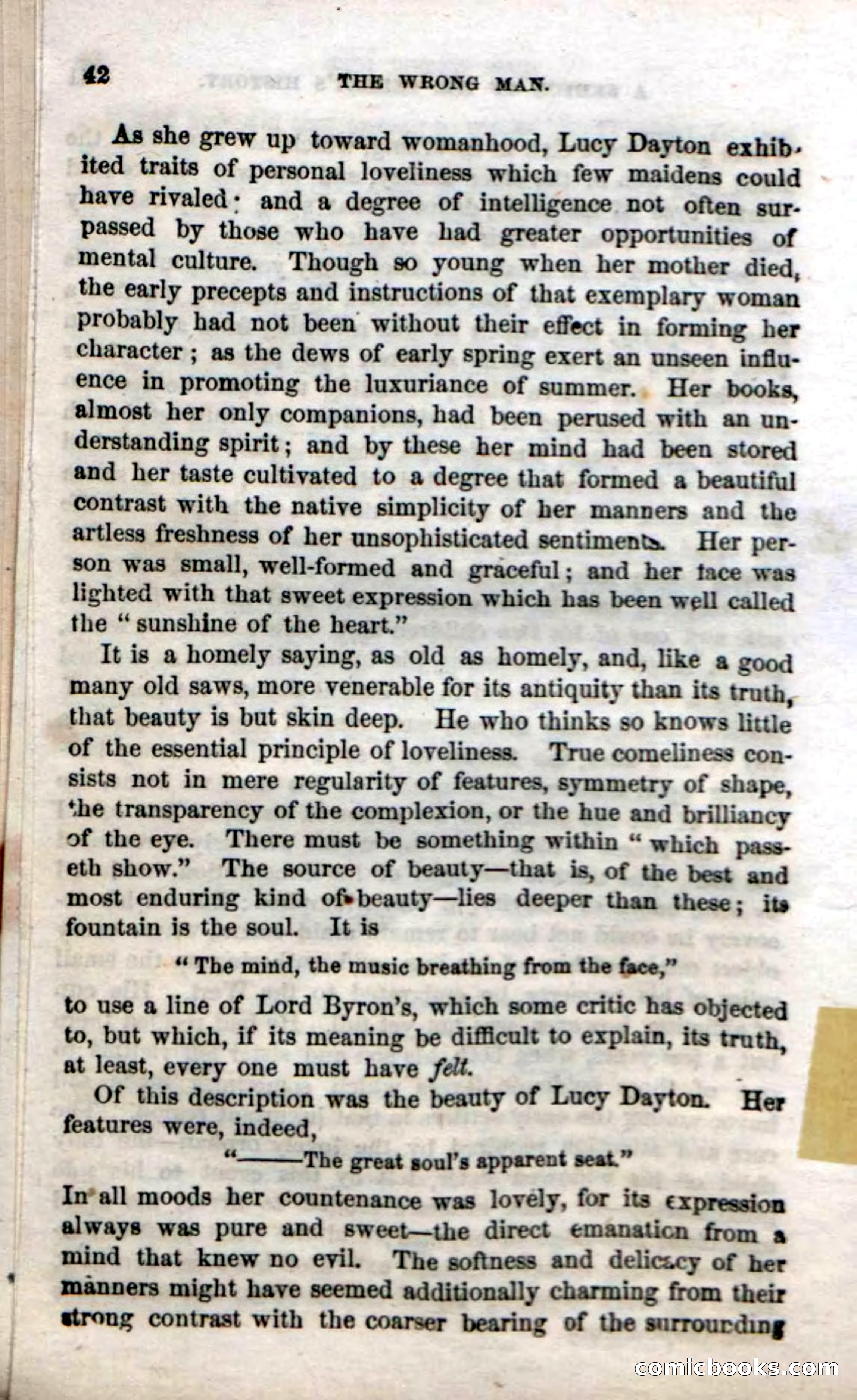
A restored page from Pulp Fiction, 1862. Page through the whole issue in the reader above.
📄 Transcribed text from this page (OCR, searchable)
Machine-transcribed from the original scan — historical spelling and the odd misread are preserved.
| 42 THE WRONG MAN. As she grew up toward womanhood, Lucy Dayton exhib- ited traits of personal loveliness which few maidens could have rivaled: and a degree of intelligence not often sur- passed by those who have had greater opportunities of mental culture. Though so young when her mother died, the early precepts and instructions of that exemplary woman Probably had not been without their effect in forming her character ; as the dews of early spring exert an unseen influ- ence in promoting the luxuriance of summer. Her books, almost her only companions, had been perused with an un- derstanding spirit; and by these her mind had been stored and her taste cultivated to a degree that formed a beautiful contrast with the native simplicity of her manners and the artless freshness of her unsophisticated sentiments. Her per- son was small, well-formed and graceful; and her tace was lighted with that sweet expression which has been well called the “sunshine of the heart.” It is a homely saying, as old as homely, and, like a good many old saws, more venerable for its antiquity than its truth, that beauty is but skin deep. He who thinks so knows little of the essential principle of loveliness. True comeliness con- sists not in mere regularity of features, symmetry of shape, ‘he transparency of the complexion, or the hue and brilliancy of the eye. There must be something within “ which pass- eth show.” The source of beauty—that is, of the best and most enduring kind of*beauty—lies deeper than these; its fountain is the soul. It is “The mind, the music breathing from the face,” to use a line of Lord Byron’s, which some critic has objected to, but which, if its meaning be difficult to explain, its truth, at least, every one must have felt. ; Of this description was the beauty of Lucy Dayton. Her features were, indeed, “The great soul’s apparent seat.” In’all moods her countenance was lovely, for its €xpression always was pure and sweet—the direct emanation from a mind that knew no eyil. The softness and delicacy of her manners might have seemed additionally charming from their strong contrast with the coarser bearing of the surrounding commcbooks.conn —