
Pulp Fiction, 1860 · page 40 of 130
Beadle's Dime Novels No. 3: Myra, the Child of Adoption — page 40: what you’re looking at
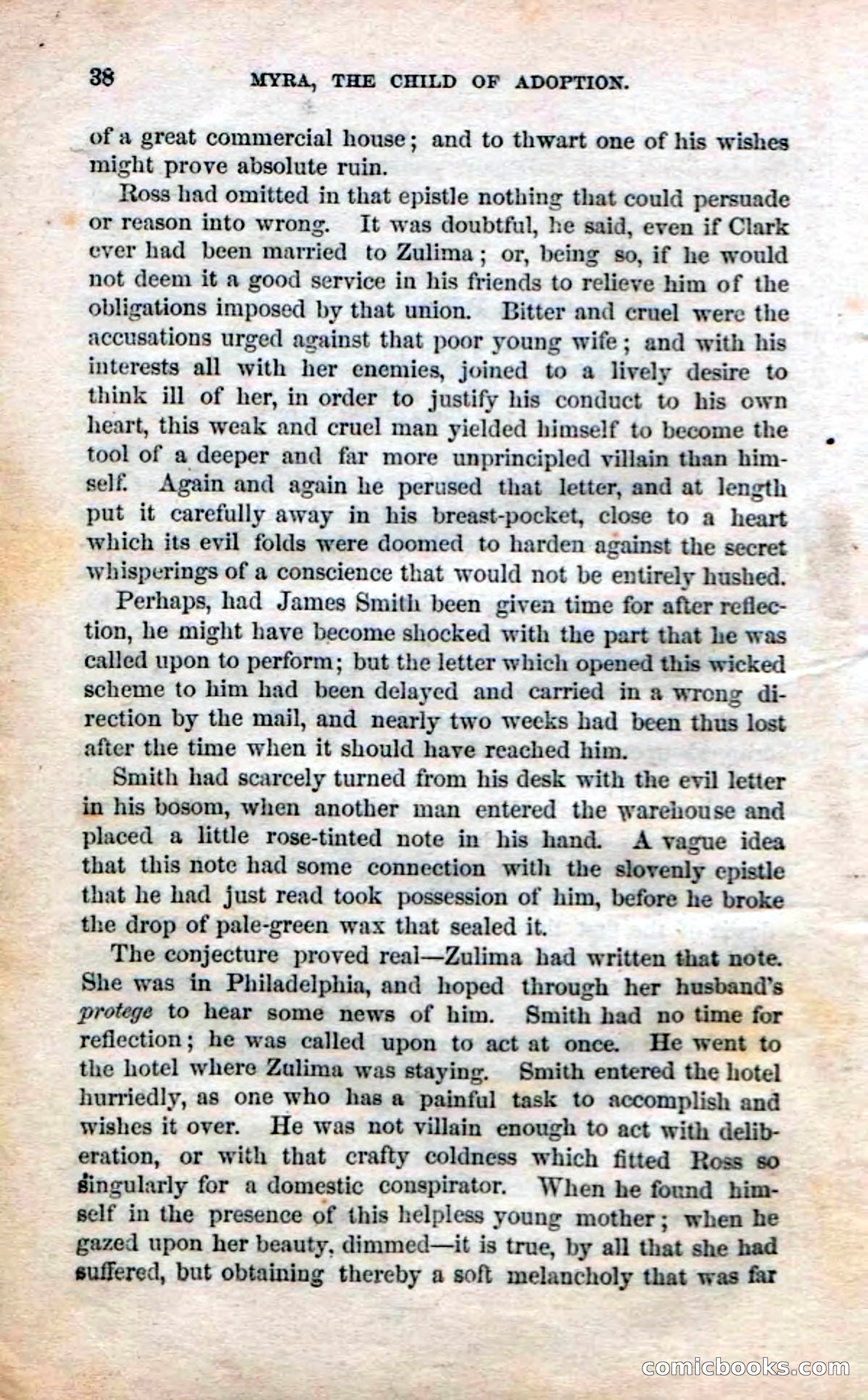
A restored page from Pulp Fiction, 1860. Page through the whole issue in the reader above.
📄 Transcribed text from this page (OCR, searchable)
Machine-transcribed from the original scan — historical spelling and the odd misread are preserved.
38 MYRA, THE CHILD OF ADOPTION. of a great commercial house; and to thwart one of his wishes might prove absolute ruin. Ross had omitted in that epistle nothing that could persuade or reason into wrong. It was doubtful, he said, even if Clark ever had been married to Zulima; or, being so, if he would not deem it a good service in his friends to relieve him of the obligations imposed by that union. Bitter and cruel were the accusations urged against that poor young wife; and with his interests all with her enemies, joined to a lively desire to think ill of her, in order to justify his conduct to his own heart, this weak and cruel man yielded himself to become the tool of a deeper and far more unprincipled villain than him- self, Again and again he perused that letter, and at length put it carefully away in his breast-pocket, close to a heart which its evil folds were doomed to harden against the secret whisperings of a conscience that would not be entirely hushed. Perhaps, had James Smith been given time for after reflec- tion, he might have become shocked with the part that he was called upon to perform; but the letter which opened this wicked scheme to him had been delayed and carried in a wrong di- rection by the mail, and nearly two weeks had been thus lost after the time when it should have reached him. Smith had scarcely turned from his desk with the evil letter in his bosom, when another man entered the warehouse and placed a little rose-tinted note in his hand. A vague idea that this note had some connection with the slovenly epistle that he had just read took possession of him, before he broke the drop of pale-green wax that sealed it. The conjecture proved real—Zulima had written that note. She was in Philadelphia, and hoped through her husband’s protege to hear some news of him. Smith had no time for reflection; he was called upon to act at once. He went to the hotel where Zalima was staying. Smith entered the hotel hurriedly, as one who has a painful task to accomplish and wishes it over. He was not villain enough to act with delib- eration, or with that crafty coldness which fitted Ross so singularly for a domestic conspirator. When he found him- self in the presence of this helpless young mother; when he gazed upon her beauty, dimmed—it is true, by all that she had suffered, but obtaining thereby a soft melancholy that was far conmmicloOoks. con