
Pulp Fiction, 1870 · page 34 of 100
Beadle's Dime Novels No. 208: The Ocean Outlaw — page 34: what you’re looking at
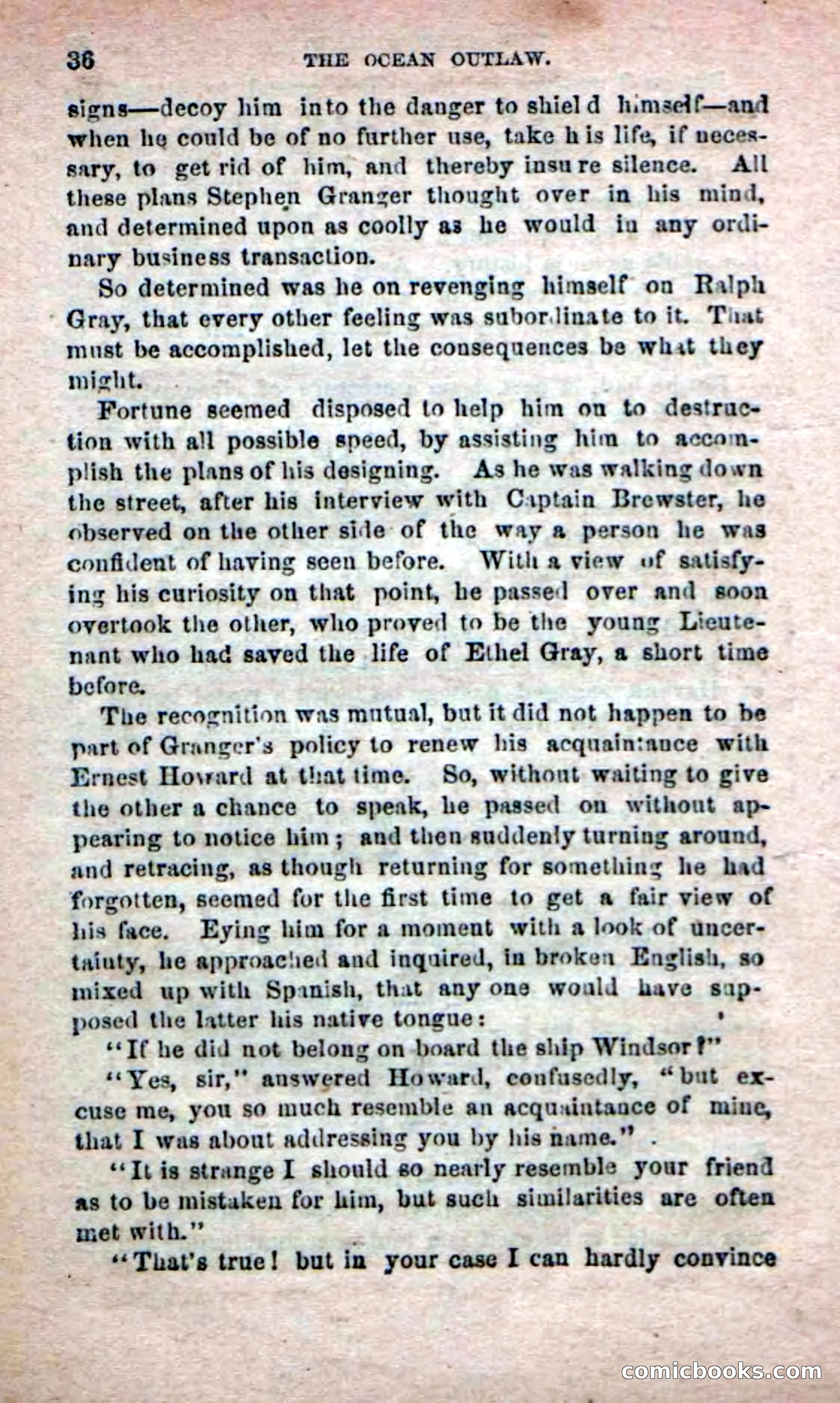
A restored page from Pulp Fiction, 1870. Page through the whole issue in the reader above.
📄 Transcribed text from this page (OCR, searchable)
Machine-transcribed from the original scan — historical spelling and the odd misread are preserved.
: £ « ™ = 36 THE OCEAN OUTLAW. signs—decoy him into the danger to shield himseif—and when he could be of no further use, take his life, if neces- sary, to get rid of him, and thereby insure silence. All these plans Stephen Granger thought over in his mind, and determined upon as coolly as he would iu any ordi- nary business transaction. So determined was he on revenging himself on Ralph - Gray, that every other feeling was subor inate to it. That must be accomplished, let the consequences be what they might. Fortune seemed disposed to help him on to destrac- tion with all possible speed, by assisting him to accam- plish the plans of his designing. As he was walking down the street, after his interview with Captain Brewster, he observed on the other side of the way a person he was confident of having seen before. Witha view of satisfy- ing his curiosity on that point, he passed over and soon overtook the other, who proved to be the young Lieute- nant who had sayed the life of Ethel Gray, a short time before. : The recognition was mutual, but it did not happen to be part of Granger's policy to renew his acquaintance with Ernest Howard at thattime. So, withont waiting to give the other a chance to speak, he passed on without ap- pearing to notice him; and then suddenly turning around, and retracing, as though returning for something he had forgotten, seemed for the first time to get a fair view of his face. Eying him for a moment with a look of uncer- taiuty, he approached and inquired, in broken English, so mixed up with Spanish, that any one would have sap- posed the latter his native tongue: “Tf he did not belong on board the ship Windsor ‘‘Yes, sir,” answered Howard, confusedly, “but ex- cuse me, you so much resemble an acquaintance of mine, that I was about addressing you by his name.” ‘‘It is strange I should so nearly resemble your friend as to be mistaken for him, but such similarities are often met with.” _ That's true! but in your case I can hardly convince Commie xoolks,.coin