
Pulp Fiction, 1868 · page 65 of 97
Ballou's Monthly Magazine, Vol. XXVII, No. 1 — page 65: what you’re looking at
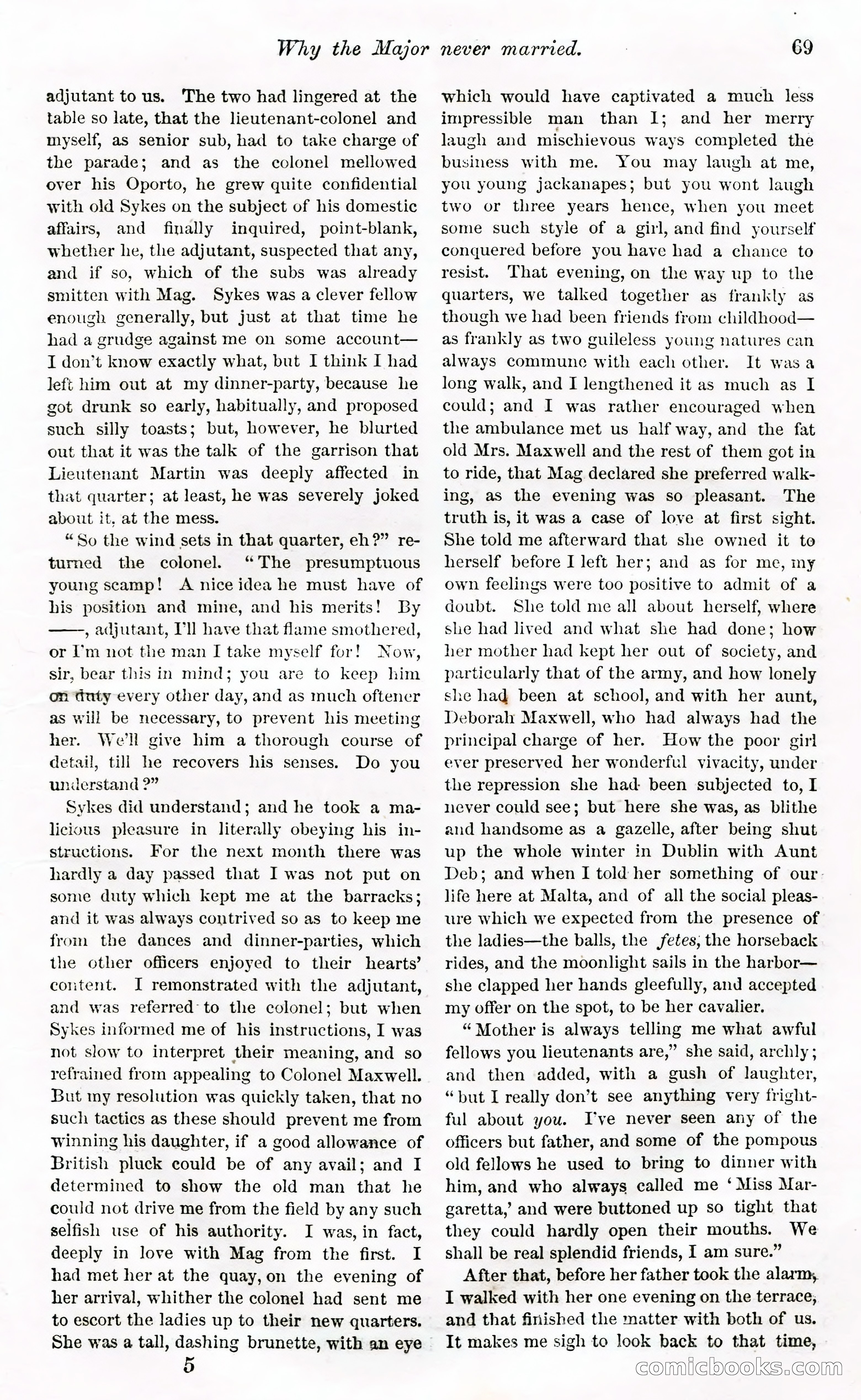
A restored page from Pulp Fiction, 1868. Page through the whole issue in the reader above.
📄 Transcribed text from this page (OCR, searchable)
Machine-transcribed from the original scan — historical spelling and the odd misread are preserved.
Why the Major never married. adjutant to us. The two had lingered at the table so late, that the lieutenant-colonel and myself, as senior sub, had to take charge of the parade; and as the colonel mellowed over his Oporto, he grew quite confidential with old Sykes on the subject of his domestic affairs, and finally inquired, point-blank, whether he, the adjutant, suspected that any, and if so, which of the subs was already smitten with Mag. Sykes was a clever fellow enough generally, but just at that time he had a grudge against me on some account— I don’t know exactly what, but I think I had left him out at my dinner-party, because he got drunk so early, habitually, and proposed such silly toasts; but, however, he blurted out that it was the talk of the garrison that Lieutenant Martin was deeply affected in that quarter; at least, he was severely joked about it, at the mess. “So the wind sets in that quarter, eh?” re- tumed the colonel. “The presumptuous young scamp! A nice idea he must have of his position and mine, and his merits! By , adjutant, Pll have that flame smothered, or I’m not the man I take myself for! Now, sir, bear this in mind; you are to keep him on duty every other day, and as much oftener as will be necessary, to prevent his meeting her. We'll give him a thorough course of detail, till he recovers his senses. Do you 1derstand ?” Sykes did understand; and he took a ma- licious pleasure in literally obeying his in- structions. For the next month there was hardly a day passed that I was not put on some duty which kept me at the barracks; and it was always contrived so as to keep me from the dances and dinner-parties, which the other officers enjoyed to their hearts’ content. J remonstrated with the adjutant, and was referred to the colonel; but when Sykes informed me of his instructions, I was not slow to interpret their meaning, and so refrained from appealing to Colonel Maxwell. But my resolution was quickly taken, that no such tactics as these should prevent me from winning his daughter, if a good allowance of British pluck could be of any avail; and I determined to show the old man that he could not drive me from the field by any such selfish use of his authority. I was, in fact, deeply in love with Mag from the first. I had met her at the quay,on the evening of her arrival, whither the colonel had sent me to escort the ladies up to their new quarters. She was a tall, dashing brunette, with an eye 9) 69 which would have captivated a much less impressible man than I; and her merry laugh and mischievous ways completed the business with me. You may laugh at me, you young jackanapes; but you wont laugh two or three years hence, when you meet some such style of a girl, and find yourself conquered before you have had a chance to resist. That evening, on the way up to the quarters, we talked together as frankly as though we had been friends from childhood— as frankly as two guileless young natures can always commune with each other. It wasa long walk, and I lengthened it as much as I could; and I was rather encouraged when the ambulance met us half way, and the fat old Mrs. Maxwell and the rest of them got in to ride, that Mag declared she preferred walk- ing, as the evening was so pleasant. The truth is, it was a case of love at first sight. She told me afterward that she owned it to herself before I left her; and as for me, my own feelings were too positive to admit of a doubt. She told me all about herself, where she had lived and what she had done; how her mother had kept her out of society, and particularly that of the army, and how lonely she had been at school, and with her aunt, Deborah Maxwell, who had always had the principal charge of her. How the poor girl ever preserved her wonderful vivacity, under the repression she had been subjected to, I never could see; but here she was, as blithe and handsome as a gazelle, after being shut up the whole winter in Dublin with Aunt Deb; and when I told her something of our: life here at Malta, and of all the social pleas- ure which we expected from the presence of the ladies—the balls, the fetes, the horseback rides, and the moonlight sails in the harbor— she clapped her hands gleefully, and accepted my offer on the spot, to be her cavalier. “Mother is always telling me what awful fellows you lieutenants are,” she said, archly ; and then added, with a gush of laughter, “but I really don’t see anything very fright- ful about you. Ive never seen any of the officers but father, and some of the pompous old fellows he used to bring to dinner with him, and who always called me ‘ Miss Mar- garetta,’ and were buttoned up so tight that they could hardly open their mouths. We shall be real splendid friends, I am sure.” After that, before her father took the alarm, I walked with her one evening on the terrace, and that firiished the matter with both of us. It makes me sigh to look back to that time, comcoooks,. com