
Pulp Fiction, 1868 · page 64 of 97
Ballou's Monthly Magazine, Vol. XXVII, No. 1 — page 64: what you’re looking at
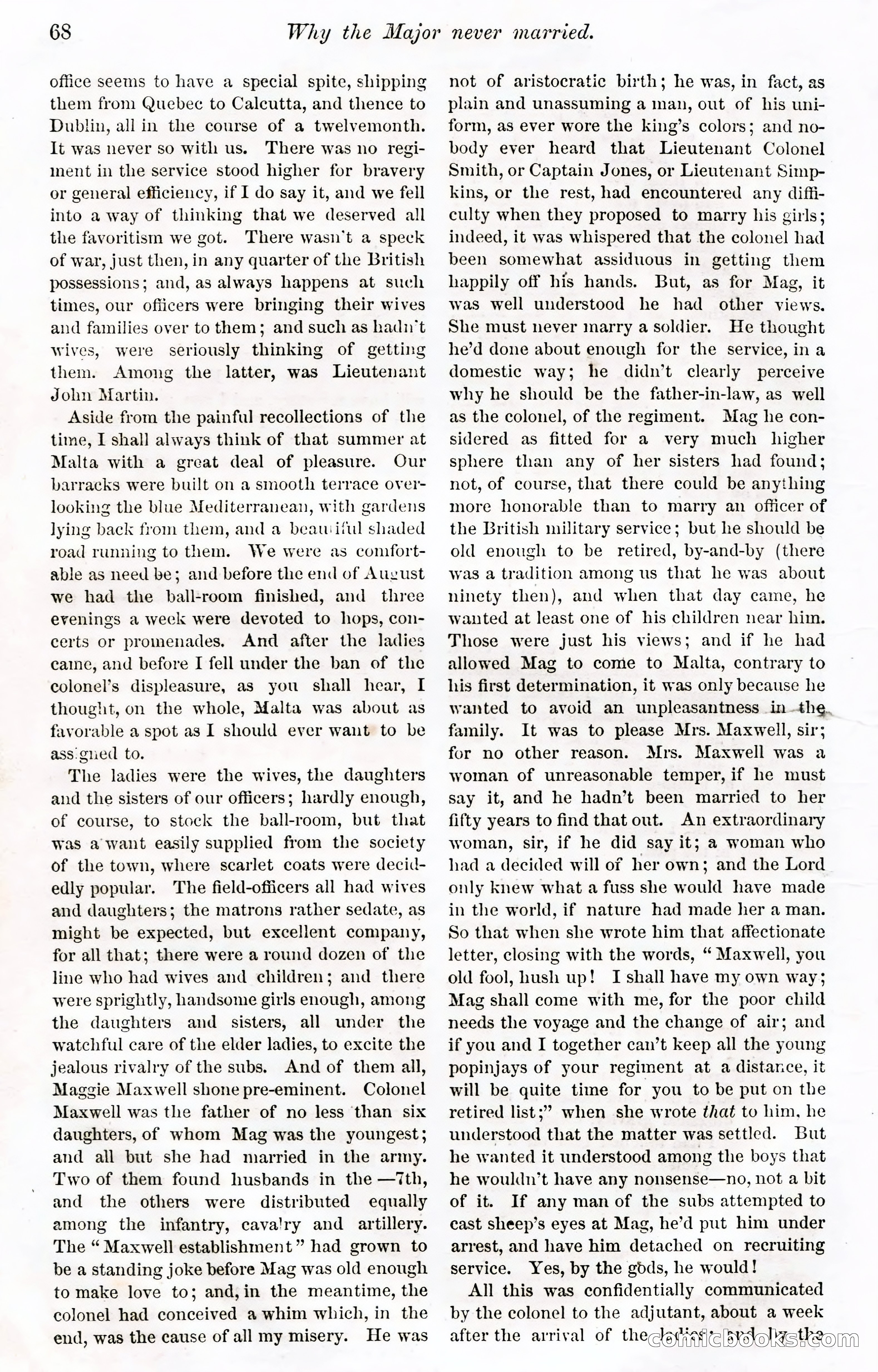
A restored page from Pulp Fiction, 1868. Page through the whole issue in the reader above.
📄 Transcribed text from this page (OCR, searchable)
Machine-transcribed from the original scan — historical spelling and the odd misread are preserved.
68 office seems to have a special spite, shipping them from Quebec to Calcutta, and thence to Dublin, all in the course of a twelvemonth. It was never so with us. There was no regi- ment in the service stood higher for bravery or general efficiency, if I do say it, and we fell into a way of thinking that we deserved all the favoritism we got. There wasn't a speck of war, just then, in any quarter of the British possessions; and, as always happens at such times, our officers were bringing their wives and families over to them; and such as hadn't wives, were seriously thinking of getting them. Among the latter, was Lieutenant John Martin. Aside from the painful recollections of the time, I shall always think of that summer at Malta with a great deal of pleasure. Our barracks were built on a smooth terrace over- looking the blue Mediterranean, with gardens lying back from them, and a beauiitul shaded road running to them. We were as comfort- able as need be; and before the end of August we had the ball-room finished, and three evenings a week were devoted to hops, con- certs or promenades, And after the ladies caine, and before I fell under the ban of the colonel’s displeasure, as you shall hear, I thought, on the whole, Malta was about as favorable a spot as I should ever want to be ass:gued to. The ladies were the wives, the daughters and the sisters of our officers; hardly enough, of course, to stock the ball-room, but that was a want easily supplied from the society of the town, where scarlet coats were decid- edly popular. The field-officers all had wives and daughters; the matrons rather sedate, as might be expected, but excellent company, for all that; there were a round dozen of the line who had wives and children; and there were sprightly, handsome girls enough, among the daughters and sisters, all under the watchful care of the elder ladies, to excite the jealous rivalry of the subs. And of them all, Maggie Maxwell shone pre-eminent. Colonel Maxwell was the father of no less than six daughters, of whom Mag was the youngest; and all but she had married in the army. Two of them found husbands in the —7th, and the others were distributed equally among the infantry, cava'ry and artillery. The “ Maxwell establishment” had grown to be a standing joke before Mag was old enough to make love to; and,in the meantime, the colonel had conceived a whim which, in the end, was the cause of all my misery. He was Why the Major never married. not of aristocratic birth; he was, in fact, as plain and unassuming a man, out of his uni- form, as ever wore the king’s colors; and no- body ever heard that Lieutenant Colonel Smith, or Captain Jones, or Lieutenant Simp- kins, or the rest, had encountered any diffi- culty when they proposed to marry his girls; indeed, it was whispered that the colonel had been somewhat assiduous in getting them happily off his hands. But, as for Mag, it was well understood he had other views. She must never marry a soldier. He thought he’d done about enough for the service, ina domestic way; he didn’t clearly perceive why he should be the father-in-law, as well as the colonel, of the regiment. Mag he con- sidered as fitted for a very much _ higher sphere than any of her sisters had found; not, of course, that there could be anything more honorable than to marry an officer of the British military service; but he should be old enough to be retired, by-and-by (there was a tradition among us that he was about ninety then), and when that day came, he wauted at least one of his children near him. Those were just his views; and if he had allowed Mag to come to Malta, contrary to his first determination, it was only because he wanted to avoid an unpleasantness inthe. family. It was to please Mrs. Maxwell, sir; for no other reason. Mrs. Maxwell was a woman of unreasonable temper, if he must say it, and he hadn’t been married to her fifty years to find that out. An extraordinary woman, sir, if he did say it; a woman who had a decided will of her own; and the Lord only knew what a fuss she would have made in the world, if nature had made her a man. So that when she wrote him that affectionate letter, closing with the words, “ Maxwell, you old fool, hush up! I shall have my own way; Mag shall come with me, for the poor child needs the voyage and the change of air; and if you and I together can’t keep all the young popinjays of your regiment at a distance, it will be quite time for you to be put on the retired list;’ when she wrote thaé to him, he understood that the matter was settled. But he wanted it understood among the boys that he wouldn’t have any nonsense—no, not a bit of it. If any man of the subs attempted to cast sheep’s eyes at Mag, he’d put him under arrest, and have him detached on recruiting service. Yes, by the gods, he would! All this was confidentially communicated by the colonel to the adjutant, about a week after the arrival of theclatiatte brake) actheaonn