
Pulp Fiction, 1868 · page 21 of 97
Ballou's Monthly Magazine, Vol. XXVII, No. 1 — page 21: what you’re looking at
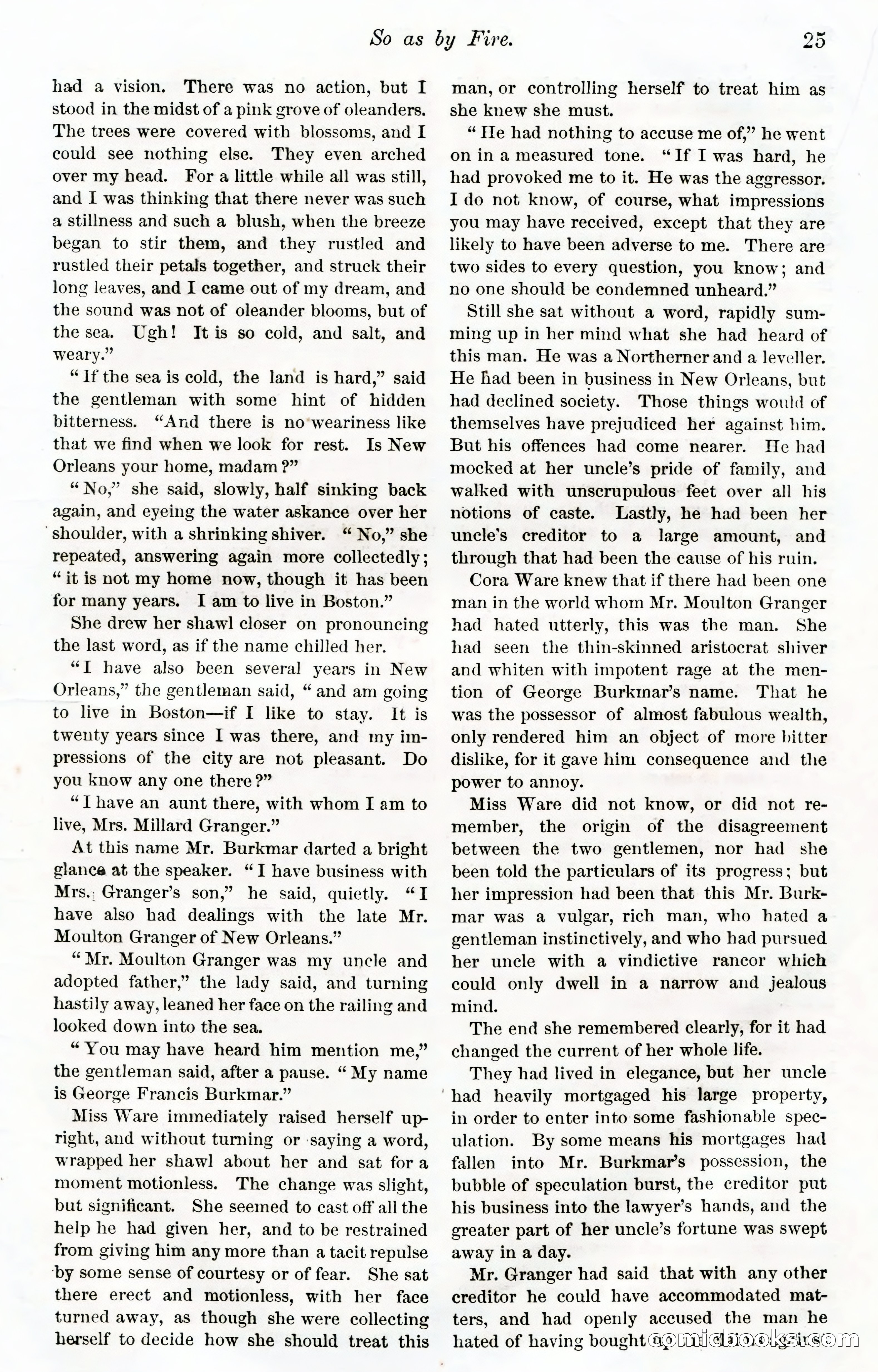
A restored page from Pulp Fiction, 1868. Page through the whole issue in the reader above.
📄 Transcribed text from this page (OCR, searchable)
Machine-transcribed from the original scan — historical spelling and the odd misread are preserved.
So as by Fire. 25 had a vision. There was no action, but I stood in the midst of a pink grove of oleanders. The trees were covered with blossoms, and I could see nothing else. They even arched over my head. For a little while all was still, and I was thinking that there never was such a stillness and such a blush, when the breeze began to stir them, and they rustled and rustled their petals together, and struck their long leaves, and I came out of my dream, and the sound was not of oleander blooms, but of the sea. Ugh! It is so cold, and salt, and weary.” “If the sea is cold, the land is hard,” said the gentleman with some hint of hidden bitterness. “And there is no’weariness like that we find when we look for rest. Is New Orleans your home, madam ?” “No,” she said, slowly, half sinking back again, and eyeing the water askance over her ‘shoulder, with a shrinking shiver. “ No,” she repeated, answering again more collectedly; “it is not my home now, though it has been for many years. I am to live in Boston.” She drew her shaw] closer on pronouncing the last word, as if the name chilled her. “T have also been several years in New Orleans,” the gentleman said, “and am going to live in Boston—if I like to stay. It is twenty years since I was there, and my im- pressions of the city are not pleasant. Do you know any one there ?” “JT have an aunt there, with whom I am to live, Mrs. Millard Granger.” At this name Mr. Burkmar darted a bright glance at the speaker. “I have business with Mrs.: Granger’s son,” he said, quietly. “I have also had dealings with the late Mr. Moulton Granger of New Orleans.” “Mr. Moulton Granger was my uncle and adopted father,” the lady said, and turning hastily away, leaned her face on the railing and looked down into the sea. “You may have heard him mention me,” the gentleman said, after a pause. “ My name is George Francis Burkmar.” Miss Ware immediately raised herself up- right, and without turning or ‘saying a word, wrapped her shawl about her and sat fora moment motionless. The change was slight, but significant. She seemed to cast off all the help he had given her, and to be restrained from giving him any more than a tacit repulse ‘by some sense of courtesy or of fear. She sat there erect and motionless, with her face turned away, as though she were collecting herself to decide how she should treat this man, or controlling herself to treat him as she knew she must. “ He had nothing to accuse me of,” he went on in a measured tone. “If I was hard, he had provoked me to it. He was the aggressor. Ido not know, of course, what impressions you may have received, except that they are likely to have been adverse to me. There are two sides to every question, you know; and no one should be condemned unheard.” Still she sat without a word, rapidly sum- ming up in her mind what she had heard of this man. He was a Northerner and a leveller. He had been in business in New Orleans, but had declined society. Those things would of themselves have prejudiced her against him. But his offences had come nearer. He had mocked at her uncle’s pride of family, and walked with unscrupulous feet over all his notions of caste. Lastly, he had been her uncle’s creditor to a large amount, and through that had been the cause of his ruin. Cora Ware knew that if there had been one man in the world whom Mr. Moulton Granger had hated utterly, this was the man. She had seen the thin-skinned aristocrat shiver and whiten with impotent rage at the men- tion of George Burkmar’s name. That he was the possessor of almost fabulous wealth, only rendered him an object of more bitter dislike, for it gave him consequence and the power to annoy. Miss Ware did not know, or did not re- member, the origin of the disagreement between the two gentlemen, nor had she been told the particulars of its progress; but her impression had been that this Mr. Burk- mar was a vulgar, rich man, who hated a gentleman instinctively, and who had pursued her uncle with a vindictive rancor which could only dwell in a narrow and jealous mind. The end she remembered clearly, for it had changed the current of her whole life. They had lived in elegance, but her uncle ‘had heavily mortgaged his large property, in order to enter into some fashionable spec- ulation. By some means his mortgages had fallen into Mr. Burkmar’s possession, the bubble of speculation burst, the creditor put his business into the lawyer’s hands, and the greater part of her uncle’s fortune was swept away in a day. Mr. Granger had said that with any other creditor he could have accommodated mat- ters, and had openly accused the man he hated of having bought GOlM Gano geirsonn