
Pulp Fiction, 1868 · page 20 of 97
Ballou's Monthly Magazine, Vol. XXVII, No. 1 — page 20: what you’re looking at
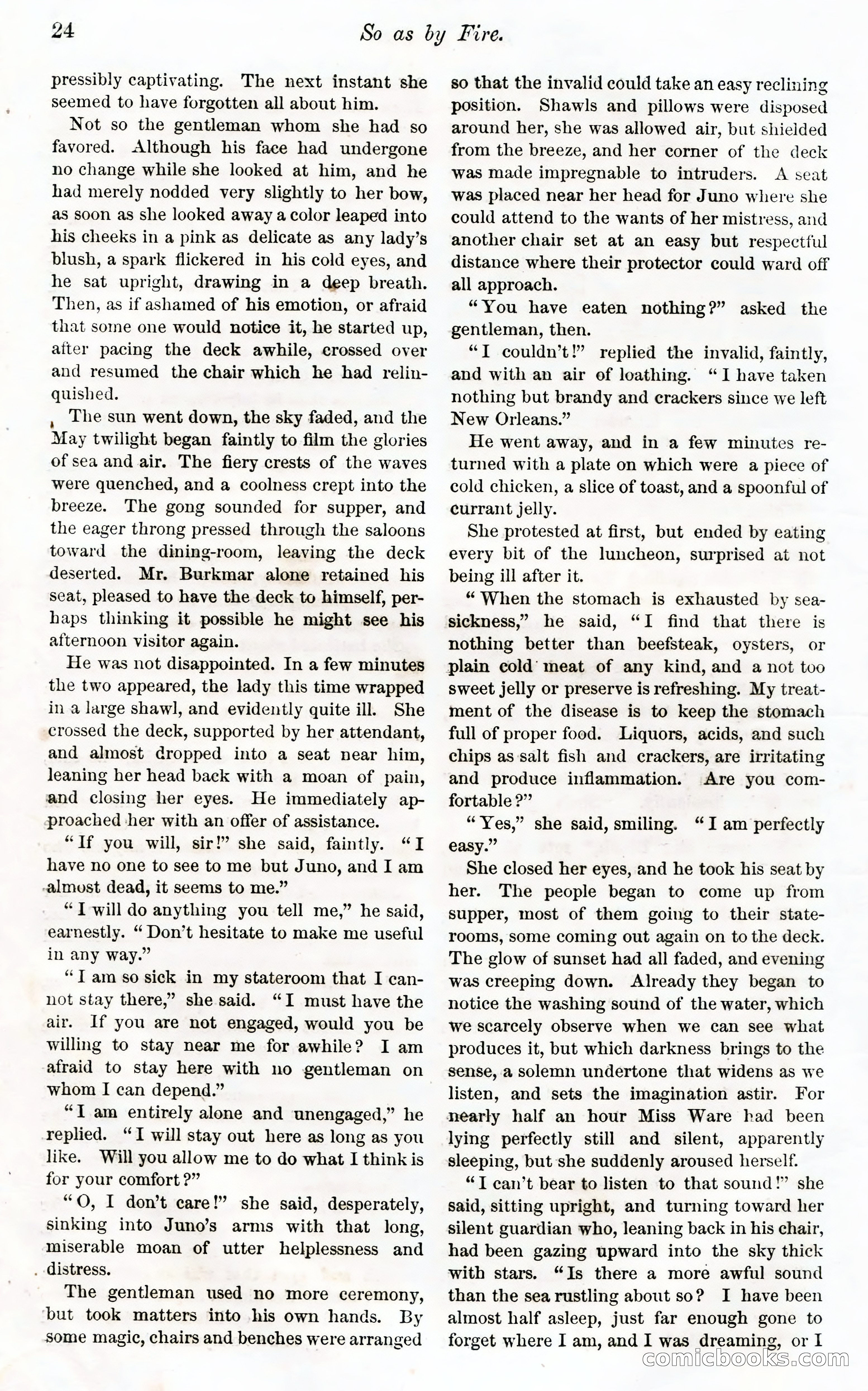
A restored page from Pulp Fiction, 1868. Page through the whole issue in the reader above.
📄 Transcribed text from this page (OCR, searchable)
Machine-transcribed from the original scan — historical spelling and the odd misread are preserved.
24 pressibly captivating. The next instant she seemed to have forgotten all about him. Not so the gentleman whom she had so favored. Although his face had undergone no change while she looked at him, and he had merely nodded very slightly to her bow, as soon as she looked away a color leaped into his cheeks in a pink as delicate as any lady’s blush, a spark flickered in his cold eyes, and he sat upright, drawing in a deep breath. Then, as if ashamed of his emotion, or afraid that some one would notice it, he started up, alter pacing the deck awhile, crossed over and resumed the chair which he had relin- quished. , The sun went down, the sky faded, and the May twilight began faintly to film the glories of sea and air. The fiery crests of the waves were quenched, and a coolness crept into the breeze. The gong sounded for supper, and the eager throng pressed through the saloons toward the dining-room, leaving the deck deserted. Mr. Burkmar alone retained his seat, pleased to have the deck to himself, per- haps thinking it possible he might see his afternoon visitor again. He was not disappointed. In a few minutes the two appeared, the lady this time wrapped in a large shawl, and evidently quite ill. She crossed the deck, supported by her attendant, and almost dropped into a seat near him, leaning her head back with a moan of pain, and closing her eyes. He immediately ap- proached ‘her with an offer of assistance. “Tf you will, sir!” she said, faintly. “I have no one to see to me but Juno, and I am almost dead, it seems to me.” “Twill do anything you tell me,” he said, earnestly. “ Don’t hesitate to make me useful in any way.” “Tam so sick in my stateroom that I can- not stay there,” she said. “I must have the air. If you are not engaged, would you be willing to stay near me for awhile? I am afraid to stay here with no gentleman on whom I can depend.” “I am entirely alone and unengaged,” he replied. “I will stay out here as long as you like. Will you allow me to do what I think is for your comfort ?” “O, I don’t care!” she said, desperately, sinking into Juno’s arms with that long, miserable moan of utter helplessness and . distress. The gentleman used no more ceremony, but took matters into his own hands. By some magic, chairs and benches were arranged So as by Fire. so that the invalid could take an easy reclining position. Shawls and pillows were disposed around her, she was allowed air, but shielded from the breeze, and her corner of the deck was made impregnable to intruders. A seat was placed near her head for Juno where she could attend to the wants of her mistress, and another chair set at an easy but respectful distance where their protector could ward off all approach. “You have eaten nothing?” asked the gentleman, then. “T couldn’t!” replied the invalid, faintly, and with an air of loathing. “I have taken nothing but brandy and crackers since we left New Orleans.” He went away, and in a few minutes re- turned with a plate on which were a piece of cold chicken, a slice of toast, and a spoonful of currant jelly. She protested at first, but ended by eating every bit of the luncheon, surprised at not being ill after it. “When the stomach is exhausted by sea- sickness,” he said, “I find that there is nothing better than beefsSteak, oysters, or plain cold’ meat of any kind, and a not too sweet jelly or preserve is refreshing. My treat- ment of the disease is to keep the stomach full of proper food. Liquors, acids, and such chips as salt fish and crackers, are irritating and produce inflammation. Are you com- fortable ?” “Yes,” she said, smiling. “I am perfectly easy.” She closed her eyes, and he took his seat by her. The people began to come up from supper, most of them going to their state- rooms, some coming out again on to the deck. The glow of sunset had all faded, and evening was creeping down. Already they began to notice the washing sound of the water, which we scarcely observe when we can see what produces it, but which darkness brings to the sense, a solemn undertone that widens as we listen, and sets the imagination astir. For nearly half an hour Miss Ware had been lying perfectly still and silent, apparently sleeping, but she suddenly aroused herself. “T can’t bear to listen to that sound!” she said, sitting upright, and turning toward her silent guardian who, leaning back in his chair, had been gazing upward into the sky thick with stars. “Is there a more awful sound than the sea rustling about so? I have been almost half asleep, just far enough gone to forget where I am, and I was dreaming, or I comlicbook S,COnn