
Pulp Fiction, 1929 · page 57 of 95
Air Wonder Stories, August 1929 — page 57: what you’re looking at
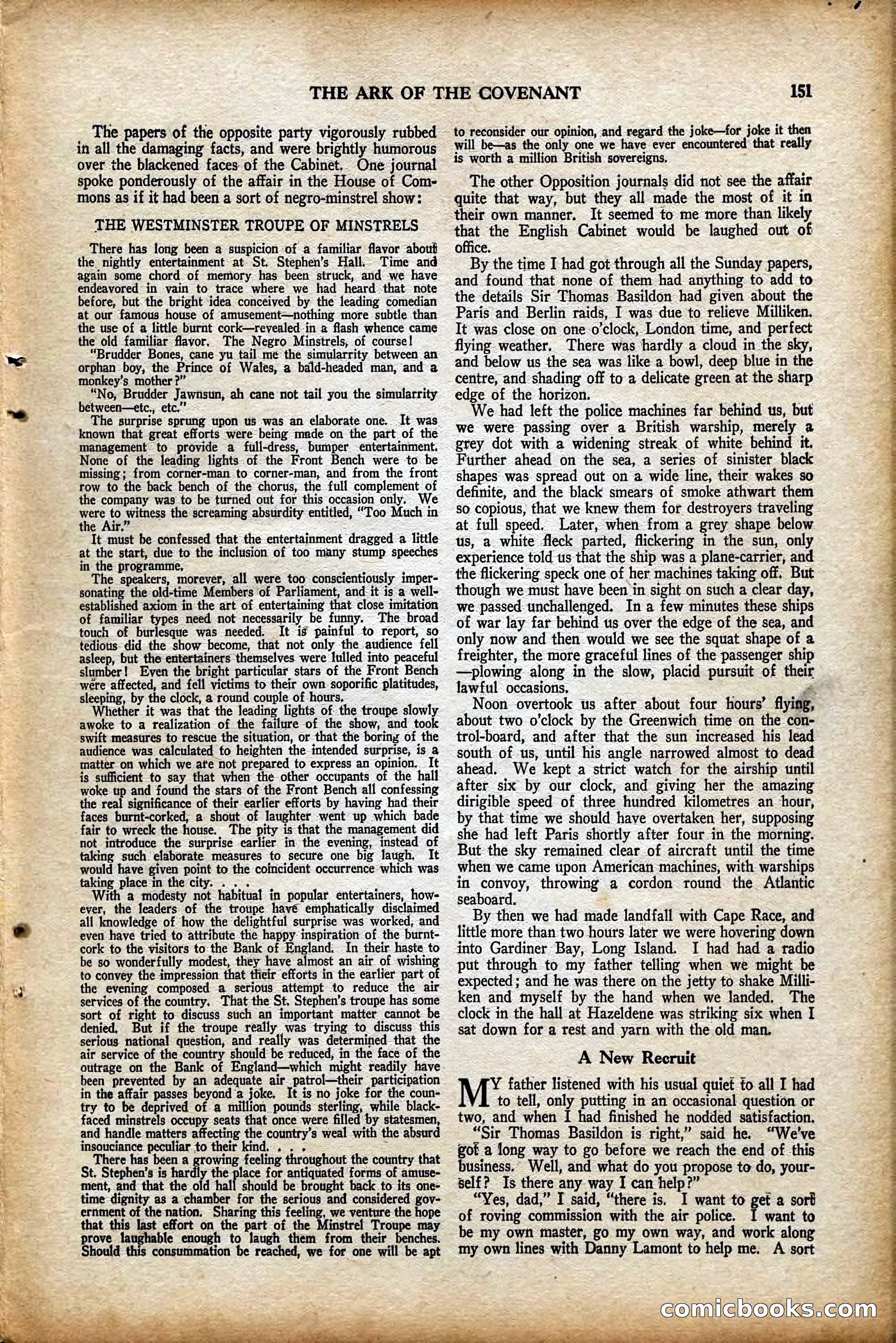
A restored page from Pulp Fiction, 1929. Page through the whole issue in the reader above.
📄 Transcribed text from this page (OCR, searchable)
Machine-transcribed from the original scan — historical spelling and the odd misread are preserved.
The papers of the opposite party vigorously rubbed in all the damaging facts, and were brightly humorous over the blackened: faces of the Cabinet, One journal spoke ponderously of the affair in the House of Com- mons as if it had been a sort of negro-minstrel show: THE WESTMINSTER TROUPE OF MINSTRELS There has long been a suspicion of a familiar flavor about the nightly etitertainment: at St. Stephen’s Hall Time and again some chord of memory. has been struck, and -we have endeavored in vain to trace where we had heard that. note before, but.the bright idea. concéived by the leading comedian at owr famous house of amusement—nothing more subtle than the use of a little burnt cork—revealed-in & flash whence came the old familiar flavor, The Negro Minstrels, of course! “Brudder Bones, cane-yu tail.me the simularrity between an orphan -boy, the Prince of Wales, a bald-headed man, and a monkey's mother?” “No, Brudder Jawnsun, ah cane not tail you the simularrity between—etc., etc.” The surprise sprung upon us was an elaborate one. It was known that great efforts were being made on the patt of the management: to provide a full-dress, bumper entertainment. None of the leading lights.of the Front Bench were -to be missing; from corner-man to corner-man,-and from the front row to the back bench of the chorus, the full complement of the company was to be turned out for this occasion only. We ieere to Witness the screaming absurdity entitled, “Too Much in the Air, It must be confessed that the entertainment dragged a little at the start, due to the inclusion of too many stump speeches in the programme, = . The speakers, morever, all were too conscientiously imper- sonating the old-time Members ‘of Parliament, and: it is a well- established axiom in'the art of entertaining that close imitation of familiar types need not necessarily be funny. The broad touch of burlesque was needed. It is painful to report, so tedious did the show become, that not only the audience fell asleep, but the-enitertainers themselves were lulled into peaceful slumber! Even the bright particular stars of the Front Bench were affected, and fell victims to their own soporific platitudes, sleeping, by the clock, a round couple of hours, Whether it was that the leadin lights of- the troupe slowly awoke to a realization ofthe failure of the show, and toolc swift measures to rescue the situation, or that the boring of the audience was calculated fo heighten the intended surprise, is a matter_on which we ate not prepared to express an opinion, It is sufficient to say that when the other occupants of the hall woke wp and found the stars of the Front Bench all confessing the real significance of their earlier efforts by having had their faces burnt-corked, a shout of laughter -went up which bade fair to wreck the house. The pity is that the management did not introduce the surprise earlier in the evening, instead of taking such elaborate measures to secure one big laugh, It would have given point to the coincident occurrence which was taking place'in the city... . | : With a modesty not habitual in popular entertainers, how- ever, the leaders of the troupe havé emphatically dis all knowledge of how. the delightful surprise was worked, and even have tried to attribute the happy- inspiration of the burnt- cork fo the visitors to:the Bank of England. In their haste to be so wonderfully modest, they have almost an air of wishing to convey the impression that their efforts in the earlier part of the evening composed a serious attempt to reduce the air services of the country. That the St, Stephen’s troupe has some sort of right to discuss stich an important matter cannot be denied, But if the troupe really was trying to discuss this serious. national question, and really was determined-that the air service of the country should’ be reduced, in the face of the outrage on the Bank of England—which might readily have been prevented by an adequate air_ patrol—their participation in the affair passes beyond a joke, It is no joke for the coun- try to be deprived of a million pounds sterling, while black- faced minstrels occupy seats that once were filled'by statesmen, and handle matters affecting the country’s weal with the absurd os te to their ves 4 eae we = ie ere een a growing feeling: throughout the country that St. Stephen's is tardly the place for antiquated forms of amuse- ment, and that the old hall should be: brought back to its one- time-dignity as a ‘chamber for the serious and considered. gov- ernment of the nation. Sharing this feeling, we venture the hope that this last effort on the patt of the Minstrel: Troupe may prove laughable enough to laugh them from their benches. Should consummation be reached, we for one will be apt THE ARK OF THE COVENANT to reconsider our opinion, and regard the joke—for joke it then will be—as the only one we have ever encountered that really is worth a million British sovereigns. The other Opposition journals did not see the affair quite that way, but they all made the most of it in eir own manner. It seemed to me more than likely wi the English Cabinet would be laughed out of office. By the time I had got through all the Sunday papers, and found that none of them had anything to add to the-details Sir Thomas. Basildon had given about the Paris and Berlin raids, I was due to relieve Milliken. Tt was close on one-o’clock, London time, and perfect flying- weather, There was ‘hardly a cloud in the sky, and below us the sea was like a-bowl, deep blue in the centre, and shading off to a delicate green at the sharp edge of the horizon. : We had left the police machines far behind us, but we were passing over a British warship, merely a grey dot with a widening streak of white behind it, Further ahead on the sea, a series of sinister black shapes was spread out on a wide line, their wakes so definite, and the black smears of smoke athwart them so. copious, that we knew them for destroyers traveling at full speed, Later, when-from a grey shape below us, a white fleck parted: flickering in the sun, only experience told us that the ship was a plane-catrier, and the flickering speck one of her machines taking off. But though we must have been in sight on such a clear day, we passed: unchallenged. Ina few minutes these ships of war lay far behind us over the edge of the sea, and only now and then. would we see the squat shape of a freighter, the more graceful lines of the passenger ship —plowing along in the slow, placid pursuit of their lawful occasions. Noon. overtook us after about four hours’ flyin about two o’clock by the Greenwich time on the con- trol-board, and after that the sun increased his lead south of. us, until his angle narrowed almost to dead ahead. We kept a strict watch for the airship until after six by our clock, and giving her the amazing dirigible speed of three hundred kilometres an hour, by that time we should have overtaken her, supposing she had left Paris shortly after four in the morning. But the sky remained clear of aircraft until the time when we came upon Americat:machines, with warships in convoy, throwing a cordon round the Atlantic seaboard. By then we had made landfall with Cape Race, and little more than two hours later we were hovering down into Gardiner Bay, Long Island. I had had a radio put through to my father telling when we might be expected; and he was there on the jetty to shake Milli- ken and myself by the hand when we landed. The clock in the hall at Hazeldene was striking six when I sat down for a rest and yarn with the old man. A New Recruit Ms“ father listened with his usual quiet to. all I had to tell, only putting in an occasional question or two, and when I had finished he nodded satisfaction. “Sir Thomas Basildon is right,’ said he. “We've @ot.a long way to go before we reach the end of this business. Well, and what do you propose to do, your- Belf? Is there any way I can help?” “Yes, dad,” I said, “there is, I want to get a sort of roving commission with the air police. I want to be my own master, go my own way, and work along my own lines with Danny. Lamont to help me. A sort > y S) Scomicbook "CO