
Pulp Fiction, 1929 · page 56 of 95
Air Wonder Stories, August 1929 — page 56: what you’re looking at
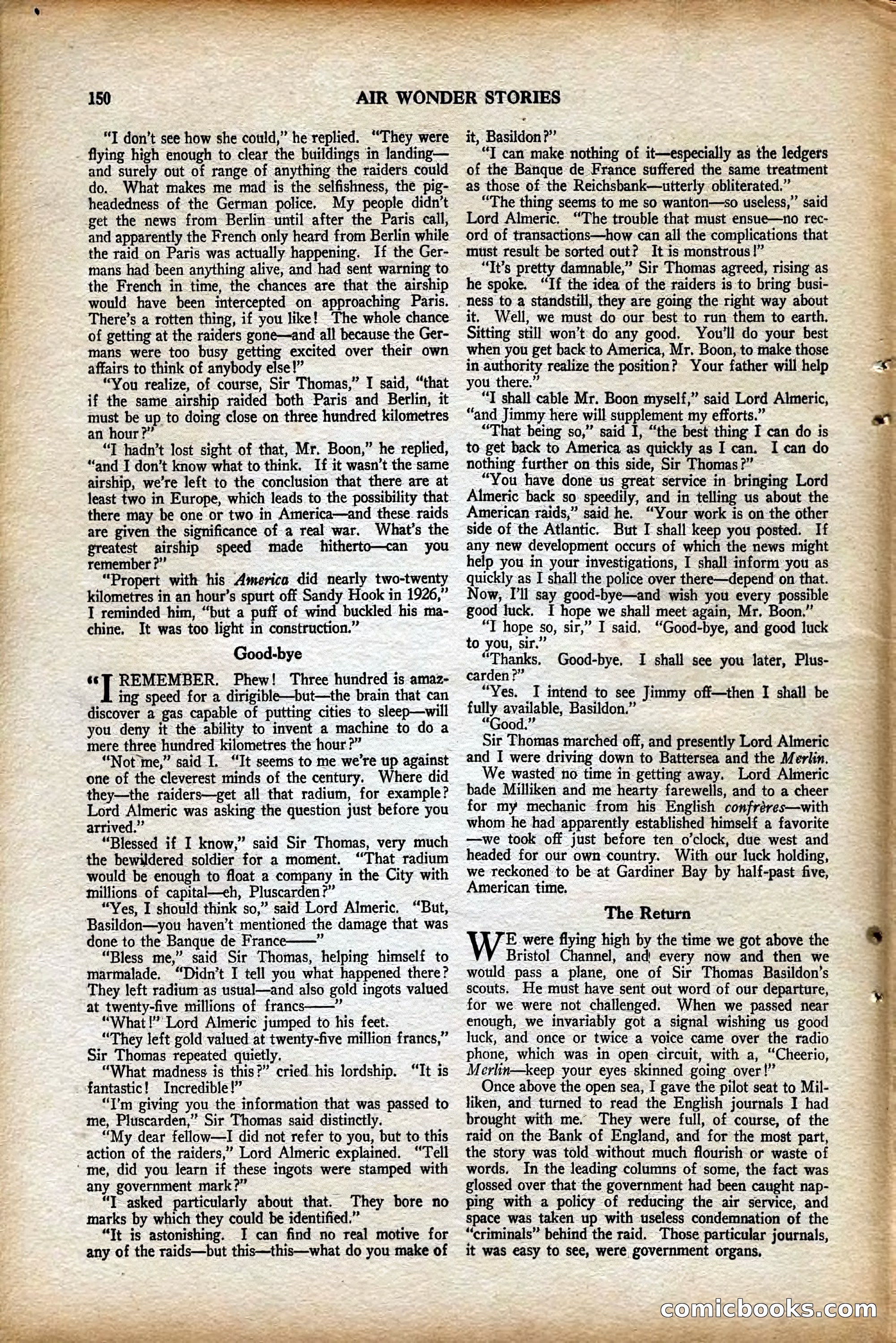
A restored page from Pulp Fiction, 1929. Page through the whole issue in the reader above.
📄 Transcribed text from this page (OCR, searchable)
Machine-transcribed from the original scan — historical spelling and the odd misread are preserved.
150 AIR WONDER STORIES *T don’t see how she could,” he replied. “They were - flying high enough to. clear the buildings in landing— and surely out of range of anything the raiders could do. What makes me mad is the selfishness, the pig- headedness of the German police, My people didn’t get the news from Berlin-until after the Paris call, and apparently the French only heard from Berlin while the raid on Paris was actually happening. If the Ger- mans had been anything alive, and had sent warning to the French in time, the chances are that the airship would. have been intercepted on: approaching Paris. There’s a rotten thing, if you like! The whole chance of getting at the raiders gone—and all because the Ger- mars were too busy getting excited over their own affairs to think of anybody else!” "You realize, of course, Sir Thomas,” I said, “that if the same airship raided both Paris-and Berlin, it must be up to doing close on three hundred kilometres an hour?” “T hadn’t lost sight of that, Mr. Boon,” he replied, “and J don’t know what to think. If it wasn’t the same airship, we’re left to the conclusion that there are at least two in Europe, which leads to the possibility that there may be one or two in America—and these. raids are given the significance of-a real war. What's the greatest airship speed made hitherto—can you remember ?”” “Propert with his America did nearly two-twenty kilometres in an hour’s spurt off Sandy Hook in 1926,” I reminded-him, “but a puff of wind buckled his ma- chine. It was too light in construction.” Good-bye 4s] REMEMBER. Phew! Three hundred is-amaz- ing speed for a dirigible—but—the brain that can discover a gas capable of putting cities to sleep—will you deny it the ability to invent a machine to do a mere three hundred kilometres. the hour?” “Not me,” said I. “It seems to me we’re up against one of the cleverest minds of the century. Where did they—the raiders—get all that radium, for example? Lord Almeric was asking the question just before you arrived.” “Blessed if I know,” said Sir Thomas, very much the bewildered soldier for a moment. “That radium would be enough to float a company in the City with tnillions. of capital—eh, Pluscarden?” “Ves, I should think so,” said Lord Almeric. “But, Basildon—you haven’t mentioned the damage that was done to the Banque de France——” “Bless me,” said Sir Thomas, helping himself to marmalade. “Didn’t I tell you what happened there? They left radium-as usttal—and also gold ingots valued at twenty-five millions of francs——” “What!” Lord Almeric jumped to his feet. “They left gold valued-at twenty-five million francs,” Sir Thomas repeated quietly. “What madness is this?” cried his lordship. “It is fantastic! Incredible!” “I'm giving you the information that was passed to me, Pluscarden,” Sir Thomas said distinctly. “My dear fellow—I did not refer to you, but to this action of the raiders,” Lord Almeric explained. “Tell “me, did you learn if these ingots were stamped with any government mark?” “T asked particularly about that. They bore no marks by which they could be identified.” “Tt is astonishing. I can find no real motive for any of the raids—but this—this—what do you make of it, Basildon?” “T can make nothing of it—especially as the ledgers of the Banque de France suffered the same treatment as those of the Reichsbank—uitterly. obliterated.” “The thing seems to ine so wanton—so useless,” said Lord Almeric, “The trouble that must ensue—no rec- ord of transactions—how can ail the complications that mitist result be sorted out? It is monstrous!” “Tt’s pretty damnable,” Sir Thomas agreed, rising as he spoke. “If the idea of the raiders is to bring busi- _ hess to a standstill, they are going the right way about it. Well, we must do our best'to run them to earth, Sitting still won’t:do any good. You'll do your best eaeh jot get back to America, Mr. Boon, to make those in-authority realize the position? Your father will help you there.” “I shall cable Mr. Boon myself,” said Lord Almeric, “and Jimmy here will stipplement my efforts.” “That being so,” said I, “the best thing I can do is to get back to America as quickly as I can. I can do nothing further on this side, Sir Thomas?” “You have done us great service in bringing Lord Almeric back so: speedily, and in telling us about the American raids,” said he. “Your work is onthe other side of the Atlantic. But I shall keep you posted. If any new development occurs of which the news might help you in your investigations, I shall inform yotr as quickly-as I shall the police over there—depend on that. Now, T’ll say good-bye—and wish you every possible good tuck. I hope we shall meet again, Mr. Boon.” “T hope so, sir,” I said, “Good-bye, and good luck to you, sir.” ‘Thanks, Good-bye, I. shall see you later, Plus- carden?” “Yes. I intend to see Jimmy off—then I shall be fully available, Basildon.” “Good.” Sir Thomas marched off, and presently Lord Almeric and I were driving down to Battersea and the Merlin, We wasted no time in getting away. Lord Almeric bade Milliken and me hearty farewells, and to a cheer for my mechanic from his English confréres—with whom he had apparently established himself a favorite —we took off just before ten o'clock, due west and headed for our own country. With our luck holding, we reckoned: to be at Gardiner Bay by half-past five, American time. The Return E were flying high by the time we got above the Bristol Channel, and every now and then we wotld pass a plane, one of Sir Thomas Basildon’s scouts. He must have sent out word of our departure, for we: were not challenged. When we passed near enough, we invariably got a signal wishing us good luck, and once or twice-a voice came over the radio phone, which was in open circuit, with a, “Cheerio, Merlin—keep your eyes skinned going over!” Once above the open sea, I gave the pilot seat to Mil- liken, and turned to read the English journals I had brought with me. They were full, of course, of the taid on the Bank of England, and for the most part, the story was told-without much flourish or waste of words, In the leading columns of some, the fact was glossed over that the government had been caught nap- ping with a policy of reducing the air service, and space was taken up with useless condemnation of the “criminals” behind the raid. Those particular journals, it was easy to see, were government organs, = ~~ Comicbooks:com|