
Pulp Fiction, 1929 · page 46 of 95
Air Wonder Stories, August 1929 — page 46: what you’re looking at
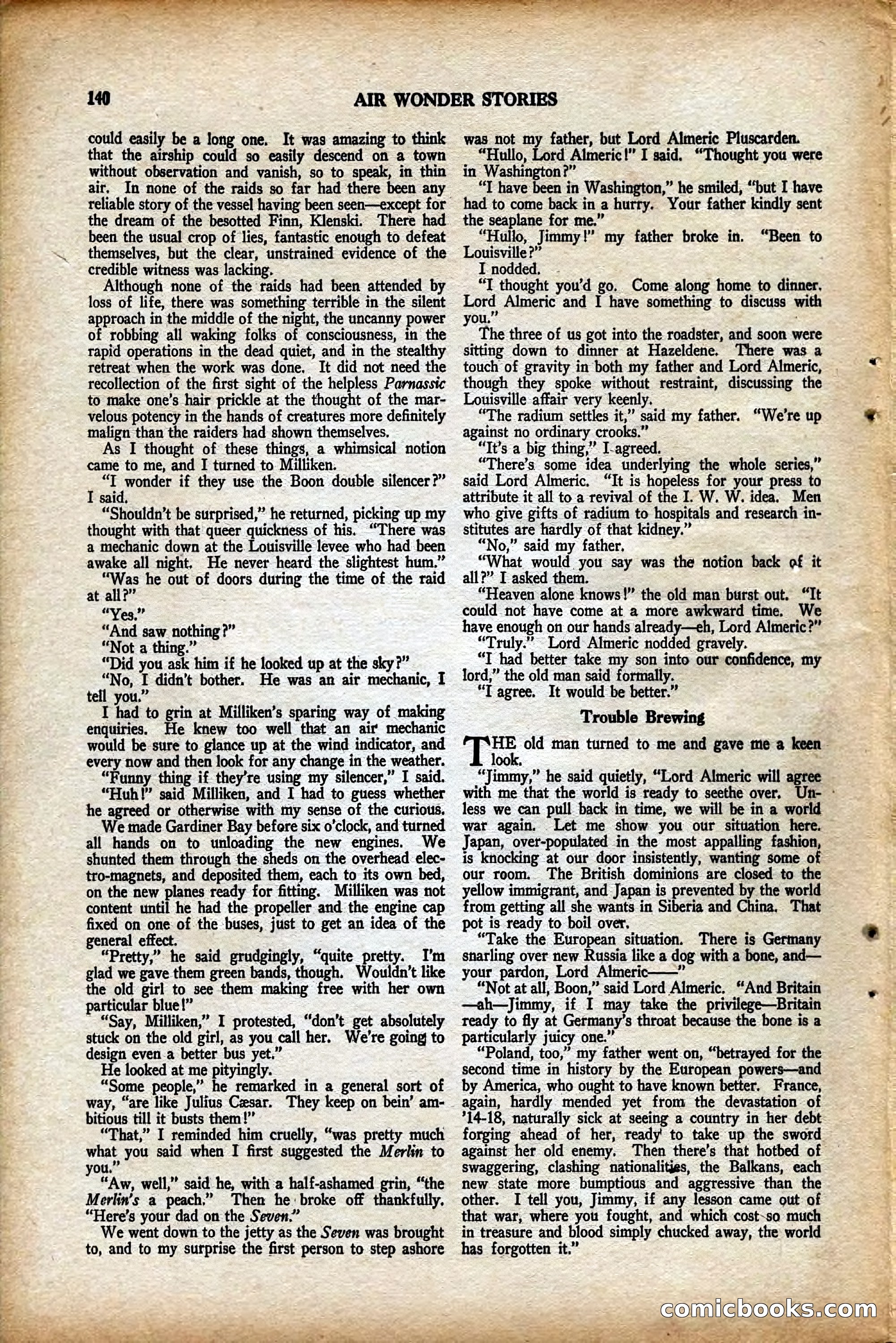
A restored page from Pulp Fiction, 1929. Page through the whole issue in the reader above.
📄 Transcribed text from this page (OCR, searchable)
Machine-transcribed from the original scan — historical spelling and the odd misread are preserved.
2 140 AIR WONDER STORIES could easily be a long one. It was amazing to think that the airship could so easily descend on a town without observation and vanish, so to speak, in thin air. In none of the raids so far had there been any reliable story of the vessel having been seen—except for the dream of the besotted Finn, Klenski. There had been the usual crop of lies, fantastic enough to defeat themselves, but the clear, unstrained evidence of the credible witness was lacking, Although none of the ‘raids had been attended by loss of life, there was something terrible in the silent approach in the middle of the night, the uncanny power of robbing all waking folks of consciousness, in the rapid operations in the dead quiet, and in the stealthy retreat when the work was done. It did not need the recollection of the first sight of the helpless Parnassic to make one’s hair prickle at the thought of the mar- velous potency in the hands of creatures more definitely malign than the raiders had shown themselves. As I thought of these things, a whimsical notion canie to me, and I turned to. Milliken. ' oder if they use the Boon double silencer?” said, “Shouldn’t be surprised,” he returned, picking up my thought with that queer quickness of his. “There was a mechanic down at the. Louisville levee who had been awake all night, He never heard the slightest hum.” “Was he out of doors during the time of the raid at all?” “Yes,” “And saw. nothing?” “Not a thing.” “Did you ask him if he looked up at the sky?” “No, I didn’t bother. He was an air mechanic, I tell you.” : T had to erin at Milliken’s sparing way of making enquiries. He knew too well that an air mechanic would be sure to glance up at the wind indicator, and every now and then look for any change in the weather. “Funny thing if they’re using my silencer,” I said. “Huh!” said Milliken, and I had to guess whether he. agreed or otherwise with my sense of the curious. We made Gardiner Bay before six o'clock, and turned all hands on to unloading the new engines. We shunted them through the sheds on the overhead. elec- tro-magnets, and deposited them, each to its own bed, on the new planes ready for fitting. Milliken was not content until he had the propeller and the engine cap fixed on one of the ‘buses, just to get an idea of the eruesel re Fi ; : ; “Pretty,” he said grudgingly, “quite pretty. I’m glad we gave them green bands, though. Wouldn’t like the old girl to see them making free with her own particular blue!” “Say, Milliken,” I protested, “don’t get absolutely stuck on the old girl, as you call her. We're going to design even.a better bus yet.” He looked at me pityingly. “Some people,” he remarked in a general sort of way, “are like Julius Cesar. They keep on bein’ am- bitious till it busts them!” “That,” I reminded him cruelly, “was pretty much what you said when I first suggested the Merlin to you.” “Aw, well,” said he, with a half-ashamed grin, “the Merlin’s a peach,” Then he: broke off thankfully, “Here's your dad on the Seven.” i We went down to the jetty as the Seven was brought to, and to my surprise the first person to step ashore was not my father, but Lord Almeric Pluscarden. “Hullo, Lord Almeric!” I said. “Thought you were in Washington?” “T have been in Washington,” he smiled, “but I have had to come back in a hurry. Your father kindly sent the seaplane for me.” “Hullo, Jimmy!” my father broke in. “Been to Louisville?” I nodded. - “I thought you’d go. Come along home to dinner, Lord Almeric and I have something to discuss with you.” ; The three of us got into the roadster, and soon were sitting down to dinner at Hazeldene. There was a touch of gravity in both my father and Lord Almeric, though they spoke without restraint, discussing the Louisville affair very keenly. “The radium settles we said my father. “We're up against no ordinary crooks.” “Tt’s a big thing,” I-agreed. “There’s some idea underlying the whole series,” said Lord Almeric. “It is hopeless for your press to attribute it all toa revival of the I. W. W. idea. Men who give gifts of radium to hospitals and research in- stitutes are hardly of that kidney.” “No,” said my father, “What would you say was the notion back of it all?” Tasked them. “Heaven alone knows!” the old man burst out. “It could not have come at a more awkward time. We have enough on our hands already—eh, Lord Almeric?” “Truly.” Lord Almeric nodded gravely. “T had better take my son into our confidence, my lord,” the old man said formally. “T agree. It would be better.” Trouble Brewing 2 Be old man turned to-me and gave mea keen ook. “Jimmy,” he said quietly, “Lord Almeric will agree with me that the world is ready to seethe over. Un- - less we can pull back in time, we will be in a world war again. Let me show you our situation here. Japan, over-populated in the most appalling fashion, is knocking at our door insistently, wanting some of our room. The British dominions are closed to the yellow immigrant, and Japan is prevented by the world from getting all-_she wants in Siberia and China. That pot is ready to boil over. “Take the European situation. There is Germany sharling over new Russia like a dog with a bone, and— your patdon, Lord Almeric-——” “Not at all, Boon,” said Lord Almeric. “And Britain —ah—Jimmy, if I may take the privilege—Britain ready to fly at Germany’s throat because the bone is a particularly juicy one.” “Poland, too,’ my father went-on, “betrayed for the second time in history by the European powers—and by America, who ought to have known better. France, again, hardly mended yet from the devastation of *14-18, naturally sick at seeing a country in her debt forging ahead of her, teady' to take: up the sword against her old enemy. ‘Then there’s that hotbed of swaggering, clashing nationalitjes, the Balkans, each new state more bumptious and aggressive than the other. I tell you, Jimmy, if any lesson came out of that war, where you fought, and which cost-so much in treasure and blood simply chucked away, the world has forgotten it,” COmiIcbooks.com | gt te oe ~. zt a AOU 1 a bt ondat dy Ba tical alate XBR a € 7 al a ai Atk.