
Pulp Fiction, 1929 · page 45 of 95
Air Wonder Stories, August 1929 — page 45: what you’re looking at
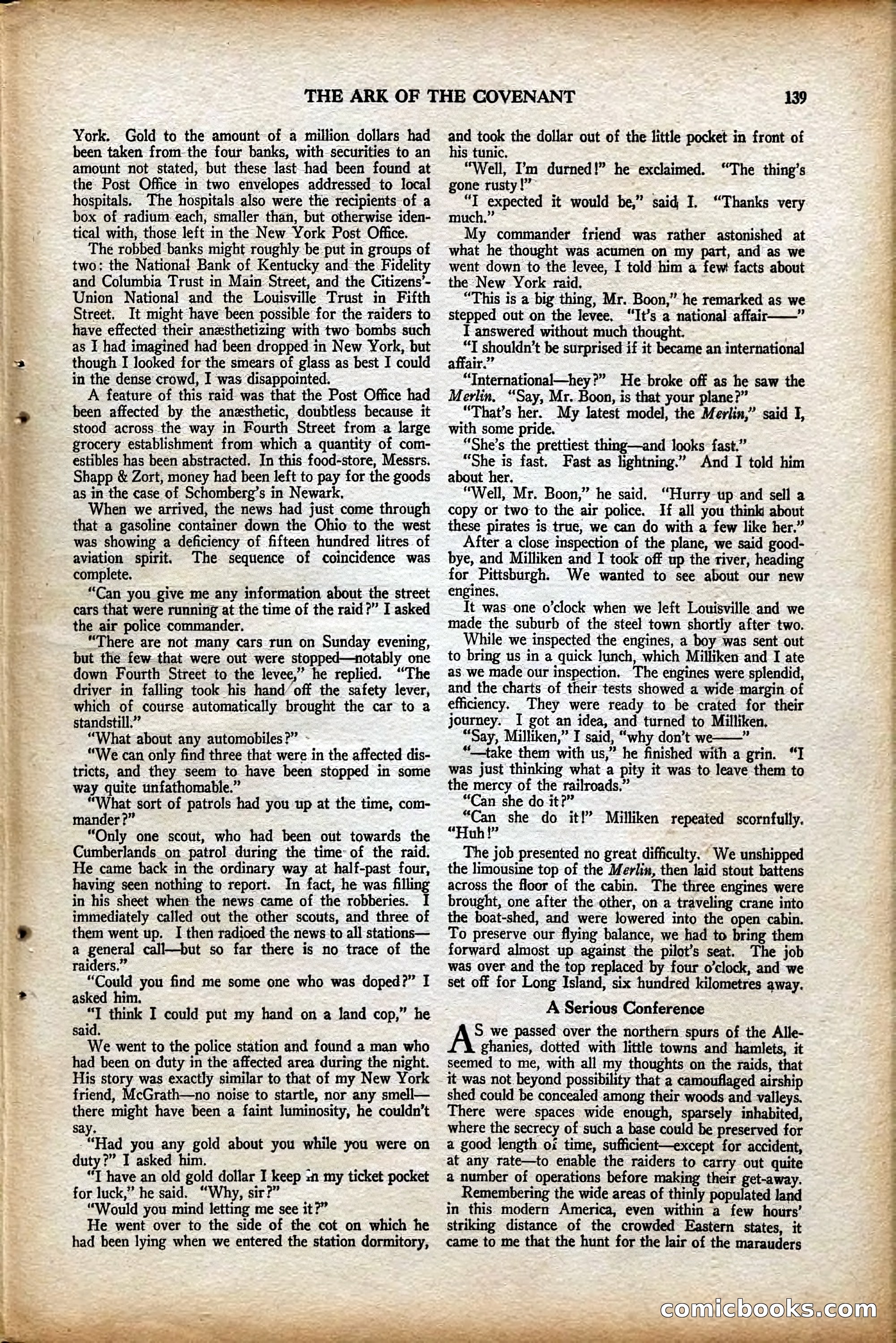
A restored page from Pulp Fiction, 1929. Page through the whole issue in the reader above.
📄 Transcribed text from this page (OCR, searchable)
Machine-transcribed from the original scan — historical spelling and the odd misread are preserved.
THE ARK OF THE GOVENANT 139 York. Gold to the amount-of a million dollars had been taken from-the four banks, with securities to an amount not stated, but these last-had been found at the Post Office in two envelopes addressed: to local hospitals. The hospitals also were the recipierits of a box of radium: each; smaller than, but otherwise iden- tical with, those left-in the New York Post Office. The robbed: banks might roughly be put in groups of two: the National Bank of Kentucky and the Fidelity and Columbia Trust in Main Street, and the Citizens’- Union National and the Louisville Trust in Fifth Street. It might have been possible for the raiders to have effected their ansthetizing with two bombs such as I had imagined had been dropped in New York, but though I looked for the smears of glass as best I could in the denise crowd, I was disappointed. A feature of this raid was that the Post Office had been affected by the anzsthetic, doubtless because it stood across.the way in Fourth Street from a large grocery establishment from which a quantity of com- estibles has been abstracted. In this food-store, Messrs. Shapp & Zort, money had been left to pay for the goods as in the case of Schomberg’s in Newark. When we arrived, the news had just come through that a gasoline container down the Ohio to. the west was showing a deficiency of fifteen hundred litres of aviation spirit, The sequence of coincidence was complete. “Can you_ give me any information about. the street cars that were running at the time of the raid?” I asked the air police commander, “There are not many cars run on Sunday evening, but the few- that were out were stopped—notably one down Fourth Street to the levee,” he replied. “The driver in falling took his hand/off the safety lever, which of course automatically brought the car to a standstill.” “What about any automobiles?” - “We can only find three that were in the affected dis- tricts, and they seem to have been stopped in some way quite unfathomable.” “What sort of patrols had you up at the time, com- mander ?” “Only one scout, who had been ott towards the Cumberlands_on patrol during the time of the raid. He came back in the ordinary way at half-past four, having seen nothing to report. In fact, he was filling in his sheet when the news came of the robberies. I immediately called out the other scouts, and three of them went up. I then radioed the news to all stations— a general call—but so far there is no trace of the raiders,” “Could you find me some one who was doped?” I asked him. a think I could put my hand on a land cop,” he said. We went to the police station and found a man who had been on duty in the affected area during the night. His story was exactly similar to that of my New York friend, McGrath—no noise to startle, nor any smell— there might have been a faint luminosity, he couldn’t say, “Had you any gold about you while you were on duty?” I asked him. “T have an old gold dollar I keep sn my ticket pocket for luck,” he said. “Why, sir?” “Would you mind letting me see it?” He went over to the side of the cot on which he had been lying when we entered the station dormitory, and took the dollar out of the little pocket in front of his tunic. “Well, I’m durned!” he exclaimed. “The thing’s gone rusty!” : 28 expected it would be,” said I. “Thanks very much.” My commander friend was rather astonished at what he thought was acumen on my part, and as we went down to the levee, I told him a few facts about the-New York raid, “This is a big thing, Mr. Boon,” he remarked as we stepped out on the levee, “It’s a national affair——” T answered without much thought. ; as shouldn’t be surprised if it became an international air.” “Tnternational—hey?” He broke off as he saw the Merlin. “Say, Mr..Boon, is that your plane?” “That’s her. My latest model, the Merlin,” said I, with some pride. “She’s the prettiest thing—and looks’ fast.” “She is fast. Fast as lightning.” And I told him about ‘her. “Well, Mr. Boon,” he said. “Hurry-up:and sell a copy or two to the air police. If all you think about these pirates is true, we can do with a few like her.” After a close inspection of the plane, we said good- bye, and Milliken and I took off up the river, heading © for Pittsburgh. We wanted to see about our new engines, It was one o’clock when we left Louisville and we made the suburb of the steel town shortly after two. While we inspected the engines, a boy was sent out to bring us in a quick lunch, which Milliken and I ate as we made our inspection. The engines were splendid, and the charts of their tests showed a wide margin. of efficiency, They were ready to be crated for their journey. I got-an idea, and turned to Milliken, “Say, Milliken,” I said, “why don’t we——” “—take-them with us,” he finished with a grin. “I was just thinking what a pity it was to leave them to the mercy of the railroads,” “Can she do-it?” Boies she do it!’ Milliken repeated scornfully, The job presented no great difficulty. ‘ We unshipped the limousine top of the Merlin, then laid stout battens across the floor of the cabin. The three engines were brought, one after the other, on a traveling crane into the boat-shed, and were lowered into the open cabin. To preserve our flying balance, we had to bring them forward almost up. against the pilot’s seat. The job was over and the top replaced by four o'clock, and we set off for Long Island, six hundred kilometres away. A Serious Conference AS we passed over the northern spurs of the Alle- ghanies, dotted with little towns and hamlets, it seemed to me, with all my thoughts on the raids, that it was not. beyond possibility that a camouflaged airship shed could be concealed among their woods and valleys. There were spaces: wide enough, sparsely inhabited, where the secrecy of such a base could be preserved for a good length ox time, sufficient—except for accident, at any rate—to enable the raiders to carry out quite a number of operations before making their get-away. Remembering the wide areas of thinly populated land in this modern America, even within a few hours’ striking distance of the crowded Eastern states, it came to me that the hunt for the lair of the marauders comiicbooks:co i . Cr. AP is