
Pulp Fiction, 1929 · page 16 of 95
Air Wonder Stories, August 1929 — page 16: what you’re looking at
A restored page from Pulp Fiction, 1929. Page through the whole issue in the reader above.
📄 Transcribed text from this page (OCR, searchable)
Machine-transcribed from the original scan — historical spelling and the odd misread are preserved.
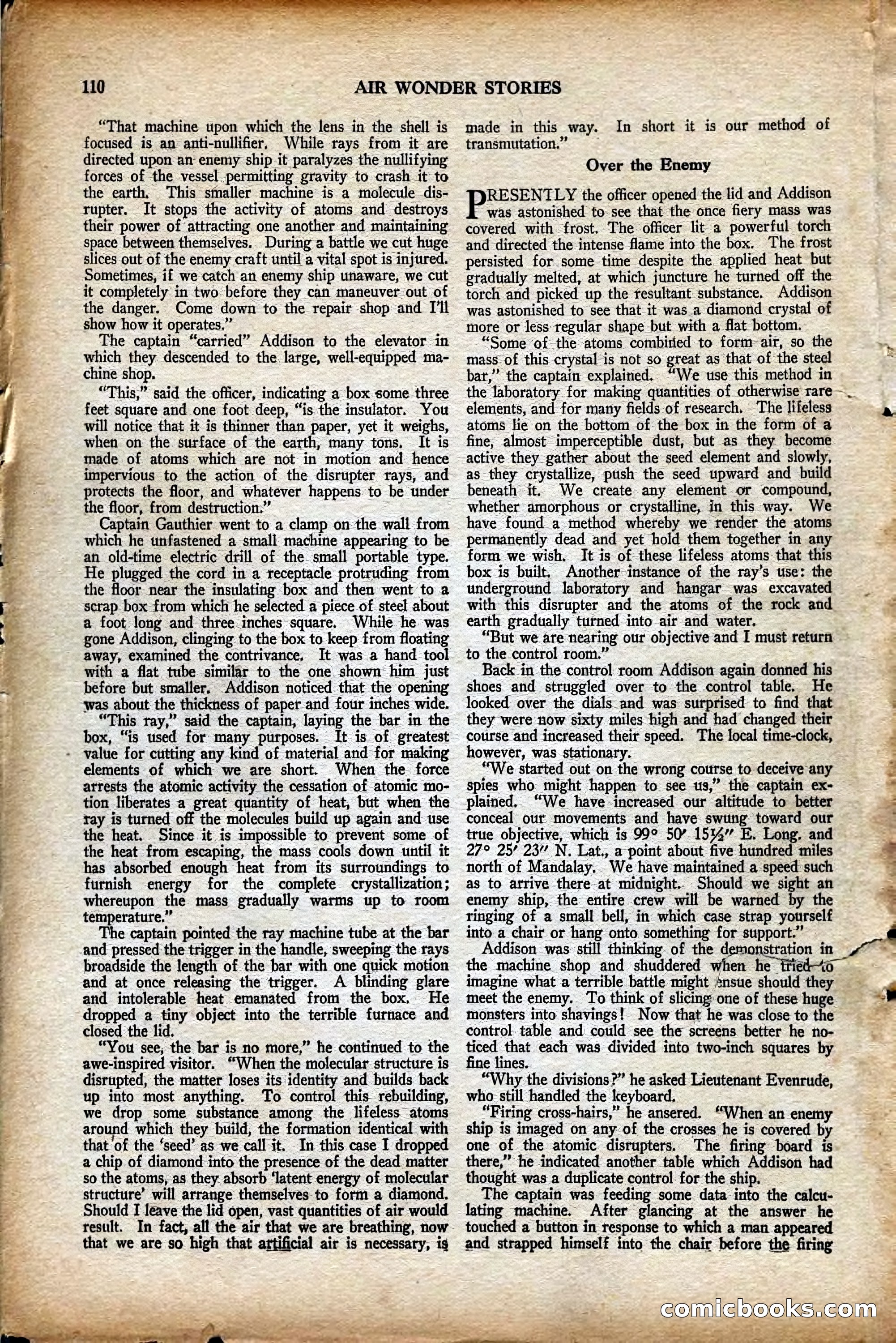
“That machine upon which the lens in the shell is focused is an: anti-nullifier, While rays from it are directed upon an- enemy ship it paralyzes the nullifying forces of the vessel permitting gravity to crash it to the earth, This smaller machine is.a molecule dis- rupter. It stops the activity of atoms and destroys their power of attracting one another and-maintaining space between themselves. During a battle we cut huge slices out of the enemy craft until a vital spot is injured. Sometimes, if we catch an enemy ship unaware, we cut it completely in two before they can maneuver-out of the danger. Come down to the repair shop and I'll show how it operates,” The captain “carried” Addison to the elevator in which they. descended to the large, well-equipped ma- chine shop. “This,” said the officer, indicating a box some three feet square and one foot deep, “is the insulator. . You will notice that it is thinner than paper, yet it weighs, when on the surface of the earth, many tons, It is made of atoms which are not in motion and hence impervious to the action of the disrupter rays, and protects the floor, and whatever happens to be under the floor, from destruction.” Captain Gauthier went to a clamp on-the wall from which he unfastened a small machine appearing to be an old-time electric drill of the small portable type. He plugged the cord in a receptacle protruding from the floor near the insulating box and then went to a scrap box from which he selected a piece of steet about a foot long and three inches square. While. he was gone Addison, clinging: to the box to keep from floating away, examined the contrivance, It was a hand tool with a flat tube similar to the one shown him just before but smaller, Addison noticed that the opening was about the thickness of paper and four inches wide. “This ray,” said the captain, laying the bar in the box, “is used for many purposes. It is. of greatest - value for cutting any kind of material and for making elements of which we are short. When the. force arrests the atomic activity the cessation of atomic mo- tion liberates a great quantity of heat, but when the ray is turned off the molecules build up again and-use the heat. Since it is impossible to prevent some of the heat from escaping, the mass cools down until it has absorbed enough heat from its surroundings to furnish energy for the complete crystallization; whereupon the mass gradually warms up to room temperature.” The captain pointed the ray machine tube at the bar and pressed the trigger in the handle, sweeping the rays broadside the length of the bar with one quick motion and at once releasing the trigger. A blinding glare and intolerable heat emanated from the box. He dropped a tiny object into the terrible furnace and closed the lid. “You see; the bar is no more,” he continued to the awe-inspired visitor. “When the molecular structure is disrupted, the matter loses its identity and builds back up into most anything. To control this rebuilding, we drop some substance among the lifeless atoms around which they build, the formation identical: with that of the ‘seed’ as we call it. In this case I dropped a chip of diamond into the presence of the dead. matter so the atoms, as they absorb ‘latent energy of molecular structure’ will arrange themselves to form a diamond. Should I leave the lid open, vast quantities of air would result. In fact, all the air that we are breathing, now that we are so high that artificial air is necessary, ig 110 AIR WONDER STORIES made in this way. In short it is our method of transmutation.” Over the Enemy pee? LY the officer opened the lid and Addison was astonished to: see that the once fiery mass was covered with frost, The officer lit a powerful torch and directed the intense flame into the box. The frost persisted for some time despite the. applied heat but gradually melted, at which juncture he turned off the torch and picked up the tesultant substance. Addison was astonished to see that it was a diamond crystal of more or less: regular shape but with a flat bottom. “Some ‘of the atoms combitied to form air, so the mass. of this crystal is not so great as that of the steel bar,” the captain explained. “We use this method in the laboratory for making quantities of otherwise rare — elements, and for manty fields of research. The lifeless atoms lie on the bottom of the box in the form of a fine, almost imperceptible dust, but as they become active they gather about the seed element and slowly, as-they crystallize, push the seed upward and build beneath it. We create any element or compound, whether amorphous or crystalline, in this way. We have found a- method whereby we render the atoms permanently dead and yet hold them together in any form we wish. It is: of these lifeless atoms that this box is built, Another-instance of the ray’s use: the underground laboratory and hangar was excavated with this disrupter and the atoms of the rock and earth gradually turned into air and water. “But we are nearing our objective and I must return to the control room.” Back in the conttol room Addison again donned his shoes and struggled over to the control table. He looked: over the dials and was surprised to find that they were now sixty miles high and had changed their course and increased their speed. The local time-clock, however, was. stationary. “We started out on the wrong course to deceive any spies who might happen to see us,” the captain ex- plained, “We have increased our altitude to better conceal our movements and have swing toward our true objective, which is 99° 507 1514” E. Long. and 27° 25’ 23” N. Lat., a point about five hundred miles north of Mandalay. . We have maintained a -speed:such as to arrive thereat midnight.. Should we sight an enemy ship, the: eritire crew will be warned by the ringing of a small bell, in which case strap yourself into a chair or hang onto something for support.” Addison was still thinking. of the d ation in the machine shop and shuddered whee he tried“o imagine what a terrible battle might Anstie should they meet the enemy. To think of slicing one of these huge monsters into shavings! Now that he was close to the control table and could see the screens better he no- ticed that each was divided into two-inch squares by fine lines. “Why the divisions?” he asked Lieutenant Evenrude, who still handled the keyboard. “Firing ctoss-hairs,” he ansered. “When an enemy ship is imaged on any of the crosses he is covered by one of the atomic disrupters. The firing board is there,” he indicated another table which Addison had thought was a duplicate control for the ship. The captain was feeding some data into the calcu- lating machine. After glancing at the answer he touched a button in response to which a man appeared and strapped himself into the chair before the firing = comicbooks:co Fo ‘ An eae >