
Pulp Fiction, 1929 · page 15 of 95
Air Wonder Stories, August 1929 — page 15: what you’re looking at
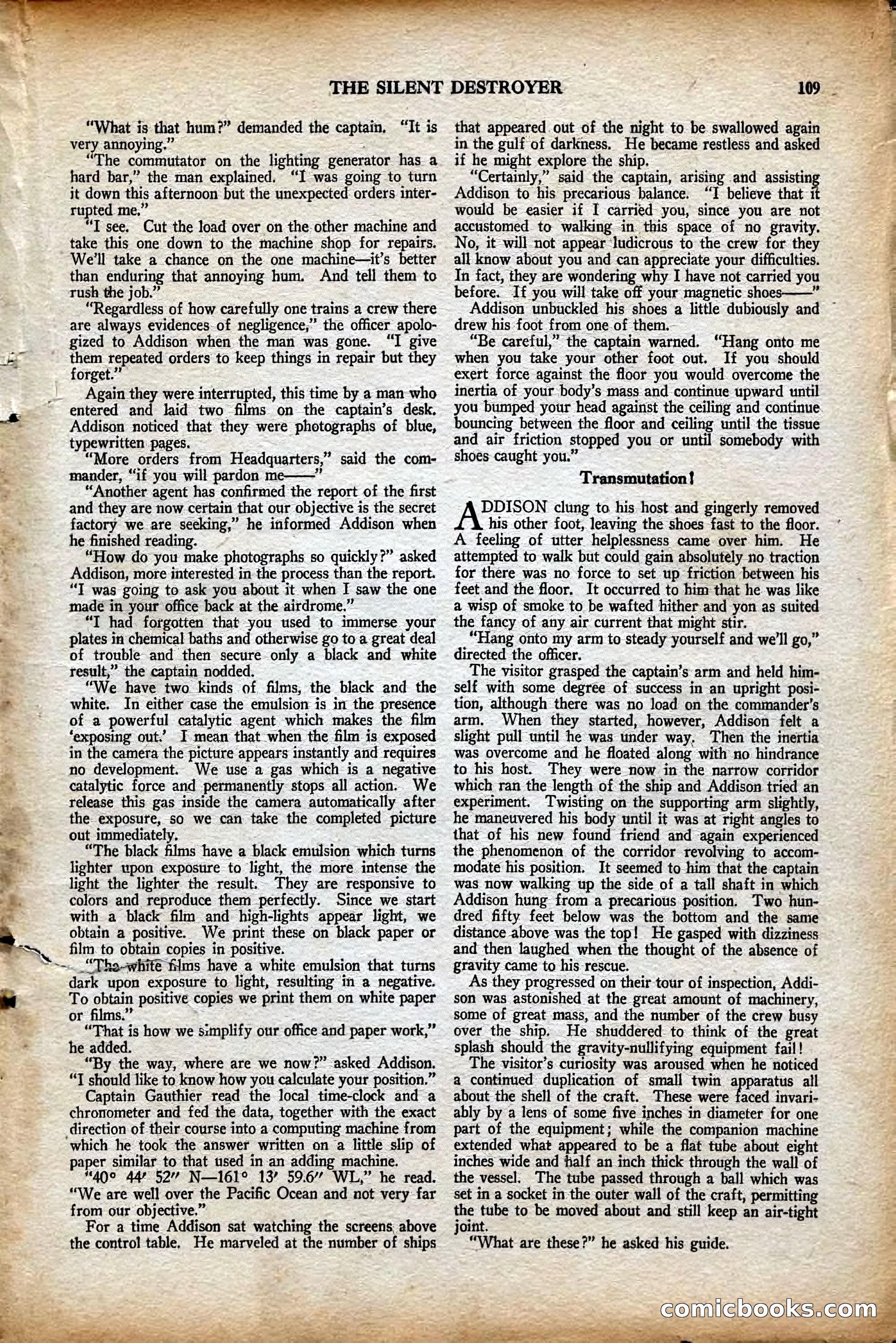
A restored page from Pulp Fiction, 1929. Page through the whole issue in the reader above.
📄 Transcribed text from this page (OCR, searchable)
Machine-transcribed from the original scan — historical spelling and the odd misread are preserved.
ian = ° OF Te Py Pr ' tae > a 3 TOR « THE SILENT DESTROYER “What is that hum?” demanded the captain. “It is very annoying.” , “The commutator on the lighting generator has a hard bar,” the man explained. “I was going to turn it down this afternoon but the unexpected orders inter- rupted me,” “I see. Cut the load over on the. other machine and take this one down to the machine shop for repairs. We'll take a chance on the one machine—it’s better than enduring that annoying hum. And tell them to tush the job.” “Regardless of how carefully one trains a crew there are always evidences-of negligence,” the officer apolo- gized to Addison when the man was gone. “I give them repeated orders to keep things in repair but they forget.” Again they were interrupted, this time by a man-who entered and laid two films on the captain’s desk. Addison noticed that they were photographs of blue, typewritten pages. “More orders from Headquarters,” said the com- mander, “if you will pardon me——” “Another agent has confirmed the report of the first and they are now certain that our objective is the secret factory we are seeking,” he informed Addison when he finished reading. “How do you make photographs so quickly?” asked Addison, more interested in the process than the report. “IT was going to ask you about it when I saw the one madé in your office back at the airdrome.” “I had. forgotten that you used to immerse your plates in chemical baths and otherwise go to a great deal of trouble and then secure only a black and white result,” the captain nodded. ‘We have two kinds of films, the black and the white. In either case the emulsion is in the presence of a powerful catalytic agent which makes the film ‘exposing out.’ I-mean that when the -film is exposed in the camera the picture appears instantly and requires no development. We use a gas which is a negative catalytic force and permanently stops all action. We release this gas inside the camera automatically after the exposure,-so we can take the completed picture out immediately. “The black films have a black emulsion which turns lighter upon expostire to light, the more. intense the light the lighter. the result. They are responsive to colors and reproduce them perfectly. Since we start with a black film and high-lights appear light, we obtain a positive. We print these on black paper or film. to obtain copies in positive. —— _“The-white films have a white emulsion that turns dark upon exposure to light, resulting in a negative. To obtain positive copies we print them on white paper or films.” “That is how we simplify our office and paper work,” he added. “By the way, where are we now?” asked Addison. “T should like to know how you calculate your position.” Captain Gauthier read the local time-clock and a chronometer and fed the data, together with the exact direction of their course into a computing machine from which he took the answer written on a little slip of paper similar to that used in-an adding machine. "40° 44" 52” N—161° 13’ 59.6’ WL,” he read. “We are well over the Pacific Ocean and not very far from our objective,” For a time Addison sat watching the screens above the control table, He marveled at the number of ships that appeared out of the night to be swallowed again in the gulf of darkness. He became restless and asked if he might explore the ship. “Certainly,” said the captain, arising and assistin Addison to his precarious balance. “TI believe that 1 would be easier if I carried you, since you are not accustomed to walking in this space of no gravity. No, it will-not appear Iudicrous to the crew for. they all know about you and can appreciate your difficulties. In fact, they are wondering why I have not carried you before. If you will take off your: magnetic shoes——” Addison unbuckled his shoes a little dubiously and ~ drew his foot from one of them. “Be careful,” the captain warned. “Hang onto me when you take your other foot out. If you should exert force against the floor you would overcome the inertia of your body’s mass and-continue upward until you bumped your head against the ceiling and continue bouncing between the floor and ceiling until the tissue and air friction stopped you or until somebody with shoes caught you.” Transmutation! AbrEen clung to his host-and gingerly removed his other foot, leaving the shoes fast to the floor. A. feeling of utter helplessness came over him. He attempted to walk but could gain absolutely no traction for there was no force to set up friction between his feet.and the floor. It occurred to him that he. was like a wisp of smoke to be wafted hither and yon as suited the fancy of any air current that might stir. “Hang onto my arm to steady yourself and we'll go,” directed: the officer. The visitor grasped the captain's arm and held him- self. with some degree of success in an upright posi- tion, although there was no load on the commander's arm. When they started, however, Addison felt a slight pull until he was under way. Then the inertia was overcome and he floated along with no hindrance to his host. They were now in the narrow corridor which ran the-length. of the ship and Addison tried an experiment. Twisting on the supporting arm slightly, he maneuvered his body until it was at right angles to that of his new found friend and again experienced the phenomenon of the corridor revolving to accom- modate his position. It seemed to him that the captain was.now walking up the side of a tall shaft in which Addison hung from a precarious position. Two hun- dred fifty. feet below was the bottom and the same distance above was the top! He gasped with dizziness and then laughed when the thought of the absence of gravity came to his-rescue. As they progressed on their tour of inspection, Addi- son was. astonished at the great amount of machinery, some of great mass, and the number of the crew busy over the ship, He shuddered-to think of the great splash should the gravity-nullifying equipment fail! The visitor’s curiosity was aroused when he noticed a continued duplication of small twin apparatus all about the shell of the craft. These were faced invari- ably bya lens of some five inches in diameter for one part of the equipment; while the companion machine extended what appeared to be a flat tube about eight inches wide and half an inch thick through the wall of the vessel. The tube passed through a ball which was set in a socket in the outer wall of the craft, permitting the tube to be moved about and still keep an air-tight joint. “What are these?” he asked his guide. 109. - =comicbooks:com ee ~~ oh Pa nae" a