
Pulp Fiction, 1929 · page 9 of 100
Air Wonder Stories, July 1929 — page 9: what you’re looking at
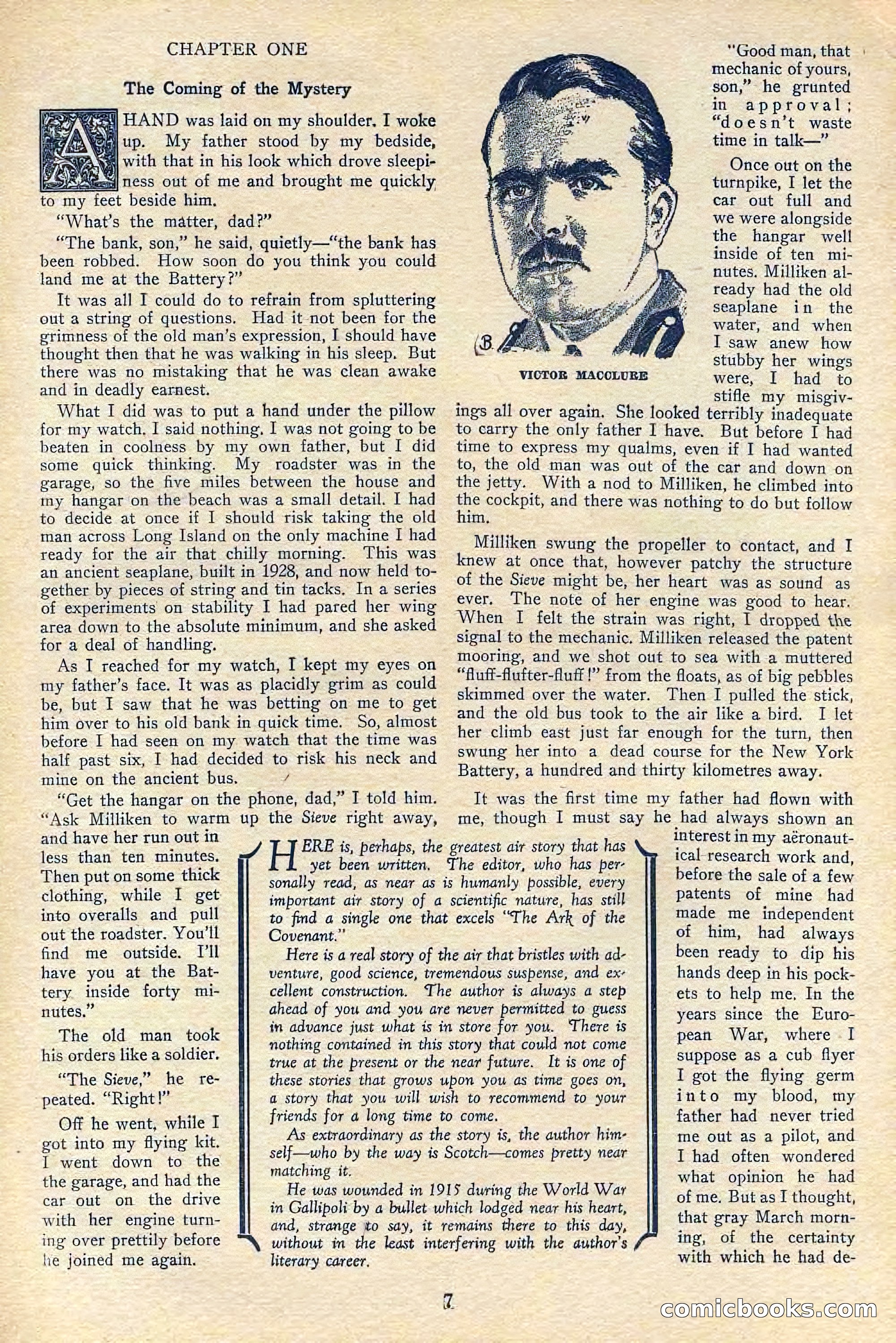
A restored page from Pulp Fiction, 1929. Page through the whole issue in the reader above.
📄 Transcribed text from this page (OCR, searchable)
Machine-transcribed from the original scan — historical spelling and the odd misread are preserved.
CHAPTER ONE The Coming of the Mystery Yeas] HAND was laid on my shoulder, I woke piup. My father stood by my bedside, 4g with that in his look which drove sleepi- £4 . fooSNtecrd| ess out of me and brought me quickly. to my feet beside him, “What's the matter, dad?” “The bank, son,” he said, quietly—‘the bank has been robbed. How soon do you think you could land me at the Battery?” It was all I could do to refrain from spluttering out a string of questions. Had it not been for the grimness of the old man’s expression, I should have thought then that he was walking in his sleep. But there was no mistaking that he was clean awake and in deadly earnest. What I did was to put a hand under the pillow for my watch. I said nothing, I was not going to be beaten in coolness by my own father, but I did some quick thinking. My roadster was in the garage, so the five miles between the house and my hangar on the beach was a small detail. I had to decide at once if I should risk taking the old man across Long Island on the only machine I had ready for the air that chilly morning. This was an ancient seaplane, built in 1928, and now held to- gether by pieces of string and tin tacks, In a series of experiments on stability I had pared her wing area down to the absolute minimum, and she asked for a deal of handling. As I reached for my watch, I kept my eyes on my father’s face. It was as placidly grim as could be, but I saw that he was betting on me to get him over to his old bank in quick time. So, almost before I had seen on my watch that the time was half past six, I had decided to risk his neck and mine on the ancient bus. / “Get the hangar on the phone, dad,” I told him. “Ask Milliken to warm up the Sieve right away, “Good man, that + mechanic of yours, son,” he grunted in approval; “doesn’t waste time in talk—” Once out on the turnpike, I let the car out full and we were alongside the hangar well inside of ten mi- nutes. Milliken al- ready had the old seaplane in the water, and when I saw anew how stubby her wings were, I had to : : stifle my misgiv- ings all over again. She looked terribly inadequate to carry the only father I have. But before I had time to express my qualms, even if I had wanted to, the old man was out of the car and down on the jetty. With a nod to Milliken, he climbed into He cockpit, and there was nothing to do but follow im, VICTOR MACOLURE Milliken swung the propeller to contact, and I knew at once that, however patchy the structure of the Sieve might be, her heart was as sound as ever. The note of her engine was good to hear. When I felt the strain was right, I dropped the signal to the mechanic. Milliken released the patent mooring, and we shot out to sea with a muttered “fluff-flufter-fluff !” from the floats, as of big pebbles skimmed over the water. Then I pulled the stick, and the old bus took to the air like a bird. I let her climb east just far enough for the turn, then swung her into a dead course for the New York Battery, a hundred and thirty kilometres away. It was the first time my father had flown with me, though I must say he had always shown an and have her run out in less than ten minutes. Then put on some thick clothing, while I get into overalls and pull out the roadster. You'll find me outside. Til have you at the Bat- tery inside forty mi- nutes.” The old man took his orders like a soldier. “The Sieve,” he re- peated. “Right!” Off he went, while I got into my flying kit. I went down to the the garage, and had the car out on the drive with her engine turn- ing over prettily before “\ le joined me again. H™ is, perhaps, the greatest air story that has yet been written, The editor, who has per- sonally read, as near as is humanly possible, every important air story of a scientific nature, has still to find a single one that excels “Ihe Ark of the Covenant.” Here is a real story of the air that bristles with ad- venture, good science, tremendous suspense, and ex- cellent construction. The author is always a step ahead of you and you are never permitted to guess in advance just what is in store for you. ‘There is nothing contained in this story that could not come true at the present or the near future. It is one of these stories that grows upon you as time goes on, a story that you will wish to recommend to your friends for a long time to come. As extraordinary as the story is, the author him- self—who by the way is Scotch—comes pretty near matching it. He was wounded in 1915 during the World War in Gallipoli by a bullet which lodged near his heart, and, strange to say, it remains there to this day, without in the least interfering with the author's literary career. interest in my aéronaut- ical research work and, before the sale of a few patents of mine had made me independent of him, had always been ready to dip his hands deep in his pock- ets to help me, In the years since the Euro- pean War, where I suppose as a cub flyer I got the flying germ into my blood, my father had never tried me out as a pilot, and I had often wondered what opinion he had of me. But as I thought, that gray March morn- ing, of the certainty with which he had de- comnliclooolks.conn