
Pulp Fiction, 1929 · page 10 of 100
Air Wonder Stories, July 1929 — page 10: what you’re looking at
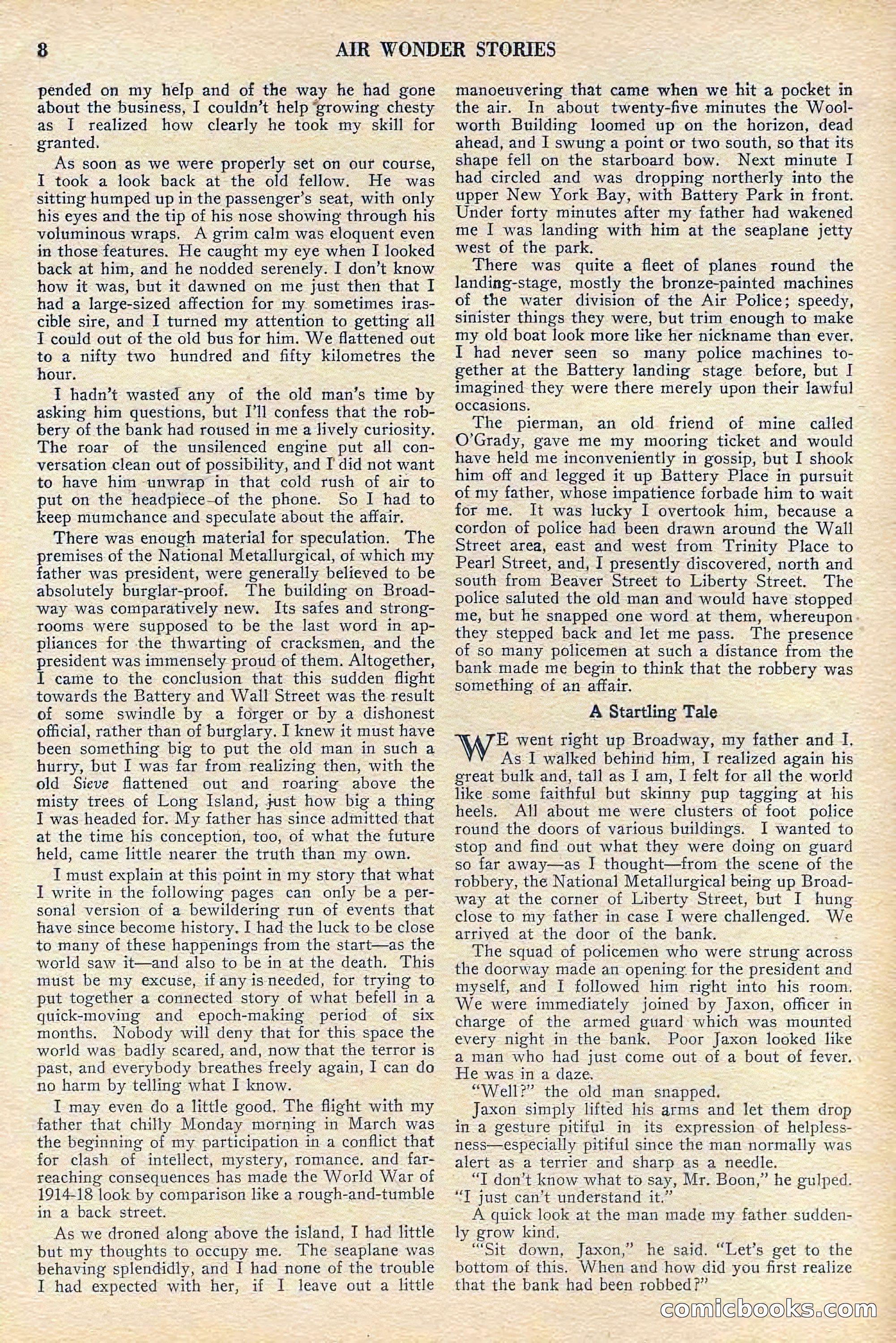
A restored page from Pulp Fiction, 1929. Page through the whole issue in the reader above.
📄 Transcribed text from this page (OCR, searchable)
Machine-transcribed from the original scan — historical spelling and the odd misread are preserved.
8 AIR WONDER STORIES pended on my help and of the way he had gone about the business, I couldn’t help ‘growing chesty as I realized how clearly he took my skill for granted. As soon as we were properly set on our course, I took a look back at the old fellow. He was sitting humped up in the passenger’s seat, with only his eyes and the tip of his nose showing through his voluminous wraps. A grim calm was eloquent even in those features. He caught my eye when I looked back at him, and he nodded serenely. I don’t know how it was, but it dawned on me just then that I had a large-sized affection for my sometimes iras- cible sire, and I turned my attention to getting all T could out of the old bus for him. We flattened out to a nifty two hundred and fifty kilometres the hour. I hadn’t wasted any of the old man’s time by asking him questions, but I’ll confess that the rob- bery of the bank had roused in me a lively curiosity. The roar of the unsilenced engine put all con- versation clean out of possibility, and I' did not want to have him unwrap in that cold rush of air to put on the headpiece-of the phone. So IJ had to keep mumchance and speculate about the affair. There was enough material for speculation. The premises of the National Metallurgical, of which my father was president, were generally believed to be absolutely burglar-proof, The building on Broad- way was comparatively new. Its safes and strong- tooms were supposed to be the last word in ap- pliances for the thwarting of cracksmen, and the president was immensely proud of them. Altogether, I came to the conclusion that this sudden flight towards the Battery and Wall Street was the result of some swindle by a forger or by a dishonest official, rather than of burglary. I knew it must have been something big to put the old man in such a hurry, but I wags far from realizing then, with the old Sieve flattened out and roaring above the misty trees of Long Island, just how big a thing T was headed for. My father has since adinitted that at the time his conception, too, of what the future held, came little nearer the truth than my own. T must explain at this point in my story that what I write in the following pages can only be a per- sonal version of a bewildering run of events that have since become history. I had the luck to be close to many of these happenings from the start—as the world saw it—and also to be in at the death. This must be my excuse, ifany isneeded, for trying to put together a connected story of what befell in a quick-moving and epoch-making period of six months. Nobody will deny that for this space the world was badly scared, and, now that the terror is past, and everybody breathes freely again, I can do no harm by telling what I know. I may even do a little good, The flight with my father that chilly Monday morning in March was the beginning of my participation in a conflict that for clash of intellect, mystery, romance. and far- reaching consequences has made the World War of 1914-18 look by comparison like a rough-and-tumble in a back street. As we droned along above the island, I had little but my thoughts to occupy me. The seaplane was behaving splendidly, and I had none of the trouble I had expected with her, if I leave out a little manoetvering that came when we hit a pocket in the air. In about twenty-five minutes the Wool- worth Building loomed up on the horizon, dead ahead, and I swung a point or two south, so that its shape fell on the starboard bow. Next minute I had circled and was dropping northerly into the upper New York Bay, with Battery Park in front. Under forty minutes after my father had wakened me I was landing with him at the seaplane jetty west of the park. There was quite a fleet of planes round the landing-stage, mostly the bronze-painted machines of the water division of the Air Police; speedy, sinister things they were, but trim enough to make my old boat look more like her nickname than ever, I had never seen so many police machines to- gether at the Battery landing stage before, but I imagined they were there merely upon their lawful occasions. The pierman, an old friend of mine called O'Grady, gave me my mooring ticket and would have held me inconveniently in gossip, but I shook him off and legged it up Battery Place in pursuit of my father, whose impatience forbade him to wait for me. It was lucky I overtook him, because a cordon of police had been drawn around the Wall Street area, east and west from Trinity Place to Pearl Street, and, I presently discovered, north and south from Beaver Street to Liberty Street. The police saluted the old man and would have stopped me, but he snapped one word at them, whereupon they stepped back and let me pass. The presence of so many policemen at such a distance from the bank made me begin to think that the robbery was something of an affair. A Startling Tale Wwe went right up Broadway, my father and I, As I walked behind him, I realized again his great bulk and, tall as I am, I felt for all the world like some faithful but skinny pup tagging at his heels. All about me were clusters of foot police round the doors of various buildings. I wanted to stop and find out what they were doing on guard so far away—as J thought—from the scene of the robbery, the National Metallurgical being up Broad- way at the corner of Liberty Street, but I hung close to my father in case I were challenged. We arrived at the door of the bank. The squad of policemen who were strung across the doorway made an opening: for the president and myself, and I followed him right into his room, We were immediately joined by Jaxon, officer in charge of the armed guard which was mounted every night in the bank. Poor Jaxon looked like a man who had just come out of a bout of fever. He was in a daze, “Well?” the old man snapped. Jaxon simply lifted his arms and let them drop in a gesture pititul in its expression of helpless- ness—especially pitiful since the man normally was alert as a terrier and sharp as a needle. “T don't know what to say, Mr. Boon,” he gulped. “T just can’t understand it.” A quick look at the man made my father sudden- ly grow kind, “Sit down, Jaxon,” he said. “Let’s get to the bottom of this. When and how did you first realize that the bank had been robbed?” comnliclooolks.com