
Pulp Fiction, 1929 · page 50 of 100
Air Wonder Stories, July 1929 — page 50: what you’re looking at
A restored page from Pulp Fiction, 1929. Page through the whole issue in the reader above.
📄 Transcribed text from this page (OCR, searchable)
Machine-transcribed from the original scan — historical spelling and the odd misread are preserved.
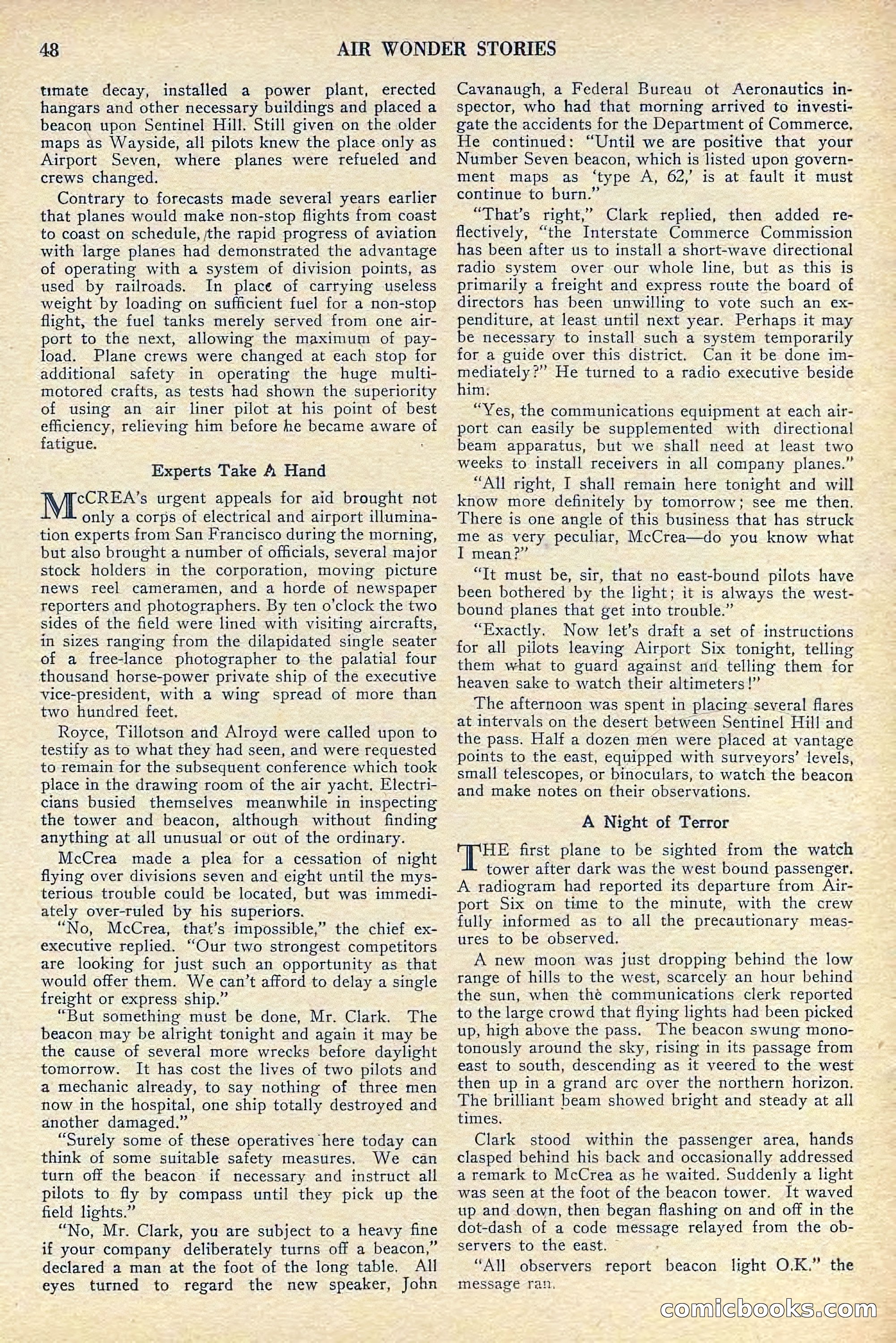
48 AIR WONDER STORIES timate decay, installed a power plant, erected hangars and other necessary buildings and placed a beacon upon Sentinel Hill, Still given on the older maps as Wayside, all pilots knew the place only as Airport Seven, where planes were refueled and crews changed. Contrary to forecasts made several years earlier that planes would make non-stop flights from coast to coast on schedule, the rapid progress of aviation with large planes had demonstrated the advantage of operating with a system of division points, as used by railroads. In place of carrying useless weight by loading on sufficient fuel for a non-stop flight, the fuel tanks merely served from one air- port to the next, allowing the maximum of pay- load. Plane crews were changed at each stop for additional safety in operating the huge multi- motored crafts, as tests had shown the superiority of using an air liner pilot at his point of best efficiency, relieving him before he became aware of fatigue. : Experts Take 4 Hand cCREA’s urgent appeals for aid brought not only a corps of electrical and airport illumina- tion experts from San Francisco during the morning, but also brought a number of officials, several major stock holders in the corporation, moving picture news reel cameramen, and a horde of newspaper reporters and photographers. By ten o'clock the two sides of the field were lined with visiting aircrafts, in sizes ranging from the dilapidated single seater of a free-lance photographer to the palatial four thousand horse-power private ship of the executive vice-president, with a wing spread of more than two hundred feet. Royce, Tillotson and Alroyd were called upon to testify as to what they had seen, and were requested to remain for the subsequent conference which took place in the drawing room of the air yacht. Electri- cians busied themselves meanwhile in inspecting the tower and beacon, although without finding anything at all unusual or out of the ordinary. McCrea made a plea for a cessation of night flying over divisions seven and eight until the mys- terious trouble could be located, but was immedi- ately over-ruled by his superiors. “No, McCrea, that’s impossible,” the chief ex- executive replied. “Our two strongest competitors are looking for just such an opportunity as that would offer them. We can’t afford to delay a single freight or express ship.” “But something must be done, Mr. Clark. The beacon may be alright tonight and again it may be the cause of several more wrecks before daylight tomorrow. It has cost the lives of two pilots and a mechanic already, to say nothing of three men now in the hospital, one ship totally destroyed and another damaged.” “Surely some of these operatives here today can think of some suitable safety meastires. We can turn off the beacon if necessary and instruct all pilots to fly by compass until they pick up the field lights.” “No, Mr. Clark, you are subject to a heavy fine if your company deliberately turns off a beacon,” declared a man at the foot of the long table, All eyes turned to regard the new speaker, John Cavanaugh, a Federal Bureau ot Aeronautics in- spector, who had that morning arrived to investi- gate the accidents for the Department of Commerce, He continued: “Until we are positive that your Number Seven beacon, which is listed upon govern- ment maps as ‘type A, 62,’ is at fault it must continue to burn.” “That’s right,” Clark replied, then added re- flectively, “the Interstate Commerce Commission has been after us to install a short-wave directional radio system over our whole line, but as this is primarily a freight and express route the board of directors has been unwilling to vote such an ex- penditure, at least until next year. Perhaps it may be necessary to install such a system temporarily for a guide over this district. Can it be done im- mediately?” He turned to a radio executive beside him. “Yes, the communications equipment at each air- port can easily be supplemented with directional beam apparatus, but we shall need at least two weeks to install receivers in all company planes.” “All right, I shall remain here tonight and will know more definitely by tomorrow; see me then, There is one angle of this business that has struck me as very peculiar, McCrea—do you know what I mean?” “It must be, sir, that no east-bound pilots have been bothered by the light; it is always the west- bound planes that get into trouble.” “Exactly. Now let’s draft a set of instructions for all pilots leaving Airport Six tonight, telling them what to guard against and telling them for heaven sake to watch their altimeters!” The afternoon was spent in placing several flares at intervals on the desert between Sentinel Hill and the pass. Half a dozen men were placed at vantage points to the east, equipped with surveyors’ levels, small telescopes, or binoculars, to watch the beacon and make notes on theit observations. A Night of Terror Tee first plane to be sighted from the watch tower after dark was the west bound passenger. A radiogram had reported its departure from Air- port Six on time to the minute, with the crew fully informed as to all the precautionary meas- ures to be observed. A new moon was just dropping behind the low range of hills to the west, scarcely an hour behind the sun, when thé communications clerk reported to the large crowd that flying lights had been picked up, high above the pass. The beacon swung mono- tonously around the sky, rising in its passage from east to south, descending as it veered to the west then up in a grand arc over the northern horizon. The brilliant beam showed bright and steady at all times, Clark stood within the passenger area, hands clasped behind his back and occasionally addressed a remark to McCrea as he waited. Suddenly a light was seen at the foot of the beacon tower. It waved up and down, then began flashing on and off in the dot-dash of a code message relayed from the ob- servers to the east. © “All observers report beacon light O.K.” the message ran, comnlicloooks.com