
Pulp Fiction, 1929 · page 49 of 100
Air Wonder Stories, July 1929 — page 49: what you’re looking at
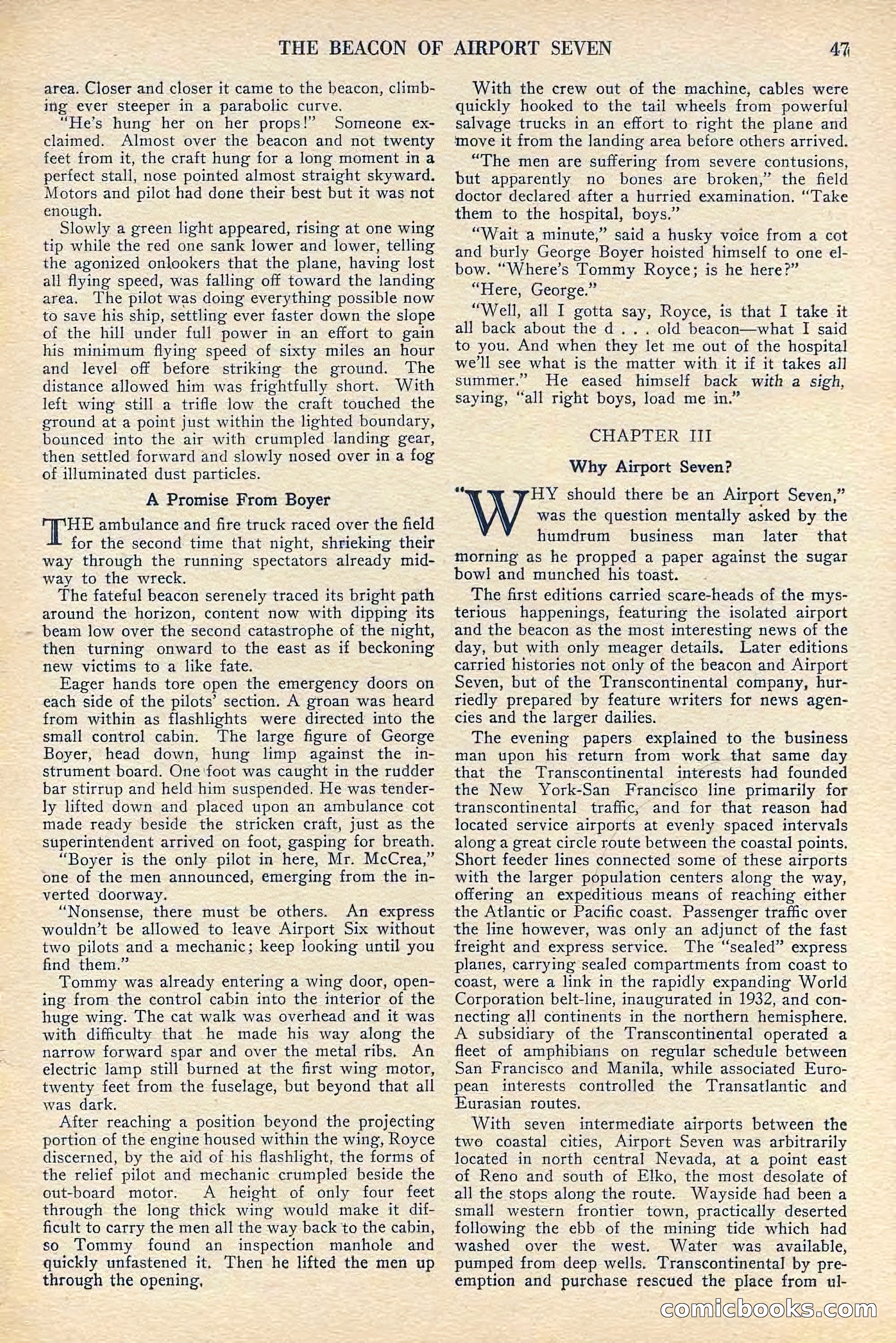
A restored page from Pulp Fiction, 1929. Page through the whole issue in the reader above.
📄 Transcribed text from this page (OCR, searchable)
Machine-transcribed from the original scan — historical spelling and the odd misread are preserved.
THE BEACON OF area. Closer and closer it came to the beacon, climb- ing ever steeper in a parabolic curve. “He’s hung her on her props!” Someone ex- claimed. Almost over the beacon and not twenty feet from it, the craft hung for a long moment in a perfect stall, nose pointed almost straight skyward. Motors and pilot had done their best but it was not enough, Slowly a green light appeared, rising at one wing tip while the red one sank lower and lower, telling the agonized onlookers that the plane, having lost all flying speed, was falling off toward the landing area. The pilot was doing everything possible now to save his ship, settling ever faster down the slope of the hill under full power in an effort to gain his minimum flying speed of sixty miles an hour and level off before striking the ground. The distance allowed him was frightfully short. With left wing still a trifle low the craft touched the ground at a point just within the lighted boundary, bounced into the air with crumpled landing gear, then settled forward and slowly nosed over in a fog of illuminated dust particles. A Promise From Boyer HE ambulance and fire truck raced over the field for the second time that night, shrieking their way through the running spectators already mid- way to the wreck. The fateful beacon serenely traced its bright path around the horizon, content now with dipping its - beam low over the second catastrophe of the night, then turning onward to the east as if beckoning new victims to a like fate. Eager hands tore open the emergency doors on each side of the pilots’ section. A groan was heard from within as flashlights were directed into the small control cabin. The large figure of George Boyer, head down, hung limp against the in- strument board. One ‘foot was caught in the rudder bar stirrup and held him suspended, He was tender- ly lifted down and placed upon an ambulance cot made ready beside the stricken craft, just as the superintendent arrived on foot, gasping for breath. “Boyer is the only pilot in here, Mr. McCrea,” one of the men announced, emerging from the in- verted doorway. “Nonsense, there must be others. An express wouldn’t be allowed to leave Airport Six without two pilots and a mechanic; keep looking until you find them.” Tommy was already entering a wing door, open- ing from the control cabin into the interior of the huge wing. The cat walk was overhead and it was with difficulty that he made his way along the narrow forward spar and over the metal ribs, An electric lamp still burned at the first wing motor, twenty feet from the fuselage, but beyond that all was dark. After reaching a position beyond the projecting portion of the engine housed within the wing, Royce discerned, by the aid of his flashlight, the forms of the relief pilot and mechanic crumpled beside the out-board motor. A height of only four feet through the long thick wing would make it dif- ficult to carry the men all the way back to the cabin, so Tommy found an inspection manhole and quickly unfastened it. Then he lifted the men up through the opening, AIRPORT SEVEN AG With the crew out of the machine, cables were quickly hooked to the tail wheels from powerful salvage trucks in an effort to right the plane and move it from the landing area before others arrived. “The men are suffering from severe contusions, but apparently no bones are broken,” the field doctor declared after a hurried examination. “Take them to the hospital, boys.” “Wait a minute,” said a husky voice from a cot and burly George Boyer hoisted himself to one el- bow. “Where’s Tommy Royce; is he here?” “Here, George.” “Well, all I gotta say, Royce, is that I take it all back about the d... old beacon—what I said to you. And when they let me out of the hospital we'll see what is the matter with it if it takes all summer,” He eased himself back with a sigh, saying, “all right boys, load me in.” CHAPTER III Why Airport Seven? ie HY should there be an Airport Seven,” W was the question mentally asked by the humdrum business man later that morning as he propped a paper against the sugar bowl and munched his toast. The first editions carried scare-heads of the mys- terious happenings, featuring the isolated airport and the beacon as the most interesting news of the day, but with only meager details, Later editions carried histories not only of the beacon and Airport Seven, but of the Transcontinental company, hur- tiedly prepared by feature writers for news agen- cies and the larger dailies. The evening papers explained to the business man upon his return from work that same day that the Transcontinental interests had founded the New York-San Francisco line primarily for transcontinental traffic, and for that reason had located service airports at evenly spaced intervals along a great circle route between the coastal points. Short feeder lines connected some of these airports with the larger population centers along the way, offering an expeditious means of reaching either the Atlantic or Pacific coast. Passenger traffic over the line however, was only an adjunct of the fast freight and express service. The “sealed” express planes, carrying sealed compartments from coast to coast, were a link in the rapidly expanding World Corporation belt-line, inaugurated in 1932, and con- necting all continents in the northern hemisphere. A subsidiary of the Transcontinental operated a fleet of amphibians on regular schedule between San Francisco and Manila, while associated Euro- pean interests controlled the Transatlantic and Eurasian routes. With seven intermediate airports between the two coastal cities, Airport Seven was arbitrarily located in north central Nevada, at a point east of Reno and south of Elko, the most desolate of all the stops along the route. Wayside had been a small western frontier town, practically deserted following the ebb of the mining tide which had washed over the west. Water was available, pumped from deep wells. Transcontinental by pre- emption and purchase rescued the place from ul- comnlicloooks.com