
Pulp Fiction, 1950 · page 86 of 132
Avon Fantasy Reader No. 13 — page 86: what you’re looking at
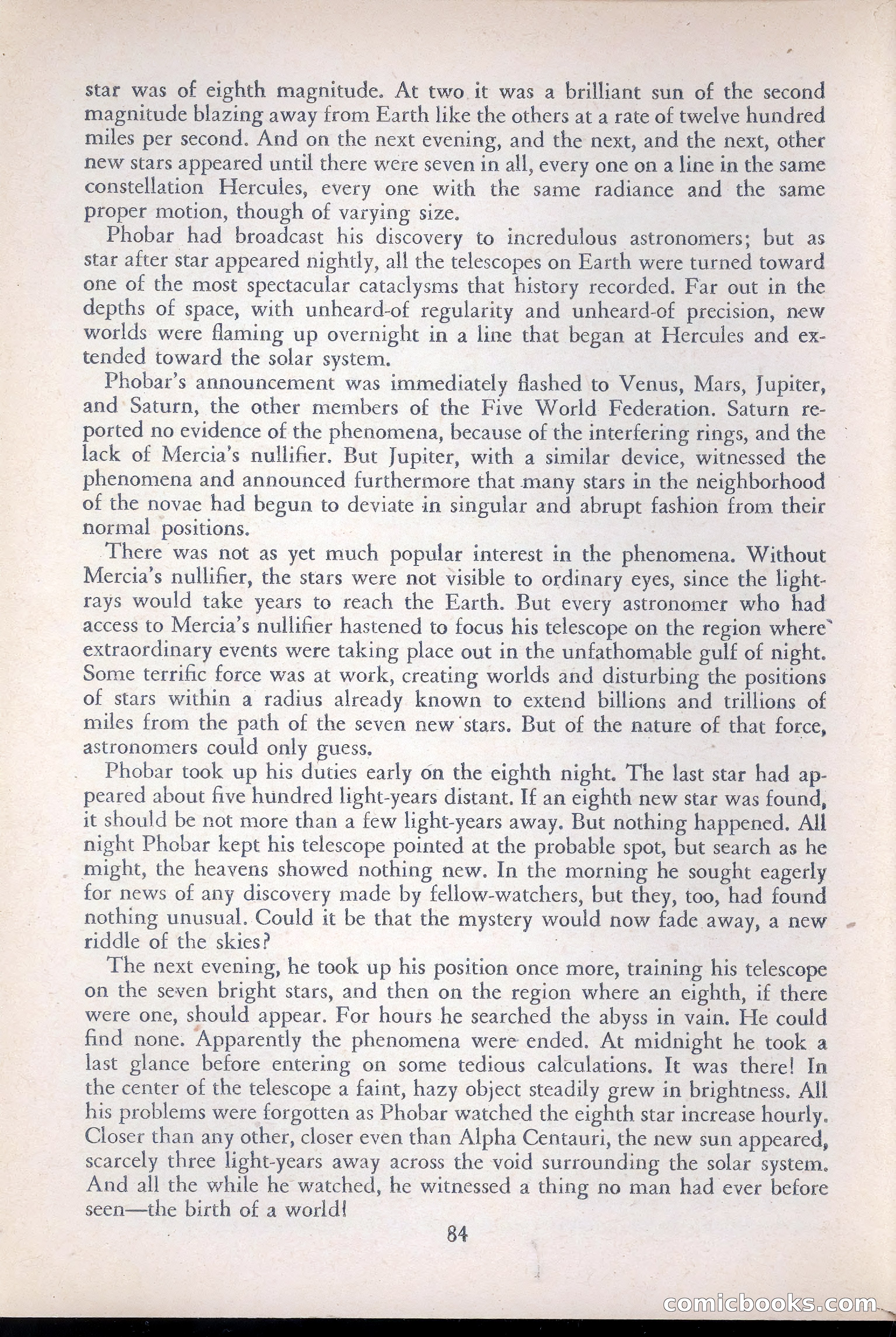
A restored page from Pulp Fiction, 1950. Page through the whole issue in the reader above.
📄 Transcribed text from this page (OCR, searchable)
Machine-transcribed from the original scan — historical spelling and the odd misread are preserved.
* Star was of eighth magnitude. At two it was a brilliant sun of the second magnitude blazing away from Earth like the others at a rate of twelve hundred miles per second. And on the next evening, and the next, and the next, other new stars appeared until there were seven in all, every one on a line in the same constellation Hercules, every one with the same radiance and the same proper motion, though of varying size. Phobar had broadcast his discovery to incredulous astronomers; but as star after star appeared nightly, all the telescopes on Earth were turned toward one of the most spectacular cataclysms that history recorded. Far out in the depths of space, with unheard-of regularity and unheard-of precision, new worlds were flaming up overnight in a line that began at Hercules and ex- tended toward the solar system. Phobar’s announcement was immediately flashed to Venus, Mars, Jupiter, and Saturn, the other members of the Five World Federation. Saturn re- ported no evidence of the phenomena, because of the interfering rings, and the lack of Mercia’s nullifier. But Jupiter, with a similar device, witnessed the phenomena and announced furthermore that many stars in the neighborhood — of the novae had begun to deviate in singular and abrupt fashion from their normal positions. . There was not as yet much popular interest in the phenomena. Without Mercia’s nullifier, the stars were not visible to ordinary eyes, since the light- rays would take years to reach the Earth. But every astronomer who had access to Mercia’s nullifier hastened to focus his telescope on the region where” extraordinary events were taking place out in the unfathomable gulf of night. Some terrific force was at work, creating worlds and disturbing the positions of stars within a radius already known to extend billions and trillions of miles from the path of the seven new stars. But of the nature of that force, astronomers could only guess. | | Phobar took up his duties early on the eighth night. The last star had ap- peared about five hundred light-years distant. If an eighth new star was found, it should be not more than a few light-years away. But nothing happened. All night Phobar kept his telescope pointed at the probable spot, but search as he might, the heavens showed nothing new. In the morning he sought eagerly for news of any discovery made by fellow-watchers, but they, too, had found nothing unusual, Could it be that the mystery would now fade away, a new riddle of the skies? es The next evening, he took up his position once more, training his telescope on the seven bright stars, and then on the region where an eighth, if there were one, should appear. For hours he searched the abyss in vain. He could find none. Apparently the phenomena were ended. At midnight he took a last glance before entering on some tedious calculations. It was there! In the center of the telescope a faint, hazy object steadily grew in brightness. All his problems were forgotten as Phobar watched the eighth star increase hourly. Closer than any other, closer even than Alpha Centauri, the new sun appeared, scarcely three light-years away across the void surrounding the solar system. And all the while he watched, he witnessed a thing no man had ever before seen—the birth of a world! 84 im) Conmiclooolks.ccOrnal see oS me oonercons