
Pulp Fiction, 1950 · page 85 of 132
Avon Fantasy Reader No. 13 — page 85: what you’re looking at
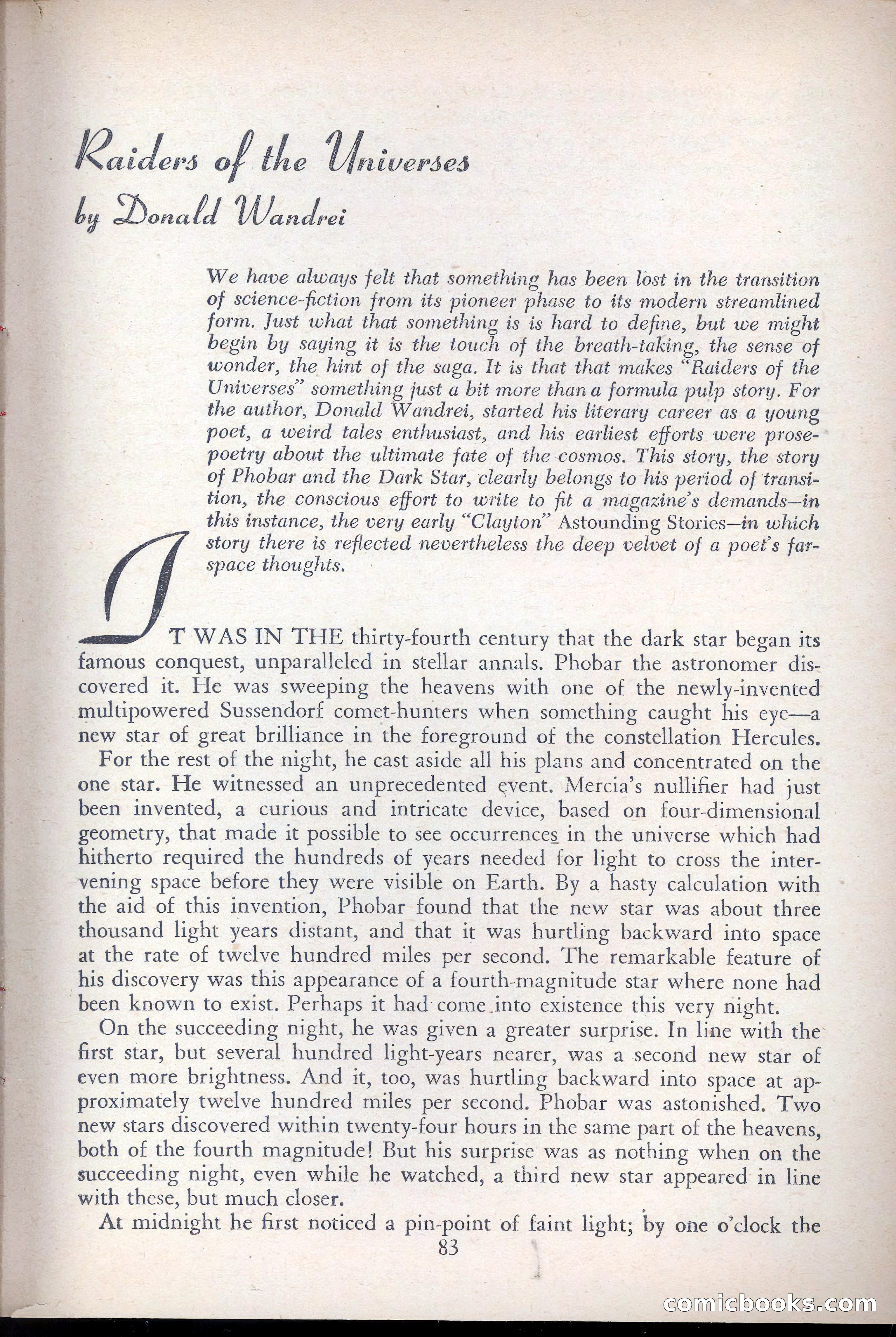
A restored page from Pulp Fiction, 1950. Page through the whole issue in the reader above.
📄 Transcribed text from this page (OCR, searchable)
Machine-transcribed from the original scan — historical spelling and the odd misread are preserved.
Raiders of the (5 by sDisnakt Wiadks We have always felt that something has been lost in the transition of science-fiction from its pioneer phase to its modern streamlined form. Just what that something is is hard to define, but we might begin by saying it is the touch of the breath-taking, the sense of wonder, the hint of the saga. It is that that makes “Raiders of the Universes” something just a bit more thana formula pulp story. For the author, Donald Wandrei, started his literary career as a young poet, a weird tales enthusiast, and his earliest efforts were prose- poetry about the ultimate fate of the cosmos. This story, the story of Phobar and the Dark Star, clearly belongs to his period of transi- tion, the conscious effort to write to fit a magazine's demands—in this instance, the very early “Clayton” Astounding Stories—in which story there is reflected nevertheless the deep velvet of a poet's far- space thoughts. a T WAS IN THE thirty-fourth century that the dark star began its famous conquest, unparalleled in stellar annals. Phobar the astronomer dis- covered it. He was sweeping the heavens with one of the newly-invented multipowered Sussendorf comet-hunters when something caught his eye—a new star of great brilliance in the foreground of the constellation Hercules. For the rest of the night, he cast aside all his plans and concentrated on the one star. He witnessed an unprecedented event. Mercia’s nullifier had just been invented, a curious and intricate device, based on four-dimensional geometry, that made it possible to see occurrences in the universe which had hitherto required the hundreds of years needed for light to cross the inter- vening space before they were visible on Earth. By a hasty calculation with the aid of this invention, Phobar found that the new star was about three thousand light years distant, and that it was hurtling backward into space at the rate of twelve hundred miles per second. The remarkable feature of his discovery was this appearance of a fourth-magnitude star where none had been known to exist. Perhaps it had come into existence this very night. On the succeeding night, he was given a greater surprise. In line with the first star, but several hundred light-years nearer, was a second new star of even more brightness. And it, too, was hurtling backward into space at ap- proximately twelve hundred miles per second. Phobar was astonished. Two new stars discovered within twenty-four hours in the same part of the heavens, both of the fourth magnitude! But his surprise was as nothing when on the succeeding night, even while he watched, a third new star appeared in line with these, but much closer. : At midnight he first noticed a pin-point of faint light; by one o’clock the 83 Comicbooksco im