
Pulp Fiction, 1950 · page 107 of 132
Avon Fantasy Reader No. 13 — page 107: what you’re looking at
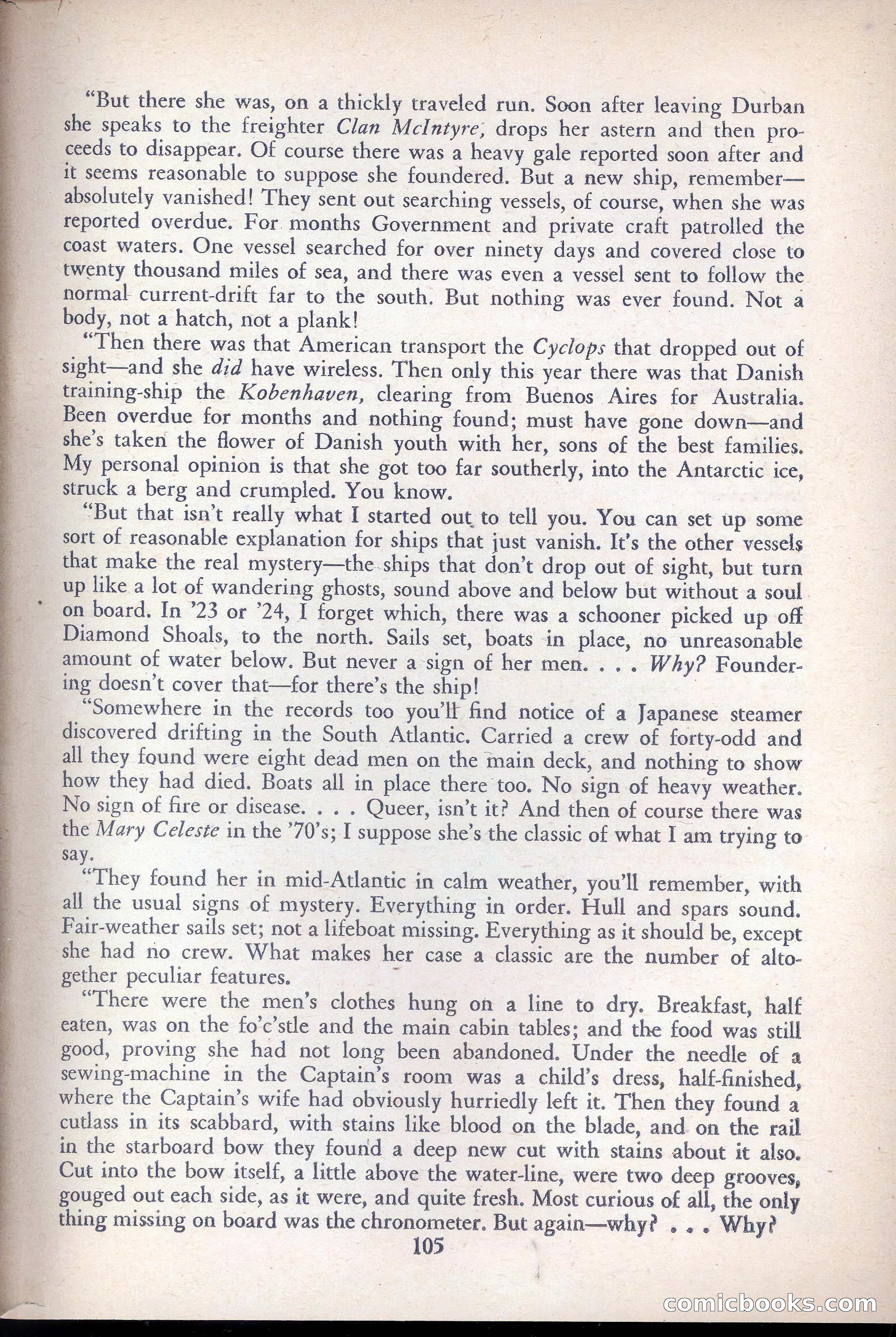
A restored page from Pulp Fiction, 1950. Page through the whole issue in the reader above.
📄 Transcribed text from this page (OCR, searchable)
Machine-transcribed from the original scan — historical spelling and the odd misread are preserved.
“But there she was, on a thickly traveled run. Soon after leaving Durban she speaks to the freighter Clan McIntyre; drops her astern and then pro- ceeds to disappear. Of course there was a heavy gale reported soon after and it seems reasonable to suppose she foundered. But a new ship, remember— _ absolutely vanished! They sent out searching vessels, of course, when she was reported overdue. For months Government and private craft patrolled the coast waters. One vessel searched for over ninety days and covered close to twenty thousand miles of sea, and there was even a vessel sent to follow the hormal current-drift far to the south. But nothing was ever found. Not a body, not a hatch, not a plank! “Then there was that American transport the C yclops that dropped out of — sight—and she did have wireless. Then only this year there was that Danish training-ship the Kobenhaven, clearing from Buenos Aires for Australia. Been overdue for months and nothing found; must have gone down—and she’s taken the flower of Danish youth with her, sons of the best families. My personal opinion is that she got too far southerly, into the Antarctic ice, struck a berg and crumpled. You know. | “But that isn’t really what I started out to tell you. You can set up some sort of reasonable explanation for ships that just vanish. It’s the other vessels that make the real mystery—the ships that don’t drop out of sight, but turn up like a lot of wandering ghosts, sound above and below but without a soul on board. In ’23 or °24, I forget which, there was a schooner picked up off Diamond Shoals, to the north. Sails set, boats in place, no unreasonable amount of water below. But never a sign of her men... . Why? Founder- ing doesn’t cover that—for there’s the ship! | “Somewhere in the records too you'll find notice of a Japanese steamer discovered drifting in the South Atlantic. Carried a crew of forty-odd and all they found were eight dead men on the main deck, and nothing to show how they had died. Boats all in place there too. No sign of heavy weather. No sign of fire or disease. . . . Queer, isn’t it? And then of course there was the Mary Celeste in the ’70’s; I suppose she’s the classic of what I am trying to say. “They found her in mid-Atlantic in calm weather, you'll remember, with all the usual signs of mystery. Everything in order. Hull and spars sound. Fair-weather sails set; not a lifeboat missing. Everything as it should be, except she had no crew. What makes her case a classic are the number of alto- gether peculiar features. : “There were the men’s clothes hung on a line to dry. Breakfast, half eaten, was on the fo’c’stle and the main cabin tables: and the food was still good, proving she had not long been abandoned. Under the needle of a sewing-machine in the Captain’s room was a child’s dress, half-finished, where the Captain’s wife had obviously hurriedly left it. Then they found a cutlass in its scabbard, with stains like blood on the blade, and. on the rail in the starboard bow they found a deep new cut with stains about it also. Cut into the bow itself, a little above the water-line, were two deep grooves, gouged out each side, as it were, and quite fresh. Most curious of all, the only thing missing on board was the chronometer. But again—why? ... Why? 105 Comicbookshco im