
Pulp Fiction, 1950 · page 106 of 132
Avon Fantasy Reader No. 13 — page 106: what you’re looking at
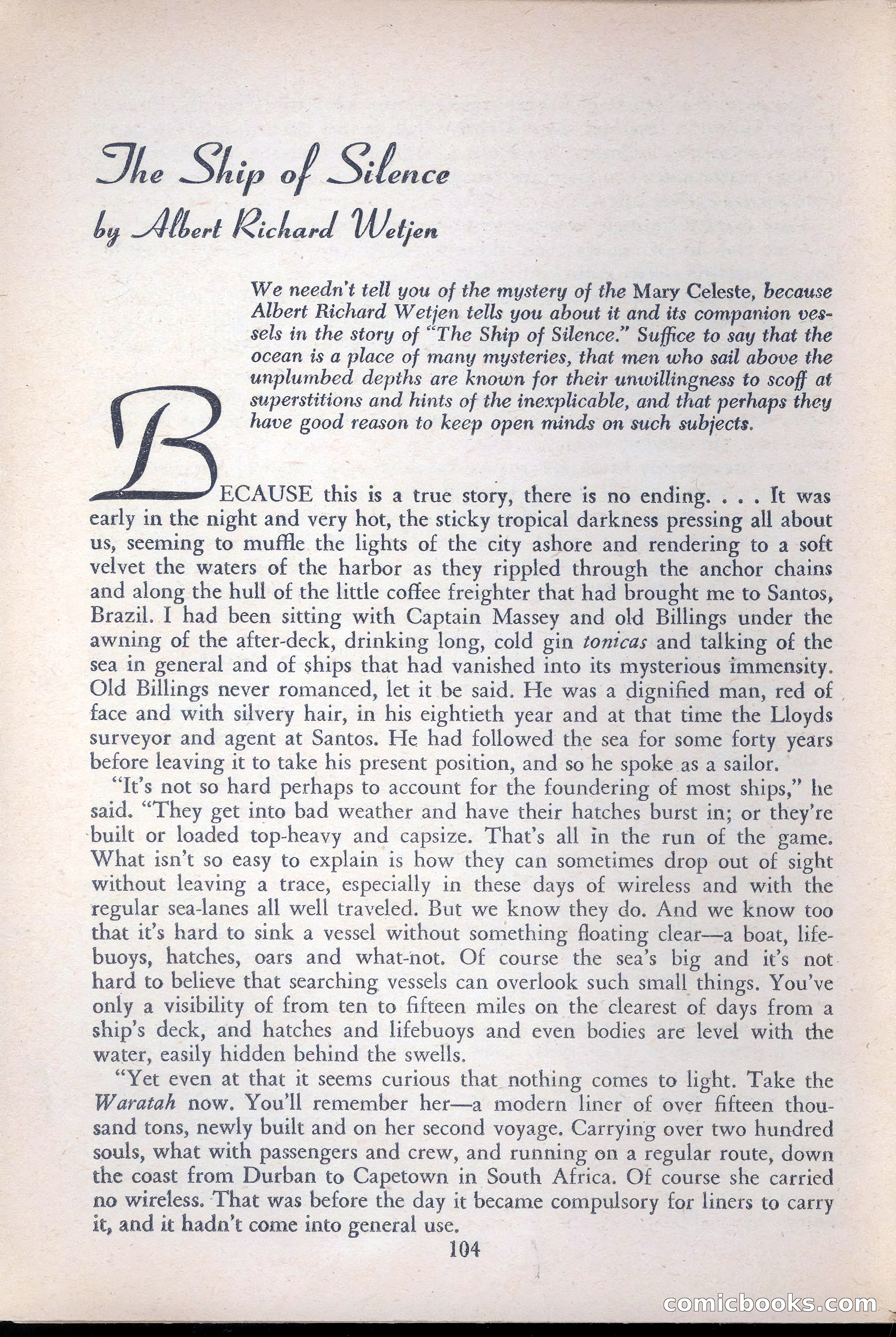
A restored page from Pulp Fiction, 1950. Page through the whole issue in the reader above.
📄 Transcribed text from this page (OCR, searchable)
Machine-transcribed from the original scan — historical spelling and the odd misread are preserved.
She Ship of Silence by ‘Albert Kelaed Wetjen We needn't tell you of the mystery of the Mary Celeste, because Albert Richard Wetjen tells you about it and its companion ves- sels in the story of “The Ship of Silence.” Suffice to say that the ocean is a place of many mysteries, that men who sail above the unplumbed depths are known for their unwillingness to scoff at superstitions and hints of the inexplicable, and that perhaps they have good reason to keep open minds on such subjects. mmm” 1} CAUSE this is a true story, there is no ending. .. . It was early in the night and very hot, the sticky tropical darkness pressing all about us, seeming to muffle the lights of the city ashore and rendering to a soft velvet the waters of the harbor as they rippled through the anchor chains and along the hull of the little coffee freighter that had brought me to Santos, Brazil. I had been sitting with Captain Massey and old Billings under the awning of the after-deck, drinking long, cold gin tomicas and talking of the sea in general and of ships that had vanished into its mysterious immensity. Old Billings never romanced, let it be said. He was a dignified man, red of | face and with silvery hair, in his eightieth year and at that time the Lloyds surveyor and agent at Santos. He had followed the sea for some forty years before leaving it to take his present position, and so he spoke as a sailor. “It’s not so hard perhaps to account for the foundering of most ships,” he said. “They get into bad weather and have their hatches burst in; or they’re ‘built or loaded top-heavy and capsize. That’s all in the run of the game. What isn’t so easy to explain is how they can sometimes drop out of sight without leaving a trace, especially in these days of wireless and with the regular sea-lanes all well traveled. But we know they do. And we know too that it’s hard to sink a vessel without something floating clear—a boat, life- buoys, hatches, oars and what-not. Of course the sea’s big and it’s not- hard to believe that searching vessels can overlook such small things. You’ve only a visibility of from ten to fifteen miles on the clearest of days from a ship's deck, and hatches and lifebuoys and even bodies are level with the water, easily hidden behind the swells. “Yet even at that it seems curious that nothing comes to light. Take the Waratah now. You'll remember her—a modern liner of over fifteen thou- sand tons, newly built and on her second voyage. Carrying over two hundred souls, what with passengers and crew, and running on a regular route, down the coast from Durban to Capetown in South Africa. Of course she carried no wireless. That was before the day it became compulsory for liners to carry it, and it hadn’t come into general use. | 104 Comicbooksreom:!