
Pulp Fiction, 1950 · page 119 of 132
Avon Fantasy Reader No. 12 — page 119: what you’re looking at
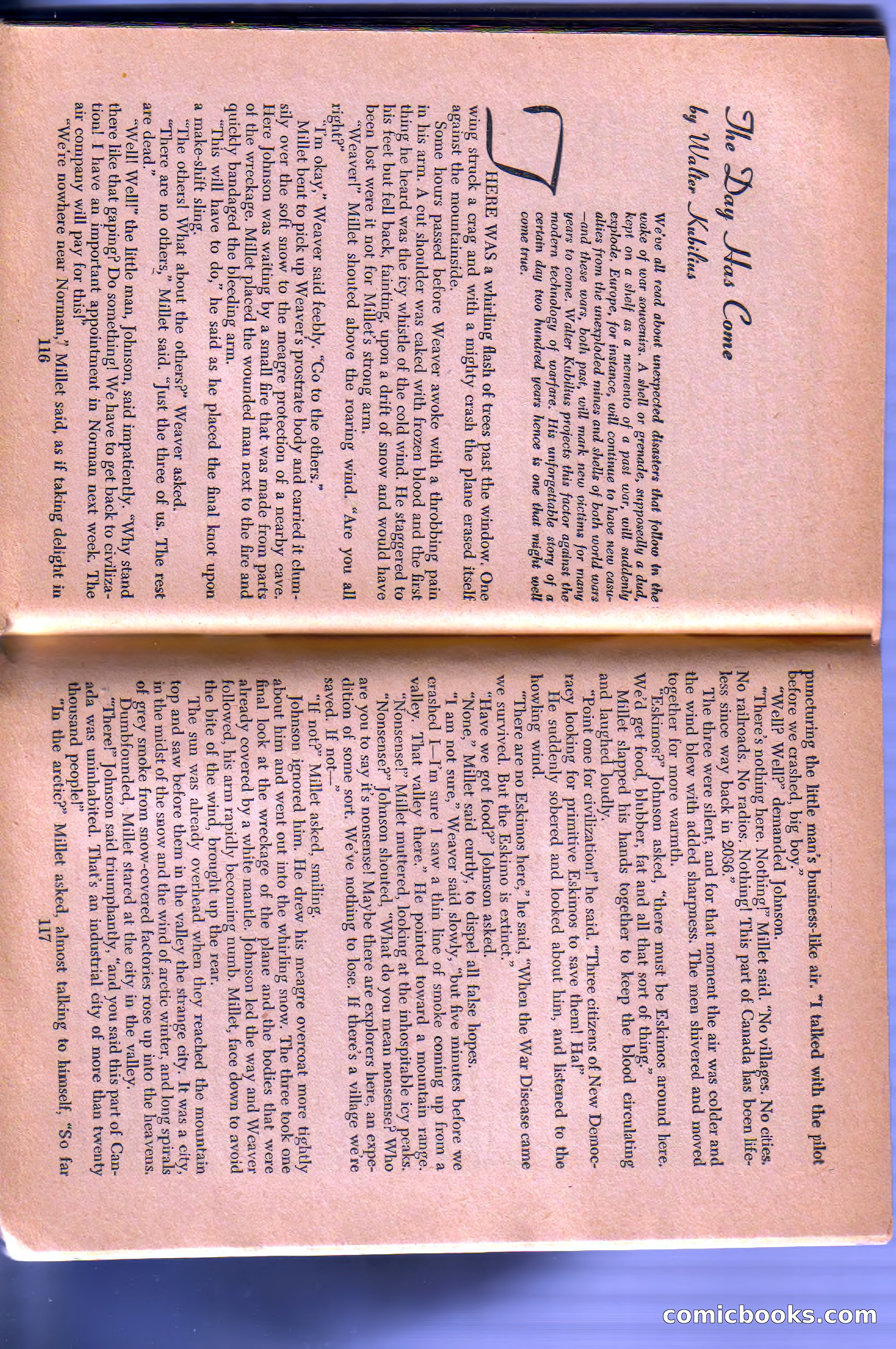
A restored page from Pulp Fiction, 1950. Page through the whole issue in the reader above.
📄 Transcribed text from this page (OCR, searchable)
Machine-transcribed from the original scan — historical spelling and the odd misread are preserved.
The Dag Kos Uae by Waller Kubiles We've all read about unexpected disasters that follow tn the ' wake of war souvenirs. A shell or grenade, sts kept on a shelf as @ memento We past pugs Lee explode, Europe, for instance, will continue to have new. casi- alties from the unexploded mines and shells of both world wars —and these wars, both past, will mark new. victims for many years to come, Walter Kubilius projects this factor against the modern technology of warfare. His unforgettable story of a rtain ore a two hundred years hence is one that might well HERE WAS a whirling flash of trees the wi sages ast the window. One i 2 the oe bee Winks a mighty crash the plane erased itself _ Some hours passed before Weaver awoke with a tl i a his arm. A cut shoulder was caked with fier blood. oo oa ning he heard was the icy whistle of the cold wind. He staggered to his feet but fell back, fainting, upon a drift of snow and would have ne lost were it not for Millers strong arm. ae Millet shouted above the roaring wind. “Are you all “I'm okay,” Weaver said feebly. “Go to the others.” sleet bent to a up Weavst's prostrate body and carried it clum- - y over the soft snow to the meagre protection of a nearby cave vr Bain ae ete by a small fire that was made from parts eckage. et placed th ut baad ae a : = ae man next to the fire and : ee ‘ a to do,” he said as he placed the final knot upon “The others! What about the others?” We A eds iat about hers aver asked. ne ree as no others,” Millet said. “Just the three of us. The rest “Welll Welll” the little man, Johnson, said impatiently. “Wh ete Lopes gapingt ‘el ote oe We have to get back to vane l impor appointment in No si company il ae tee nee ntment in Norman next week. The ‘ere nowhere near Norman,’ Millet said, as if taking delight 116 : : sai ‘puncturing the little man’s business-like air. “I talked with the pilot: before we crashed, big boy.” “Well? Well?” demanded Johnson. “There’s nothing here. Nothing!” Millet said. “No villages. No cities. No railroads. No radios, Nothing! This part of Canada has been life- Tess since way back in 2036.” _ The three were silent, and for that moment the air was colder and “the wind blew with added sharpness. The men shivered and moved ogether for more warmth. “Eskimos?” Johnson asked, “there must be Eskimos around here, We'd get food, blubber, fat and all that sort of me _ Millet slapped his hands together to keep the blood circulating and Died loudly. _ “Point one for civilization]” he said. “Three citizens of New Democ- "racy looking for primitive Eskimos to save them! Ha!” _ He suddenly sobered and looked about him, and listened to the howling wind. “There are no Eskimos here,” he said, “When the War Disease came we survived. But the Eskimo is extinct.” “Have we got food?” Johnson asked. - “None,” Millet said curtly, to dispel all false hopes. “1 am not sure,” Weaver said slowly, “but five minutes before we ‘crashed I—I’m sure I saw a thin line of smoke coming up from a valley. That valley there.” He pointed toward a mountain ka “Nonsense!” Millet muttered, looking at the inhospitable icy peaks. _ “Nonsense?” Johnson shouted, “What do you mean nonsense? Who are you to say it’s nonsense! Maybe there are ig ee here, an expe- ‘dition of some sort. We've nothing to lose. If there’s a village we're saved. If not—" Tf not?” Millet asked, smiling. Johnson ignored him. He drew his meagre overcoat more tightly Sout him and went out into the whirling snow. The three took one nal look at the wreckage of the plane and,the bodies that were lready covered by a white mantle. Johnson led the way and Weaver llowed, his arm rapidly becoming numb. Millet, face down to avoid the bite of the eee brought up the rear. The sun was already overhead when they reached the mountain op and saw before them in the valley the strange city. It was a city, ‘in the midst of the snow and the wind of arctic winter, and long spirals of grey smoke from snow-covered factories rose up into the heavens. ~ Pumbfounded, Millet stared at the city in the valley. ', “There!” Johnson said triumphantly, “and you said this part of Can- 4 was uninhabited. That’s an industrial city of more than twenty sand people!” “Tn the arctic?” Millet asked, almost talking to himaself, “So far a 117