
Pulp Fiction, 1948 · page 97 of 132
Avon Fantasy Reader No. 8 — page 97: what you’re looking at
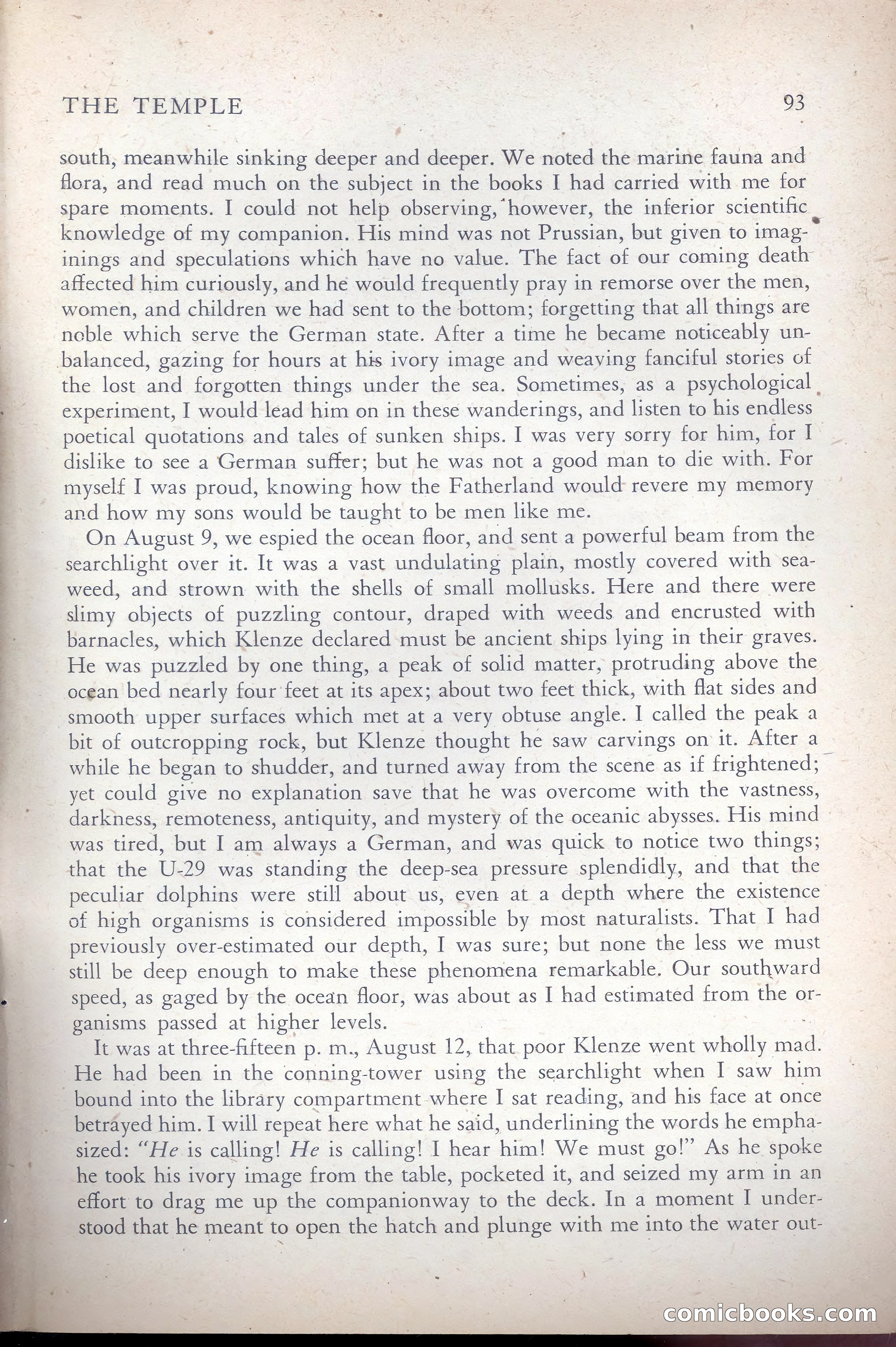
A restored page from Pulp Fiction, 1948. Page through the whole issue in the reader above.
📄 Transcribed text from this page (OCR, searchable)
Machine-transcribed from the original scan — historical spelling and the odd misread are preserved.
_THE TEMPLE Se 2 ae south, meanwhile sinking deeper and deeper. We noted the marine fauna and flora, and read much on the subject in the books I had carried with me for spare moments. I could not help observing, however, the inferior scientific knowledge of my companion. His mind was not Prussian, but given to imag-— inings and speculations which have no value. The fact of our coming death affected him curiously, and he would frequently pray in remorse over the men, women, and children we had sent to the bottom; forgetting that all things are | neble which serve the German state. After a time he became noticeably un- | balanced, gazing for hours at his ivory image and weaving fanciful stories of the lost and forgotten things under the sea. Sometimes, as a psychological | experiment, I would lead him on in these wanderings, and listen to his endless poetical quotations and tales of sunken ships. I was very sorry for him, for I dislike to see a German suffer; but he was not a good man to die with. For myself I was proud, knowing how the Fatherland would revere my memory and how my sons would be taught to be men like me. | On August 9, we espied the ocean floor, and sent a powerful beam from the searchlight over it. It was a vast undulating plain, mostly covered with sea- weed, and strown with the shells of small mollusks. Here and there were slimy objects of puzzling contour, draped with weeds and encrusted with barnacles, which Klenze declared must be ancient ships lying in their graves. He was puzzled by one thing, a peak of solid matter, protruding above the ocean bed nearly four feet at its apex; about two feet thick, with flat sides and smooth upper surfaces which met at a very obtuse angle. I called the peak a bit of outcropping rock, but Klenze thought he saw carvings on it. After a while he began to shudder, and turned away from the scene as if frightened; yet could give no explanation save that he was overcome with the vastness, darkness, remoteness, antiquity, and mystery of the oceanic abysses. His mind was tired, but I am always a German, and was quick to notice two things; that the U-29 was standing the deep-sea pressure splendidly, and that the peculiar dolphins were still about us, even at a depth where the existence of high organisms is considered impossible by most naturalists. That I had previously over-estimated our depth, I was sure; but none the less we must still be deep enough to make these phenomena remarkable. Our southward speed, as gaged by the ocean floor, was about as I had estimated from the or- ganisms passed at higher levels. 3 -. It was at three-fifteen p. m., August 12, that poor Klenze went wholly mad. He had been in the conning-tower using the searchlight when I saw him bound into the library compartment where | sat reading, and his face at once % _ betrayed him. I will repeat here what he said, underlining the words he empha- 2 sized: “He is calling! He is calling! I hear him! We must go!” As he spoke he took his ivory image from the table, pocketed it, and seized my arm in an effort to drag me up the companionway to the deck. In a moment I under- stood that he meant to open the hatch and plunge with me into the water out- bool S.C in es