
Pulp Fiction, 1956 · page 69 of 162
Authentic Science Fiction Monthly No. 72 — page 69: what you’re looking at
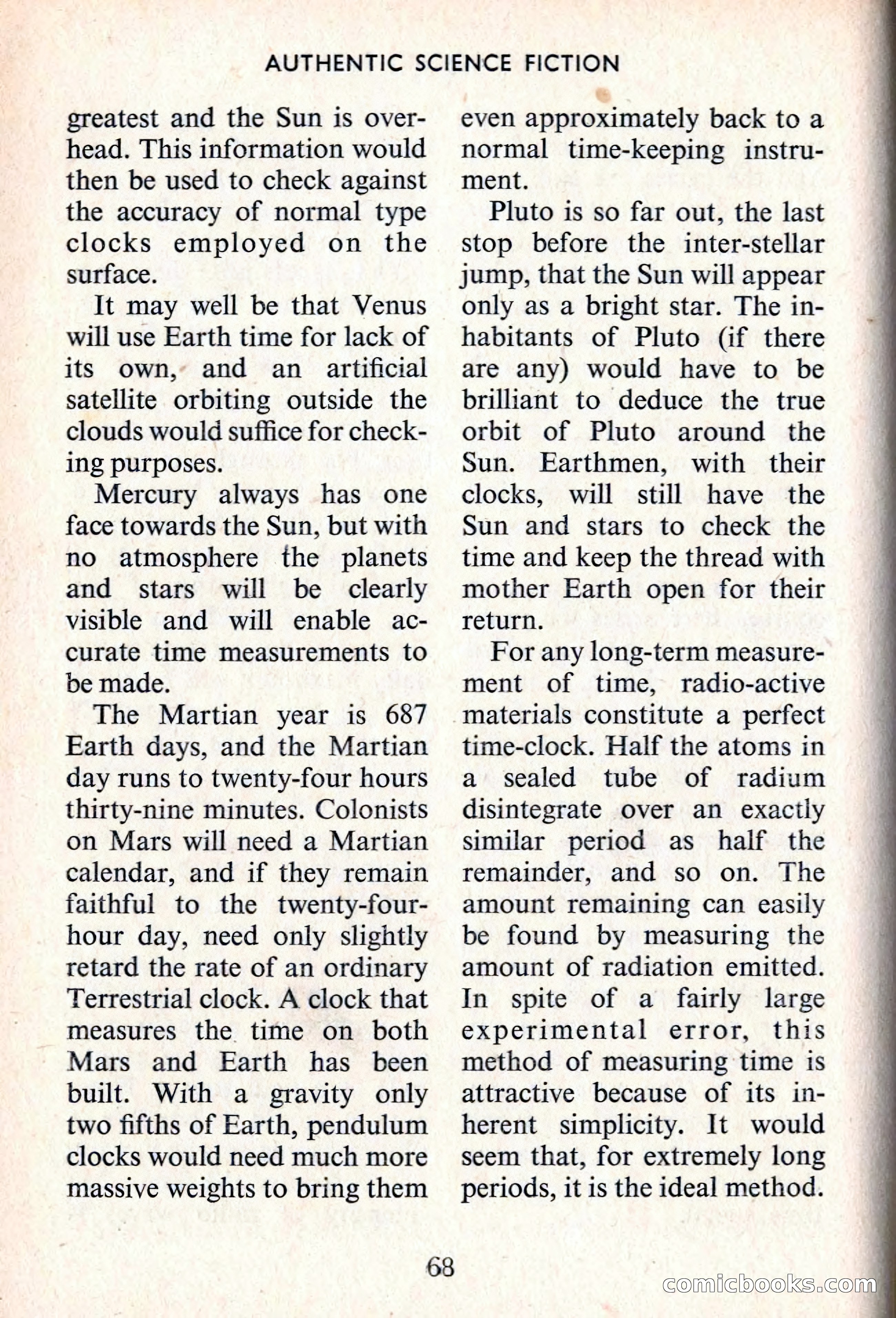
A restored page from Pulp Fiction, 1956. Page through the whole issue in the reader above.
📄 Transcribed text from this page (OCR, searchable)
Machine-transcribed from the original scan — historical spelling and the odd misread are preserved.
AUTHENTIC SCIENCE FICTION greatest and the Sun is over- head. This information would then be used to check against the accuracy of normal type clocks employed on the surface. It may well be that Venus will use Earth time for lack of its own, and an artificial satellite orbiting outside the clouds would suffice for check- ing purposes. Mercury always has one face towards the Sun, but with no atmosphere the planets and stars will be clearly visible and will enable ac- curate time measurements to be made. The Martian year is 687 Earth days, and the Martian day runs to twenty-four hours thirty-nine minutes. Colonists on Mars will need a Martian calendar, and if they remain faithful to the twenty-four- hour day, need only slightly retard the rate of an ordinary Terrestrial clock. A clock that measures the time on both Mars and Earth has been built. With a gravity only two fifths of Earth, pendulum clocks would need much more massive weights to bring them 68 even approximately back to a normal time-keeping instru- ment. Pluto is so far out, the last stop before the inter-stellar jump, that the Sun will appear only as a bright star. The in- habitants of Pluto (if there are any) would have to be brilliant to deduce the true orbit of Pluto around the Sun. Earthmen, with their clocks, will still have the Sun and stars to check the time and keep the thread with mother Earth open for their return. For any long-term measure- ment of time, radio-active materials constitute a perfect time-clock. Half the atoms in a sealed tube of radium disintegrate over an exactly similar period as half the remainder, and so on. The amount remaining can easily be found by measuring the amount of radiation emitted. In spite of a fairly large experimental error, this method of measuring time is attractive because of its in- herent simplicity. It would seem that, for extremely long periods, it is the ideal method. comicloooks.coma)