
Pulp Fiction, 1956 · page 68 of 162
Authentic Science Fiction Monthly No. 72 — page 68: what you’re looking at
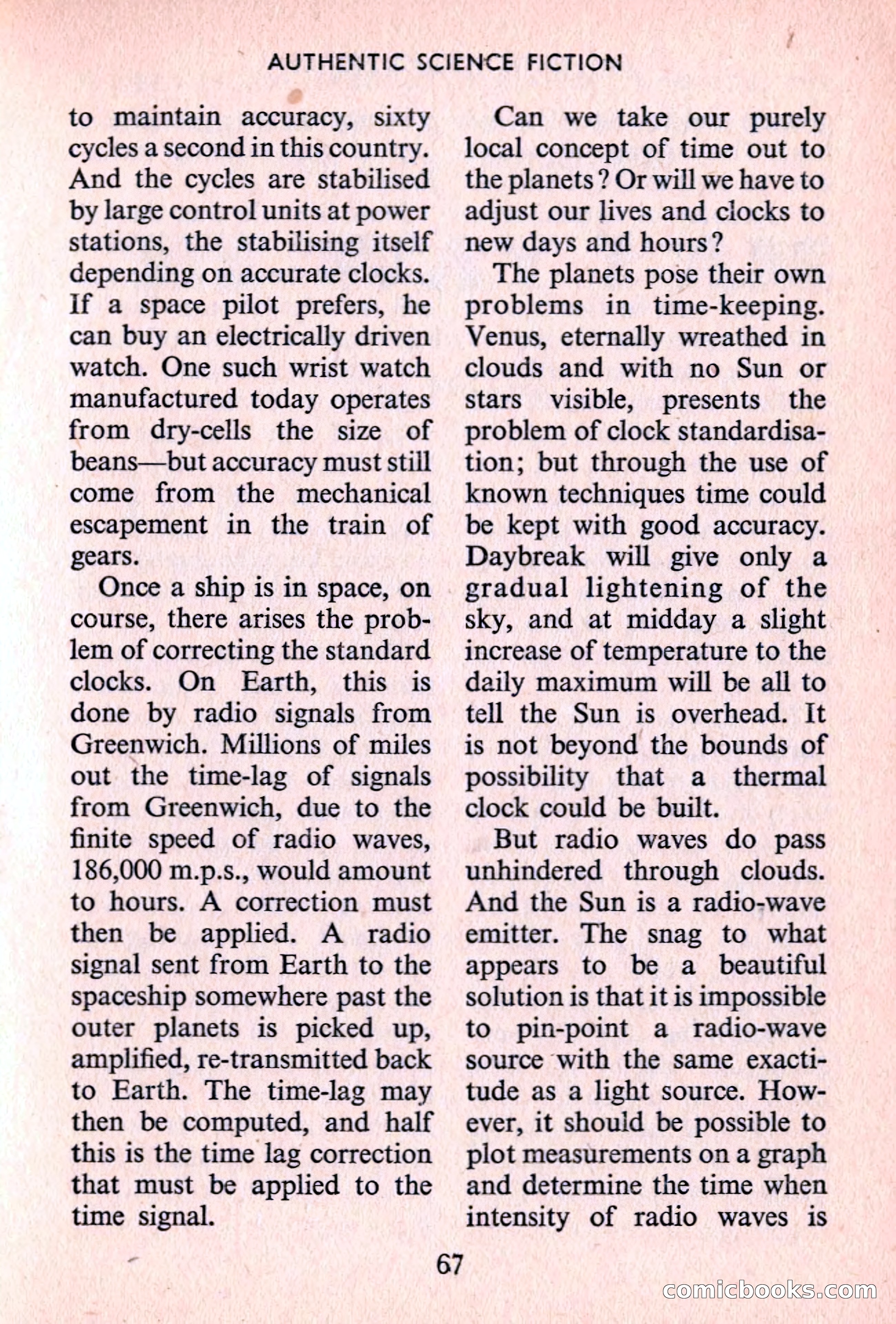
A restored page from Pulp Fiction, 1956. Page through the whole issue in the reader above.
📄 Transcribed text from this page (OCR, searchable)
Machine-transcribed from the original scan — historical spelling and the odd misread are preserved.
AUTHENTIC SCIENCE FICTION to maintain accuracy, sixty cycles a second in this country. And the cycles are stabilised by large control units at power stations, the stabilising itself depending on accurate clocks. if a space pilot prefers, he can buy an electrically driven watch. One such wrist watch manufactured today operates from dry-cells the size of beans—but accuracy must still come from the mechanical escapement in the train of gears. Once a ship is in space, on course, there arises the prob- lem of correcting the standard clocks. On Earth, this is done by radio signals from Greenwich. Millions of miles out the time-lag of signals from Greenwich, due to the finite speed of radio waves, 186,000 m.p.s., would amount to hours. A correction must then be applied. A_ radio signal sent from Earth to the spaceship somewhere past the outer planets is picked up, amplified, re-transmitted back to Earth. The time-lag may then be computed, and half this is the time lag correction that must be applied to the time signal. 67 Can we take our purely local concept of time out to the planets ? Or will we have to adjust our lives and clocks to new days and hours? The planets pose their own problems in time-keeping. Venus, eternally wreathed in clouds and with no Sun or stars visible, presents the problem of clock standardisa- tion; but through the use of known techniques time could be kept with good accuracy. Daybreak will give only a gradual lightening of the sky, and at midday a slight increase of temperature to the daily maximum will be all to tell the Sun is overhead. It is not beyond the bounds of possibility that a thermal clock could be built. But radio waves do pass unhindered through clouds. And the Sun is a radio-wave emitter. The snag to what appears to be a _ beautiful solution is that it is impossible to pin-point a radio-wave source with the same exacti- tude as a light source. How- ever, it should be possible to plot measurements on a graph and determine the time when intensity of radio waves is connicloooks.comn